Introduction
The buoyancy of water makes swimming one of the most joint-friendly aerobic exercises, with the body’s weight in water reduced to about 10% of its weight on land. For senior athletes, this characteristic is almost irreplaceable. However, the statement “swimming is good for the joints” needs an important caveat: proper technique is what protects the joints, while incorrect stroke mechanics can equally cause shoulder impingement, cervical spine strain, or breaststroke knee.
Joint Stress Assessment by Stroke
| Stroke | Shoulder Joint Stress | Cervical Spine Stress | Knee Joint Stress | Recommendation Level |
|---|---|---|---|---|
| Freestyle | Moderate (adjustable) | Low to Moderate | Low | Priority Recommendation |
| Backstroke | Low | Low | Low | Strongly Recommended |
| Breaststroke | Low | Moderate to High | Moderate to High | Requires Technical Adjustment |
| Butterfly | High | High | Low | Not Recommended for Regular 60+ Practice |
Senior-Friendly Adjustments for Freestyle
Breathing Technique
Traditional unilateral breathing (every 2 strokes) can cause asymmetric cervical spine rotation. Senior swimmers are advised to switch to bilateral breathing (every 3 strokes) to balance the rotational load on the cervical spine. If stamina is insufficient, breathing every 2 strokes is acceptable, but the side should be alternated regularly.
Pull Path
The “High Elbow Catch” is the most efficient freestyle technique, but it places higher demands on the rotator cuff muscles. Senior swimmers with shoulder joint degeneration can adopt a slightly “flatter” hand entry angle to reduce external rotation stress on the shoulder.
Kick Frequency
Senior swimmers typically suit a 4-beat or 6-beat kick (kicking 4 or 6 times per full stroke cycle). Compared to a 2-beat kick, this better supports body rotation and balance, though cardiovascular demand is slightly higher. It is recommended to start with a 6-beat kick and try a 4-beat kick once technique is stable.
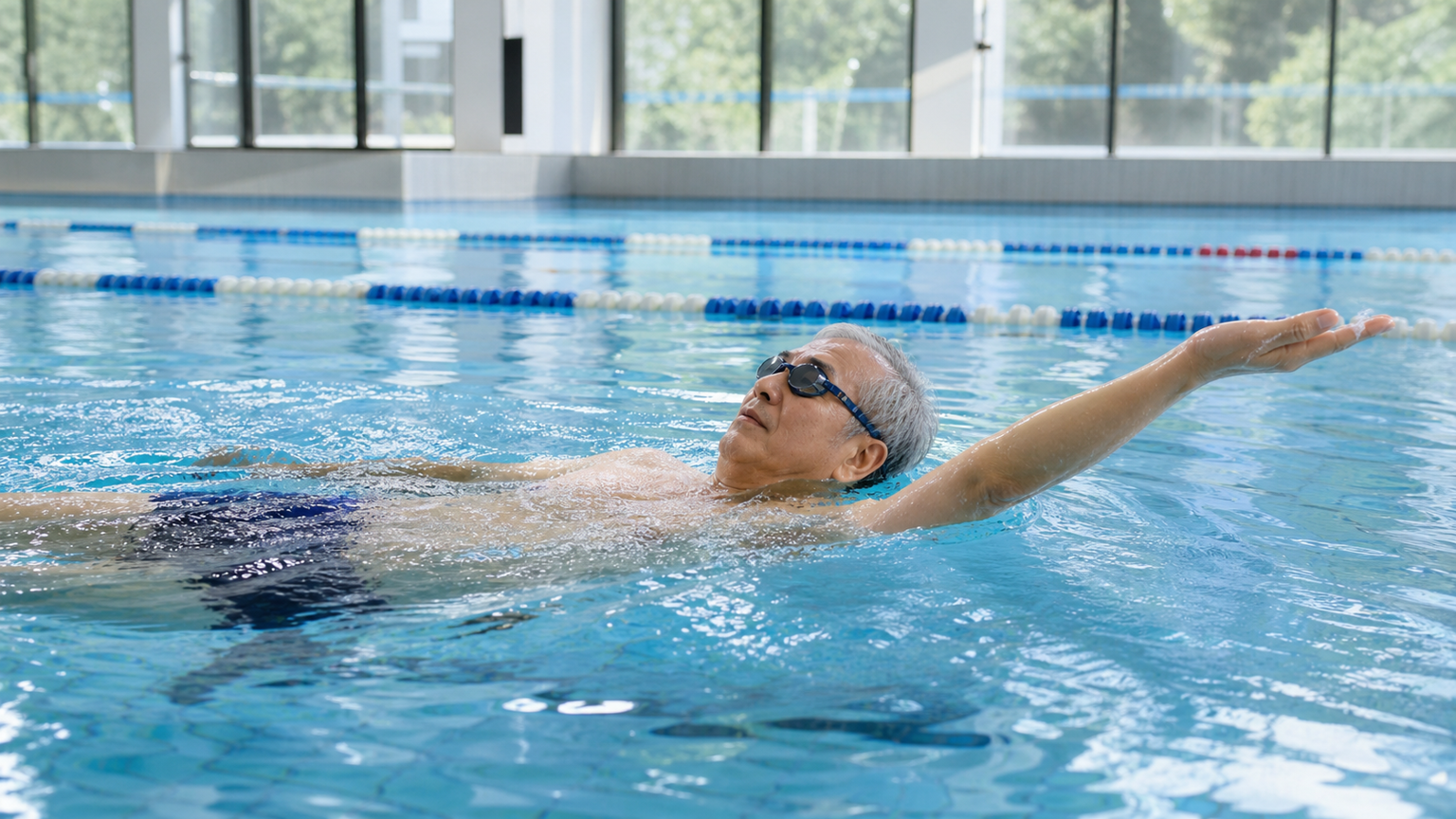
Backstroke: The Top Choice for Senior Swimmers
Backstroke is the stroke most worth promoting for the senior population, for the following reasons:
- Face-up position completely avoids cervical spine rotation during breathing
- Shoulders remain below the waterline, reducing impingement risk
- Legs primarily perform straight-knee up-and-down kicking, placing minimal stress on the knee joints
- Spine stays horizontal, which is friendly to the lumbar spine
The main challenge of backstroke is orientation and spatial awareness. Recommendations:
- Use lane lines in the pool as a directional reference
- Every 8 to 10 strokes, use peripheral vision to check the distance to the wall
- Use backstroke flags as a turn preparation signal (typically 5 meters from the end wall)
Prevention and Adjustment of Breaststroke Knee
The leg action of breaststroke (the frog kick) places rotational stress on the medial collateral ligament (MCL) and meniscus, particularly at the moment of “kick-out → close together.” Adjustment recommendations for senior swimmers:
- Reduce kick width: Narrow the leg spread angle from the traditional 90 degrees to 60 to 70 degrees
- Use a “relaxed frog kick” instead of a “powerful whip kick”: Prioritize smoothness over explosive power
- Limit breaststroke proportion: Restrict breaststroke to no more than 30% of training, using freestyle or backstroke for the remainder
Lifting the head too high during breaststroke breathing is the main cause of cervical spine strain. The “low-head breathing” technique is recommended: during inhalation, the chin barely clears the water rather than fully lifting the head.
Training Volume and Intensity Recommendations
A weekly training framework suitable for swimmers aged 65 and above:
- 3 sessions per week, 45 to 60 minutes each
- Each session includes a 300 to 400 meter warm-up (slow, easy freestyle)
- Main set focuses on 500 to 800 meters, interspersed with technique drills
- Cool down with 200 meters of low-intensity backstroke or back float
- Every 4 weeks, reduce total weekly distance by 30% as a recovery week
Appropriate Use of Training Aids
- Hand Paddles: Can increase upper-body resistance, but should be avoided by those with shoulder joint degeneration
- Kickboard: Helps with leg training, but the neck must remain neutral during prolonged kickboard kicking to avoid lifting the head
- Pull Buoy: Placed between the legs to allow the upper body to focus on pulling; suitable for shoulder recovery periods
- Goggles: Clear underwater vision aids technique correction and prevents chlorine from irritating the eyes
Practical Advice
- Before entering the water, perform 5 minutes of on-land shoulder circles and dynamic arm stretches, followed by a slow in-water warm-up
- If shoulder pain persists for more than 24 hours after swimming, stop swimming and consult a physical therapist
- Swimming with a partner is not only safer but also helps with mutual observation of technique issues
- Consider asking a swim coach for video technique analysis—senior swimmers’ potential for technical improvement often exceeds expectations
Conclusion
Water is the most friendly environment for senior athletes, but fully leveraging its protective advantages requires proper technique. By choosing the right stroke, adjusting details, and incorporating appropriate aids, swimmers over 60 can maintain high-frequency training and find a healthy yet enjoyable lifestyle in the water.
Related Reading
- Swimming and Joint Protection: The Best Choice for Low-Impact Exercise
- 50+ Senior Swimming Prescription: Low-Impact, High-Benefit Water Exercise
- Swimming and Arthritis: The Best Choice for Low-Impact Exercise
- Swimming and Joint Protection: Swimming Recommendations for Patients with Degenerative Joint Disease
白沙屯媽祖進香在家走!UREVO 坡度自調走步機 / 可連接訓練遊戲APP MyWhoosh / 邊看直播邊走起來 / CT Yeh
11 個月前
[教學] Premiere 影片 手震 修正 教學 防抖 單眼 影像 GoPro 穩定 Video Stabilization
8 年前
CT 喇低賽) 武嶺牽車 才是王道 西進牽車四小時內秘訣 攝手位置 如何判斷 防抽筋小秘訣
7 年前
再一組! 全碳幅條 碟煞/無內胎輪組 開箱! 到底好騎嗎? UNAAS X40 | 公路車 | CT Yeh
4 年前
抖肩舞 台灣x日本交流版 (台灣 vs 前橋) 赤城山登山賽 coincidance
8 年前
靠單車減肥35公斤 心得分享與整理
7 年前
一日北高/長距離團騎 常見問題補充篇 / 組團或跟團的眉角 / 壯車友容易被瘦車友慢性拉爆 / 原來屁股痛可能是這個原因...? / 風場配速法 / 公路車 / CT Yeh
2 年前
碟煞公路車 銑面器 !? 原來銑完差這麼多! 降低蹭碟機率! | TIME 公路車 保養小記錄 | CT Yeh
3 年前