/no_think
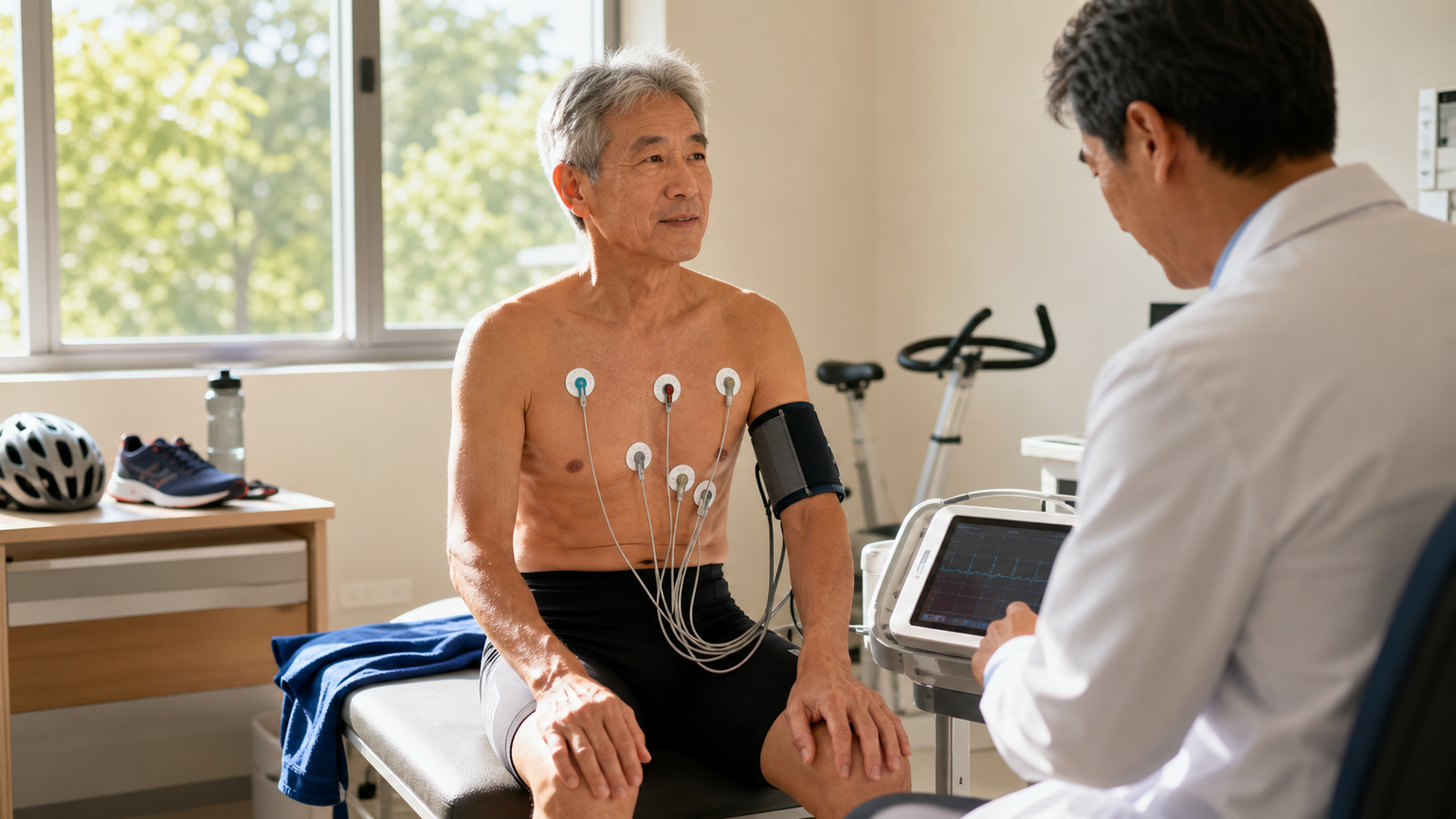
Introduction
Whenever the news reports a participant suffering a heart attack during a marathon or cycling event, public opinion often casts doubt on exercise itself. But the truth is: properly assessed, moderate exercise is the best preventive medicine for heart disease—the problem is that the “assessment” step is often overlooked. For older athletes, pre-exercise cardiac screening is not a bureaucratic procedure, but a safety net that ensures you can train safely over the long term.
Cardiac Risk Background for Older Athletes
- The prevalence of coronary artery disease among Taiwanese men over 65 exceeds 10%; for women, it is about 6%
- More than 40% of sudden exercise-related deaths occur in people with undiagnosed coronary artery disease
- High-intensity exercise (such as interval running or competitive cycling climbs) triggers acute cardiac events at a risk 4 to 7 times higher than low-intensity exercise
- However, the overall risk of cardiac events in people who exercise regularly over the long term is far lower than in those who are sedentary
Who Should Undergo Pre-Exercise Cardiac Screening
| Condition | Recommended Screening Level |
|---|---|
| Under 50, asymptomatic, low risk factors | Basic self-assessment is sufficient |
| 50 to 60 years old, with 1 to 2 risk factors | Basic evaluation by a family medicine physician recommended |
| Over 60, preparing to start high-intensity exercise | Comprehensive evaluation by a cardiologist recommended |
| Chest pain/syncope/dyspnea symptoms at any age | Seek immediate medical attention; training prohibited |
| Known coronary artery disease, arrhythmia, or cardiomyopathy | Must obtain exercise clearance from a cardiologist |
Standard Screening Test Descriptions
Tier 1: Basic Evaluation (Family Medicine / Health Check-up)
- Resting Electrocardiogram (12-lead ECG): Can detect old myocardial infarction, arrhythmias, and ventricular hypertrophy
- Blood Pressure Measurement: Pre-exercise systolic blood pressure should be below 160 mmHg (if higher, blood pressure should be controlled before increasing training intensity)
- Basic Blood Tests: Fasting blood glucose, lipid panel (LDL, HDL, triglycerides, total cholesterol), and kidney function
- PAR-Q Health Questionnaire: Physical Activity Readiness Questionnaire, an internationally recognized self-assessment tool
Tier 2: Advanced Evaluation (Cardiology)
- Exercise Stress Test (Treadmill Stress Test): Monitors the ECG during progressively increasing treadmill exercise to detect exercise-induced myocardial ischemia; currently the most commonly used screening tool for older athletes before exercise
- Echocardiography: Assesses cardiac structure, valvular function, and ventricular function
- Coronary Artery Calcium Score (CT Coronary Calcium Score): Evaluates vascular health in asymptomatic older athletes; those with high scores require further evaluation before high-intensity training is appropriate
Tier 3: Special Circumstances
- Coronary CT Angiography (CTCA): When coronary artery disease is suspected but stress test results are equivocal
- Cardiac Nuclear Medicine Scan: Assesses myocardial perfusion
- 24-Hour Holter Monitor: When intermittent arrhythmias are suspected
Key Points in Interpreting the Exercise Stress Test
Before undergoing an exercise stress test, the subject should understand:
- A normal result does not mean zero risk, but it significantly reduces the risk of acute events during high-intensity training
- If ST-segment depression (a sign of myocardial ischemia) appears during the test, the physician will recommend further investigation
- The achievement of the predicted maximal heart rate affects test validity (should reach more than 85% of the predicted maximal heart rate)
- Some beta-blocker medications reduce the heart rate response and affect test validity; the physician should be informed
Training Classification After Screening
- No restrictions: May engage in exercise at all intensities; only self-monitoring required
- Supervised exercise: Train in environments with an AED available or with a training partner
- Intensity restriction: Prohibited from exceeding a specific heart rate zone (set by the physician)
- Hold training: Training to be postponed until treatment or further evaluation is completed
Cardiac Warning Signs During Training
Regardless of screening results, training should be stopped immediately and medical attention sought if any of the following symptoms occur:
- Chest pain, chest tightness, or chest pressure (even if mild)
- Pain in the jaw, left shoulder, or left arm (atypical myocardial infarction symptoms)
- Sudden severe dyspnea (not expected from training intensity)
- Pre-syncope symptoms (dizziness, blackouts)
- Palpitations (especially a sudden irregular heartbeat)
Practical Recommendations
- The annual adult health check-up (subsidized by Taiwan’s National Health Insurance every 3 years for those over 40, and annually for those over 65) is the best entry point for basic screening
- Before registering for a major road race or cycling event, proactively seek advice from the event’s medical team
- Ensure an AED is accessible in your training environment (many sports centers and cycling finish areas are equipped with AEDs)
- Learn CPR and AED use—this is especially important for training groups composed of older athletes
Conclusion
Cardiac screening is not meant to intimidate; it is a pass that lets you train with peace of mind and full effort. Spending one afternoon completing an evaluation to gain the confidence for years of safe training is the most cost-effective health investment. Knowing the state of your heart is what truly allows you to “confidently” break every personal record.
Related Reading
- Cardiac Screening and Cycling: Heart Health Assessment Recommendations for Amateur Riders
- Heart Safety in Cycling: When to Get an Exercise Stress Test
- Cardiac Screening for Athletes: Cost-Effectiveness of 12-Lead ECG vs ECG + Echocardiography
- Safety Considerations for Older Swimmers: Precautions for Heart Disease and Hypertension Patients
西進武嶺 免費訓練分析服務 Intervals | 練不夠還是練過頭?你哪一種類型選手?AI模型告訴你! | 備戰神器 | 公路車 訓練 | CT Yeh
4 年前
#公路車 #Vo2Max #最大攝氧量 測驗 體驗 | 心肺測試
6 年前
[教學] Premiere 影片 手震 修正 教學 防抖 單眼 影像 GoPro 穩定 Video Stabilization
8 年前
一日北高/長距離團騎 常見問題補充篇 / 組團或跟團的眉角 / 壯車友容易被瘦車友慢性拉爆 / 原來屁股痛可能是這個原因...? / 風場配速法 / 公路車 / CT Yeh
2 年前
崇越盃武嶺冠軍高手 賽前JJSC 群峰會精華!對應大數據分析,會有落差嗎?/ feat. JJSC中部公路車約騎 /公路車 / CT Yeh
2 年前
2025 自行車錶排行榜 兩萬車友大數據 / Garmin Bryton 排名會大洗牌嗎? / 全新的碼表前身分析 /公路車 / CT Yeh
1 年前
西進武嶺 自製新版AI配速表產生器 x 賽前攻略 抱佛腳! 沒有功率計也可以產生配速表嗎?有什麼其他眉角賽前要注意的呢? | 西進武嶺 / 東進武嶺 KOM 攻略 | 公路車 | CT Yeh
4 年前
西進武嶺各路段 前8000名 大數據分析 配速攻略/功率/心律/推力比/維持率/踏頻/踏瓦比/牽車率 大公開 | 建大盃 NeverStop 可參考 | 公路車 | CT Yeh
5 年前