Running Shoe Selection for Older Runners: The Logic of Choosing Shoes for Fallen Arches and Cushioning Needs
Introduction
Running shoes are the most important gear for runners, and also the gear most often neglected when it comes to making the right choice. Many older runners still wear models that suited them in their younger years, or blindly follow minimalist or maximalist cushioning trends, without realizing that their foot shape and gait needs have changed with age. The wrong running shoes don’t just affect comfort—they are a major contributor to plantar fasciitis, shin splints, and knee problems.
Common Changes in Older Runners’ Feet
- Fallen Arch: The plantar ligaments loosen, and the arch lowers. Most people’s shoe size increases by 0.5 to 1 size after age 50 to 60.
- Fat Pad Atrophy: The natural cushioning fat pads under the heel and forefoot thin with age, making landings feel harder.
- Increased Foot Width: Flattening of the transverse arch widens the forefoot, and previously well-fitted widths may become too narrow.
- Toenail Issues: Reduced circulation in the feet may cause toenails to thicken, affecting toe-box space requirements.
- Worsening Hallux Valgus: If you have hallux valgus (bunions), it may progress faster with age, requiring a wider toe box.
Key Running Shoe Parameters Explained
| Parameter | Description | Recommendation for Older Runners |
|---|---|---|
| Heel-to-Toe Drop | Height difference between heel and forefoot | 8 to 12mm recommended (moderate, reduces stress on the Achilles tendon) |
| Cushioning Thickness | Midsole material thickness | 30 to 40mm recommended (max-cushioned) |
| Arch Support | Degree of medial support | Choose based on foot type (flat feet need stability shoes; normal arches need neutral shoes) |
| Toe-Box Space | Distance between the big toe and the front of the shoe | Leave 1 to 1.5cm (toenails must not touch the front) |
| Upper Material | Breathability of the covering material | Knit mesh is better than stiff leather (higher comfort) |
How to Self-Assess Your Foot Type
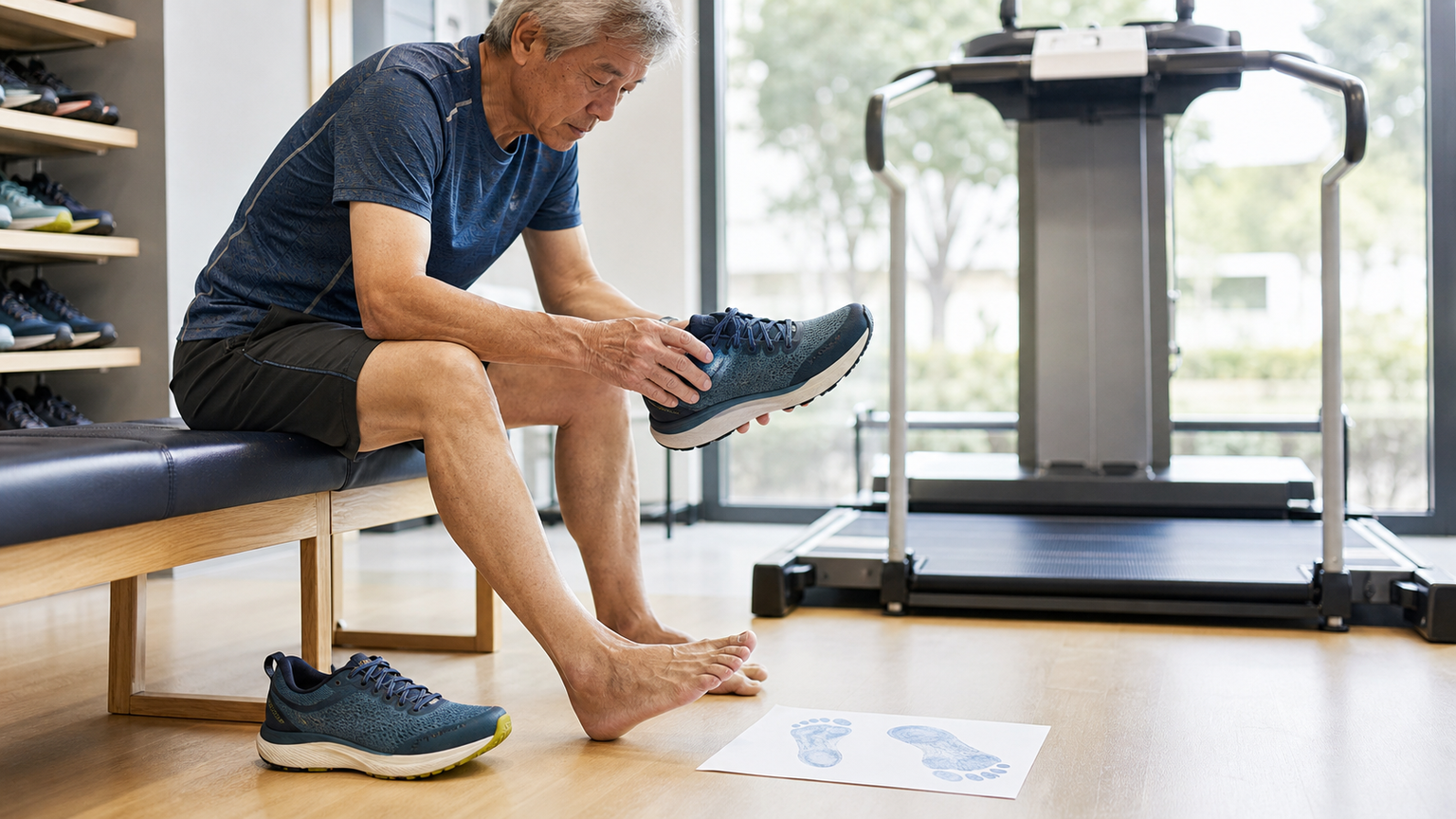
Wet Foot Test
Wet the bottom of your feet, step onto a dark piece of cardboard, and observe the imprint:
- Low Arch (Flat Feet): The imprint is nearly the full shape of the foot. Stability or motion-control shoes are suitable.
- Medium Arch (Normal): There is a clear curved notch on the inside. Neutral shoes are suitable.
- High Arch: Only the forefoot and heel show, with almost no imprint in the middle. High-cushion neutral shoes are suitable.
Gait Analysis
Many sports retailers (such as Decathlon and Asics flagship stores) offer free treadmill gait video analysis to determine overpronation or supination. It is recommended that older runners undergo a gait analysis before choosing shoes, especially those with existing foot problems.
Types of Running Shoes Suitable for Older Runners
Stability / Motion-Control Shoes
Suitable for: Runners with flat feet or overpronation
Features: Reinforced medial support (medial post) to limit excessive inward rolling
Representative models: Brooks Adrenaline GTS, Asics Kayano, New Balance 860 series
Max-Cushioned Neutral Shoes
Suitable for: Runners with normal to high arches, or those whose fat pads have atrophied and need extra cushioning
Features: Thick, max-cushioned soles, high comfort, friendly for long distances
Representative models: Hoka Bondi series, Brooks Ghost, New Balance Fresh Foam 1080
Types to Avoid
Older runners generally should not choose:
- Minimalist running shoes (0 to 4mm drop): The landing impact is too great for older runners with atrophied fat pads.
- Racing carbon-plated shoes: The forefoot plate design places high demands on the ankle joint and Achilles tendon; not recommended for daily training.
Practical Steps for Choosing Shoes
- Shop in the afternoon or evening: Your feet are slightly swollen from the day’s activity, closer to their actual size during exercise.
- Try on shoes with functional athletic socks of running thickness, not thin cotton socks.
- Jog a few steps in the store after trying them on to feel the cushioning and stability.
- Check toe space: There should be one thumb’s width of space in front of the big toe.
- Check the fit: The heel should not slip, and the sides of the forefoot should not feel compressed.
The Supplementary Role of Insoles
If your current running shoes lack sufficient arch support, consider adding custom or semi-custom insoles:
- Heat-moldable insoles: Molded to your foot shape with heat, providing good support.
- Medical orthotic insoles: Made after evaluation by a physical therapist or podiatrist; suitable for those with plantar fasciitis or obvious gait issues.
Practical Advice
- Consider replacing running shoes after 600 to 800 km (the midsole cushioning material has compressed and lost effectiveness).
- Keep two pairs of running shoes and rotate them, giving the midsoles ample time to rebound and extending their lifespan.
- If you have plantar fasciitis, consult a physical therapist and combine with a foot massage roller and Achilles tendon stretches to improve symptoms.
- If you feel discomfort during the trial period (within one week), you can usually exchange them at the brand’s store; many brands offer a trial guarantee.
Conclusion
The right running shoes are not the most expensive or the most fashionable, but the pair that best matches your current foot shape and gait needs. Older runners should re-evaluate their shoe needs every two to three years, because foot shape continues to change. A good pair of shoes gives you confidence from the very first step every time you head out for a run.
Related Reading
- Road Running Shoe Buying Guide: Arch Type, Cushioning Needs, and Mileage Lifespan
- Road Running Shoe Buying Guide: Correctly Matching Foot Type (Flat, Normal, High Arch) with Shoe Models
- The Science of Running Shoe Selection: Foot Type Analysis, Cushioning Needs, and Who Should Wear Carbon-Plated Shoes
- Beginner’s Guide to Choosing Running Shoes: Finding the Right First Pair for You
白沙屯媽祖進香在家走!UREVO 坡度自調走步機 / 可連接訓練遊戲APP MyWhoosh / 邊看直播邊走起來 / CT Yeh
11 個月前
#公路車 #Fitting 靠人工智慧APP 幫你調整單車
6 年前
單車 一日北高 ( 雙城 ) 肥宅雙人瘋狂行 紀錄片 REACTO
10 年前
一日北高/長距離團騎 常見問題補充篇 / 組團或跟團的眉角 / 壯車友容易被瘦車友慢性拉爆 / 原來屁股痛可能是這個原因...? / 風場配速法 / 公路車 / CT Yeh
2 年前
Garmin Edge 1040 重大韌體更新!! / 1050功能全下放!? / 坡度反應變快了嗎?/ 快速對比實測 / 公路車 / CT Yeh
1 年前
2025 自行車錶排行榜 兩萬車友大數據 / Garmin Bryton 排名會大洗牌嗎? / 全新的碼表前身分析 /公路車 / CT Yeh
1 年前
摔車後補裝備: 好市多新款單車安全帽& Specialized Romin 北高整路屁股都不痛的坐墊 | 一千元居然有MIPS | CT Yeh | 公路車
4 年前
大家都在開箱的...單車用藍芽對講耳機真的有幫助嗎? SENA BiKom 20 長距離旅遊 & 海鷗繞圈賽 實際體驗心得 / 公路車 / CT Yeh
9 個月前