Explosive Power Testing for Endurance Athletes: The Complete Guide to Standing Long Jump and CMJ Tests for Assessing Power Levels
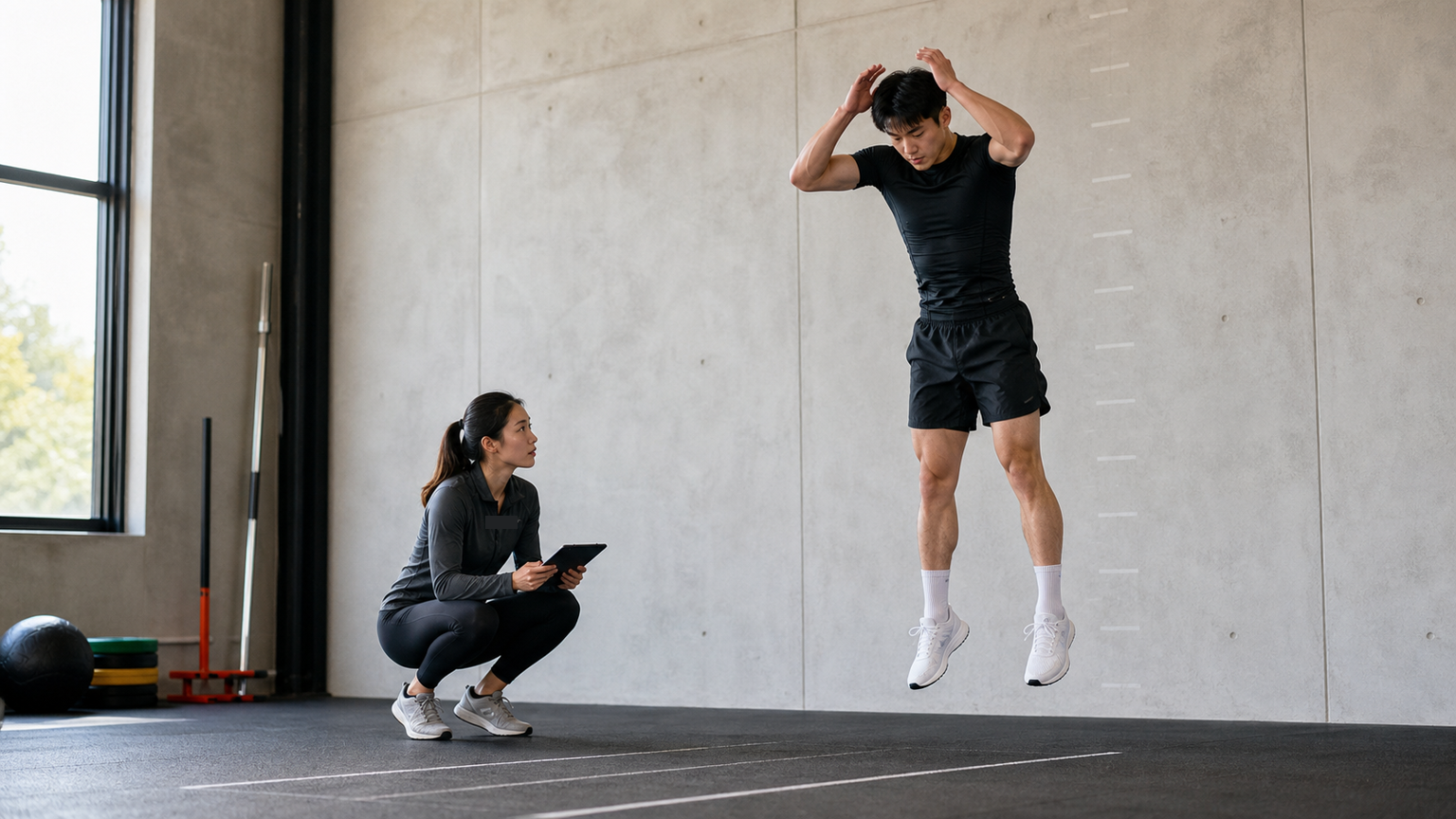
Why Do Endurance Athletes Need Explosive Power Tests?
Most endurance athletes’ training logs are filled with aerobic data: VO2max, lactate threshold pace, FTP power… but very few record their explosive power levels.
The importance of explosive power testing is reflected in the following three points:
- Establishing a Training Baseline: Only by understanding your initial explosive power level can you design appropriate plyometric training intensity
- Verifying Training Effectiveness: Retest after 6–8 weeks of plyometric training to quantify the degree of improvement and confirm training effectiveness
- Monitoring Neural Fatigue: If test results suddenly drop by more than 5%, it indicates the nervous system is overtrained—an objective signal to adjust training volume
Below are two explosive power tests best suited for endurance athletes: the Countermovement Jump (CMJ) and the Standing Long Jump (SLJ).
Test 1: Countermovement Jump (CMJ)
The CMJ is the most widely used explosive power assessment tool in the global sports science community, evaluating “lower-body explosive power” and “stretch-shortening cycle efficiency (SSC Efficiency).”
Measurement Method (No-Equipment Version)
Tools: Wall + chalk or washable paint + tape measure
Execution Steps:
- Reach upward with one hand and mark your standing reach height (standing reach height)
- Stand naturally with feet shoulder-width apart
- Quickly squat down (without pausing) while swinging arms backward
- Immediately explode upward, touching the wall with your fingers at the highest point
- Measure highest touch point - standing reach point = CMJ jump height
- Repeat 3 times, take the best attempt
Advanced Version (Smartphone Measurement):
- Use the MyJump or Physics Toolbox Suite App
- Film the jump from the side with your phone; it automatically calculates flight time and converts it to jump height
- Formula: Jump height (m) = g × t² / 8, where t = flight time (seconds)
Assessment Standards (Reference for Taiwanese Adult Endurance Athletes)
| Category | Male CMJ Height | Female CMJ Height | Training Recommendations |
|---|---|---|---|
| Excellent | > 45 cm | > 35 cm | Maintain, refine movement quality |
| Good | 38–45 cm | 28–35 cm | Add advanced plyometrics |
| Average | 30–37 cm | 22–27 cm | Standard plyometric program |
| Needs Improvement | < 30 cm | < 22 cm | Start with basic jump movement preparation |
Important Note: These standards are not precise sports science data, but rather common observational values from Taiwan’s amateur endurance sports community. They are for directional reference only; results may vary significantly across different training backgrounds.
Test 2: Standing Long Jump (SLJ)
The Standing Long Jump tests “horizontal explosive power” and is particularly suited for runners, because running is fundamentally horizontal propulsion rather than vertical elevation.
Measurement Method
Tools: Long tape measure + take-off line marker
Execution Steps:
- Stand with both feet behind the take-off line, toes not crossing the line
- Swing arms backward and bend knees to load
- Swing arms forward while taking off, jumping as far forward as possible
- Land on both feet simultaneously without falling forward
- Measure the distance from the take-off line to the nearest point where the feet last touched down
- Repeat 3 times, take the best attempt
Assessment Standards
| Category | Male SLJ Distance | Female SLJ Distance | Running Benefit Implications |
|---|---|---|---|
| Excellent | > 230 cm | > 185 cm | Strong horizontal propulsion, high stride length potential |
| Good | 200–230 cm | 160–185 cm | Normal propulsion, can be further optimized |
| Average | 170–199 cm | 135–159 cm | Horizontal explosive power is the primary training need |
| Needs Improvement | < 170 cm | < 135 cm | First strengthen hip extensor muscle groups |
Combined Interpretation of CMJ and SLJ
Combining these two tests provides richer insights:
| CMJ Result | SLJ Result | Interpretation and Recommendations |
|---|---|---|
| High | High | Excellent all-around explosive power; can take on high-intensity programs |
| High | Low | Strong vertical explosive power but insufficient horizontal conversion efficiency; add bounding (forward) training |
| Low | High | Strong horizontal propulsion but insufficient vertical elasticity; add box jumps and depth jumps |
| Low | Low | Overall explosive power needs improvement; start with movement preparation and basic plyometrics |
Testing Frequency and Tracking Recommendations
Recommended Frequency: Test every 3–4 weeks (no need for weekly testing, to avoid the tests themselves draining training energy)
Optimal Testing Timing:
- In the morning, after adequate rest (no high-intensity training the previous day)
- After completing a 10-minute dynamic warm-up (to ensure sufficient neural activation)
- Keep testing conditions as consistent as possible each time (same time of day, same location, same warm-up routine)
Tracking Tools:
- Create a simple Google Spreadsheet to record each test date, CMJ height, and SLJ distance
- Calculate the “6-week improvement rate”: (post-test - pre-test) / pre-test × 100%, with a target of 5–10% improvement per cycle
From Test Results to Training Adjustments
Testing is not the goal—it is the basis for adjusting training. Here is an example of adjusting training based on results:
Case: CMJ 31 cm, SLJ 185 cm (middle-aged male amateur marathon runner)
Interpretation: Vertical explosive power needs improvement; horizontal propulsion is normal
Training Adjustment Recommendations:
- Add box jump training twice per week (focus on improving CMJ)
- Add depth jumps to enhance elastic stiffness
- Retest after 6 weeks, targeting CMJ improvement to above 36 cm
- Maintain current training for SLJ; no special emphasis needed
Conclusion
The CMJ and Standing Long Jump are the easiest explosive power assessment tools for endurance athletes to use—they require no expensive equipment, only a tape measure and a wall. Build the habit of regular testing, let the data tell you whether your training is effective, and confirm before races that your nervous system is in an optimal state of activation. Testing is the eyes of training—only by learning to see your explosive power level can you precisely improve it.
Related Reading
- Swimming Explosive Power Training: Explosive Bench Press and Squat Jumps
- Study on the Correlation Between Countermovement Jump (CMJ) and Cycling Anaerobic Power
- Explosive Power Training for Runners: How Jump Training Improves Cadence and Stride Length
- Validity and Reliability Study of the Wingate Test for Training Monitoring
西進武嶺 免費訓練分析服務 Intervals | 練不夠還是練過頭?你哪一種類型選手?AI模型告訴你! | 備戰神器 | 公路車 訓練 | CT Yeh
4 年前
多機位拍片神器 DJI Action 2 拍出速度張力感 | 類空拍機視角 4陣列麥克風超強降風噪 實測! | 公路車 | CT Yeh
3 年前
Fitting訓練兩用功率車 ! Thinkrider ST900 完整實測!/ 坡度升降 / 鄰居測試/ smart bike/公路車/ CT Yeh
2 年前
FTL 與 SYB 車隊專訪 西進武嶺 實用攻略分享! 2小時 如何練?!你不知道的眉角!新手準備武嶺必看 EP1 | 實力派女車友 | 精華版 | 公路車 | CTYeh
4 年前
西進武嶺 8000名單車友數據分析 PART1 | 從新手到高手數量/瓦數/推力比/FTP推力比/功率計使用率 大解析 | 公路車 | CTYeh
5 年前
CT趣訪 西進武嶺 2小時組 EP2 全村的希望 蔣緯緯! 訓練菜單&技巧公開 |公路車 |CT Yeh
4 年前
Never Stop 西進武嶺 前後雙機 完整全程錄影 訓練台 實境
8 年前
DJI Osmo Action 5 Pro 首發最強!單車運動攝影機! 一顆電池錄完KOM 西進武嶺? / 超狂夜拍效果 / 4奈米AI晶片/ 一鍵數據合成 / 公路車 / CT Yeh
1 年前