Youth Multi-Sport Participation: The Long-Term Benefits of Early Specialization vs. Diversified Development
Introduction
“My child is talented, so we should focus on one sport early” — this is the mindset of many parents in Taiwan. It’s reinforced by well-known success stories in competitive sports, such as a world champion reported to have “started specialized training at age 7.” However, these stories suffer from serious survivorship bias: we see the ones who succeeded, but not the far greater number of young athletes who specialized early, burned out, and quit before ever reaching that level.
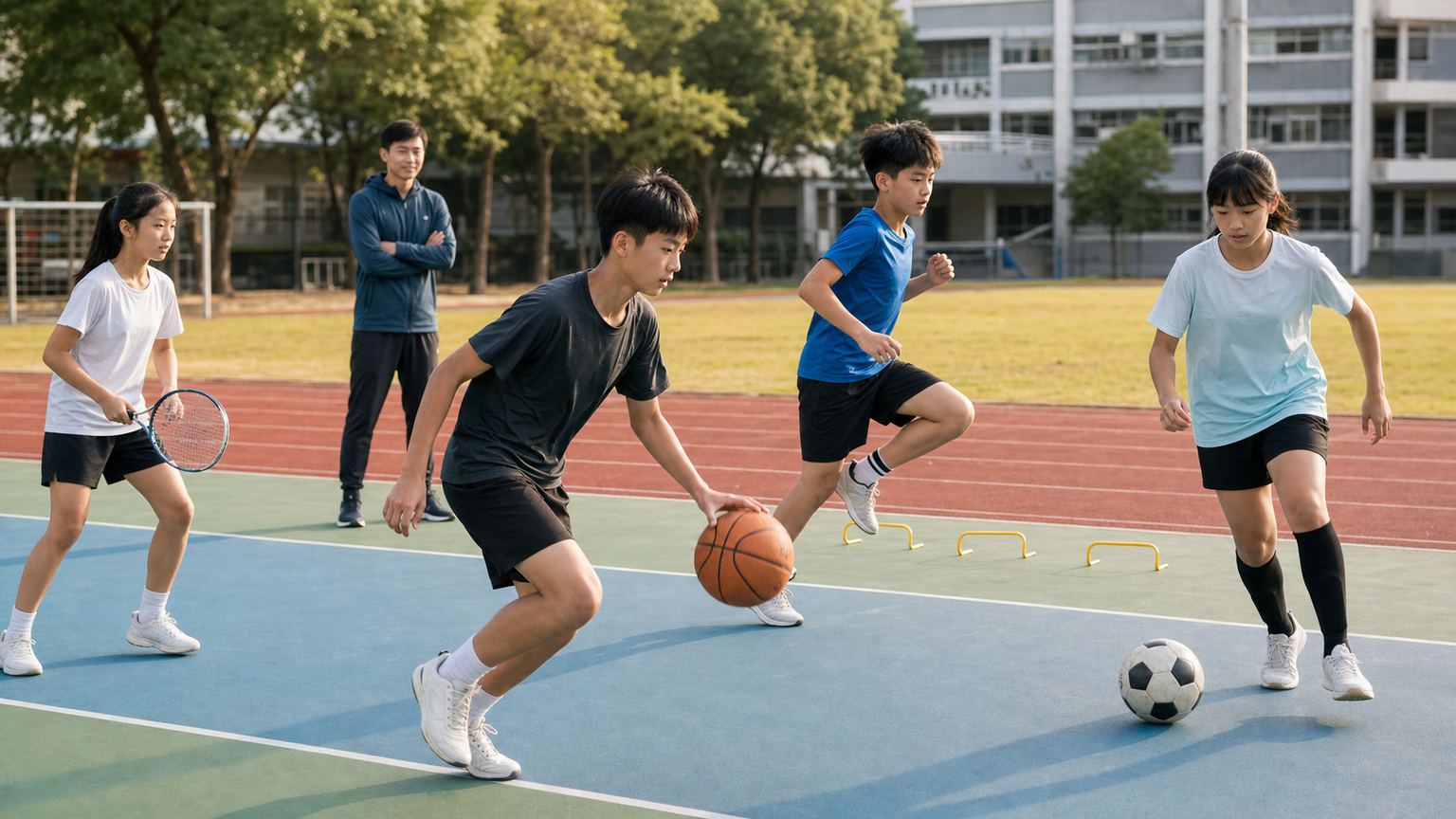
Grounded in sports science research, this article examines the pros and cons of Early Specialization versus Diversified Sport Sampling, helping parents in Taiwan make decisions that best serve their children’s long-term health and athletic development.
Definition: What Is Early Specialization?
Sports science research defines “early specialization” as meeting at least two of the following three conditions before age 12:
- Year-round focus on a single sport (no participation in other sports)
- More than 8 months of systematic training per year
- Training oriented primarily toward competition rather than play
By contrast, “diversified development” refers to broad participation in multiple sports before puberty, with specialization delayed until around age 15.
The Potential Risks of Early Specialization
A Significantly Higher Risk of Sports Injury
| Injury Type | Early Specialization | Diversified Development |
|---|---|---|
| Overuse injuries | High (accumulation of repetitive movements) | Low (varied movement patterns) |
| Growth plate stress injuries | High | Low to moderate |
| Injuries requiring surgery | 2–4 times higher than diversified development | Baseline |
| Early dropout from competitive sport | Higher | Lower |
Research from the American Orthopaedic Society for Sports Medicine (AOSSM) found that young athletes who specialize early experience overuse injuries at a rate 70–93% higher than peers who participate in multiple sports.
Psychological Burnout and Early Dropout
Long-term participation in a single sport, without novelty or varied stimulation, is one of the leading causes of burnout among young athletes. Studies indicate that roughly 30–40% of early-specialized athletes drop out of competitive sport before ever reaching an elite level.
Missing the Windows of Trainability (LTAD)
The Long-Term Athlete Development (LTAD) model identifies specific “optimal windows” during which particular athletic capacities develop best:
- Speed-sensitive window: ages 7–11 (peak neural system plasticity)
- Skill-sensitive window: ages 8–11 (the best period for learning coordination and balance)
- Aerobic-base-sensitive window: ages 13–16 (girls), 14–17 (boys)
Early specialization can lead children to over-train aerobic capacity outside the aerobic-sensitive window, while missing the optimal windows for developing speed and skill.
The Practical Advantages of Diversified Development
Transferable Athletic Skills
Many sports that appear quite different actually share underlying physical capacities:
- Swimming + cycling: core stability, symmetrical body awareness
- Gymnastics + track and field: aerial awareness, landing absorption
- Ball sports + track and field: explosive power, change of direction
- Combat sports + all other sports: proprioception, control of center of gravity
Many triathlon world champions did not train exclusively in the three triathlon disciplines during their youth. Instead, they built their running, swimming, and cycling foundations across a range of sports, and only later, as young adults, integrated these into strong competitive performance.
A Longer Competitive Career
Athletes with diversified development tend to have:
- Fewer accumulated injuries
- Greater psychological resilience (a stronger ability to cope with setbacks)
- A broader base of physical capabilities
On average, their competitive careers last 3–5 years longer than those of early-specialized athletes.
Practical Considerations for Taiwan
Taiwan’s sports system faces distinct challenges: heavy academic pressure leaves young people limited time to participate in multiple sports; school sports resources in some counties and cities are concentrated on specific sports; and coaching systems sometimes encourage children to commit early to a single training pathway.
Given this environment, parents can adopt the following practical strategy:
- Elementary school years: broadly try at least 2–3 different types of sports (individual sports plus team sports)
- Junior high, grades 1–2 (ages 12–13): narrow down to 1–2 primary sports, while still maintaining cross-training
- Junior high grade 3 through high school: once the child’s own interest and passion are confirmed, move into genuine specialization
Practical Recommendations
- Ask how your child feels: Does the child enjoy this sport? Do they still find the training enjoyable? This is the single most important indicator.
- Watch for signs of training burnout: making excuses to skip practice, low mood, and a plateau in performance are all warning signs.
- Reject outside pressure: don’t push your child into early specialization just because “other kids are doing it.”
- Choose a coach who understands LTAD: asking a coach their views on early specialization is a good way to gauge their professional expertise.
- Preserve time for “play”: unstructured, free playtime has irreplaceable value for the development of children’s athletic abilities.
Conclusion
In an environment where competitive sport increasingly emphasizes “the earlier, the better,” parents need both the knowledge and the courage to choose the path that truly benefits their child’s long-term development. Diversified sport development is not laziness — it’s science. Giving children room to explore, try, and enjoy a variety of sports is often the best way to nurture a truly outstanding athlete.
Related Reading
- Youth Multi-Sport Development: Why Early Specialization Should Be Avoided
- The Risks of Early Specialization: Why Focusing on a Single Sport Too Soon May Shorten an Athletic Career
- Timing of Specialization in Youth Swimming: The Risks and Benefits of Early Specialized Training
- A Diversified Foundation for Young Endurance Athletes: Why Specializing Later Can Mean Running Farther
一日北高/長距離團騎 常見問題補充篇 / 組團或跟團的眉角 / 壯車友容易被瘦車友慢性拉爆 / 原來屁股痛可能是這個原因...? / 風場配速法 / 公路車 / CT Yeh
2 年前
一日北高常見問題大集合 | 攻略 | 路線 | 訓練 | 補給 | 自行車 單車 | 一日雙城 | 雙塔 | TWB北高360 | 屁股痛
6 年前
滑雪新手們慘摔學習全紀錄(請開字幕),滑雪好好玩 | Snowboard + Ski | 岩原 スキー場 | 滑雪APP使用 | GoPro Max
6 年前
碟煞公路車 優缺點?換車一年半實際經驗分享 / 公路車 / CT Yeh
2 年前
崇越盃武嶺冠軍高手 賽前JJSC 群峰會精華!對應大數據分析,會有落差嗎?/ feat. JJSC中部公路車約騎 /公路車 / CT Yeh
2 年前
西進武嶺 免費訓練分析服務 Intervals | 練不夠還是練過頭?你哪一種類型選手?AI模型告訴你! | 備戰神器 | 公路車 訓練 | CT Yeh
4 年前
live) 超越北高 之一日北高12小時 策略
7 年前
2019 柯P 超越北高 第一集團實錄 (11小時實錄請參考另一部影片) 一日雙城 一日北高 NeverStop Taiwan Long Distance Cycling Challenge
7 年前