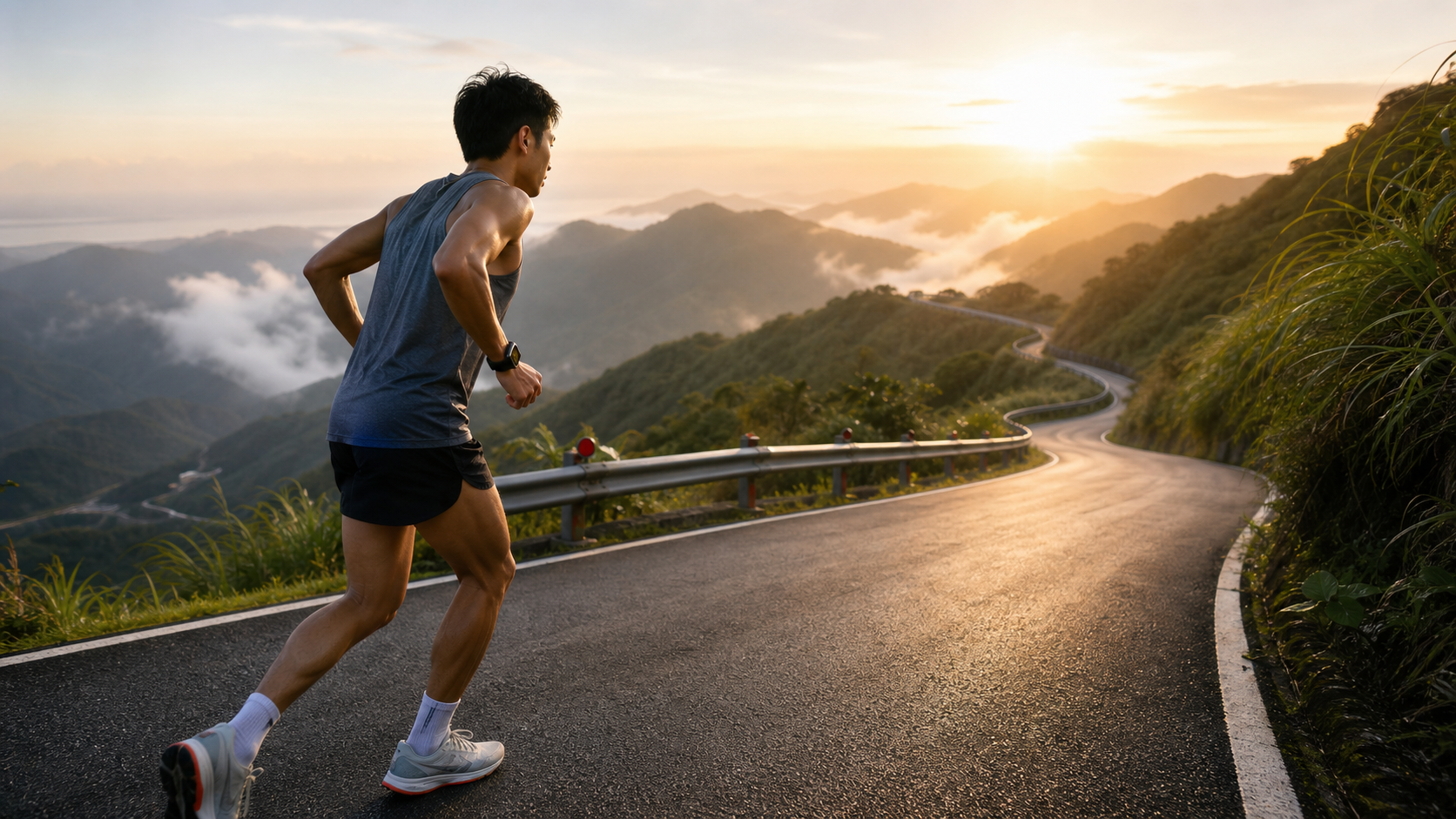
Why Does Climbing Slow You Down?
Running uphill requires additional work against gravity. The energy needed to maintain the same speed on flat ground shows non-linear growth as the gradient increases, for reasons including:
- Vertical work against gravity: Each 1-meter climb requires roughly 0.9–1.0 kcal/kg of extra energy
- Gait changes: Stride length shortens, cadence adjusts, and muscle recruitment patterns differ
- Additional demand on the quadriceps and glutes: Propulsive torque increases significantly
Core Formula: Gradient-Equivalent Pace Conversion
The most frequently cited formulas in exercise physiology come from Jack Daniels (author of Daniels’ Running Formula) and Alberto Minetti (2002, Journal of Applied Physiology):
Minetti Energy Cost Model
At a gradient i (expressed as a decimal, e.g., 3% = 0.03), the energy cost per kilogram per meter (J/kg/m) is:
$$C(i) = 280.5i^5 - 58.7i^4 - 76.8i^3 + 51.9i^2 + 19.6i + 2.5$$
This formula tells us that energy cost increases sharply above +10% gradient, while between -10% and 0%, downhill running is actually less demanding than flat running.
Simplified Conversion Table
Using a flat-ground pace of 5:00/km as the baseline, here are the “equivalent effort paces” (the flat-ground pace that consumes the same physiological energy) at various gradients:
| Gradient | Actual Running Pace | Equivalent Flat Pace | Pace Slowdown |
|---|---|---|---|
| 0% (flat) | 5:00/km | 5:00/km | Baseline |
| +1% | 5:07/km | 5:00/km | +7 sec/km |
| +2% | 5:14/km | 5:00/km | +14 sec/km |
| +3% | 5:22/km | 5:00/km | +22 sec/km |
| +5% | 5:40/km | 5:00/km | +40 sec/km |
| +8% | 6:15/km | 5:00/km | +75 sec/km |
| +10% | 6:40/km | 5:00/km | +100 sec/km |
Key rule: For every 1% increase in gradient, the equivalent pace slows by approximately 6–8 sec/km
Practical Application: Pace Planning for Taiwan’s Mountain Races
Yangmingshan Caoshan Battle (sections with 5–8% gradient)
If your flat marathon pace is 5:30/km, your target actual running pace on a 6% climb should be:
5:30 + (6 × 7 sec) = 5:30 + 42 sec = 6:12/km
Does running 6:12 feel slow? But it consumes nearly the same physiological energy as running 5:30 on flat ground.
Use Power Instead of Pace to Gauge Climbing
The most direct method: use a running power meter such as Stryd, keep the target power constant, and let your speed adjust naturally with the gradient—no mental math required.
Downhill Pacing Strategy
Going downhill is not simply about going as fast as possible:
- -1% to -5%: Actually less demanding than flat running; you can pick up the pace slightly by 5–15 sec/km
- -5% to -10%: Eccentric contraction load on the quadriceps increases dramatically; speed should be controlled
- Beyond -10%: Energy cost rises again, and the risk of knee injury increases significantly
The muscle damage from “braking” on downhills is often the hidden cause of a pace collapse in the later stages of a race.
Practical Advice
- Incorporate hill training during preparation: Schedule 1–2 sessions per week that include climbs so your body adapts to gradient pacing
- Study the elevation profile before race day: Use Strava or Garmin to review the course elevation, mark the major climbs, and calculate your slowdown in advance
- On climbs, watch your heart rate, not your pace: Keep your heart rate within limits and your speed will naturally settle where it should be
- On climbs, shorten your stride without reducing cadence: Maintain a cadence of 170–180 spm and shorten your stride to control energy expenditure
- Note for Taiwan runners: Mountain races in places like Jiufen and Pingxi commonly feature gradients of 5–12%, making pace conversion especially important
Conclusion
Uphill pace conversion is not about making excuses for running slower—it’s about ensuring you expend energy evenly throughout the entire race. True mountain specialists are not the ones who climb the fastest, but those who still have enough left to accelerate on the downhills and flats after the climbs. Master the gradient conversion formula, and you’ve unlocked the core rhythm of mountain racing.
Related Reading
- Equivalent Flat Pace for Climbing: Gradient and Pace Conversion Formula
- Uphill and Downhill Pace Adjustments: Seconds per Pace for Every 1% Gradient
- Trail Running Uphill Technique: Cadence, Propulsion, and Efficient Power Distribution
- How Course Elevation Affects Pace: How Many Seconds Slower per 100m of Climb
#公路車 #Fitting 靠人工智慧APP 幫你調整單車
6 年前
公路車 爬坡 破PR 紀錄 小技巧 分享
6 年前
西進武嶺配速器 3.0更新 / NEW 免功率FTP估算! / 大數據xAI體能模型 / 如何模擬人止關前集團效應 / 配速儲存功能 / AI全台自行車賽事行事曆 / 公路車 / CT Yeh
1 年前
靠單車減肥35公斤 心得分享與整理
7 年前
武嶺配速表最佳使用方式 #bike
1 年前
如果Pogačar騎西進武嶺可以多快?會破2嗎?各種情況深度推估探討 / 公路車 / CT Yeh
2 年前
西進武嶺 免費訓練分析服務 Intervals | 練不夠還是練過頭?你哪一種類型選手?AI模型告訴你! | 備戰神器 | 公路車 訓練 | CT Yeh
4 年前
白沙屯媽祖進香在家走!UREVO 坡度自調走步機 / 可連接訓練遊戲APP MyWhoosh / 邊看直播邊走起來 / CT Yeh
11 個月前