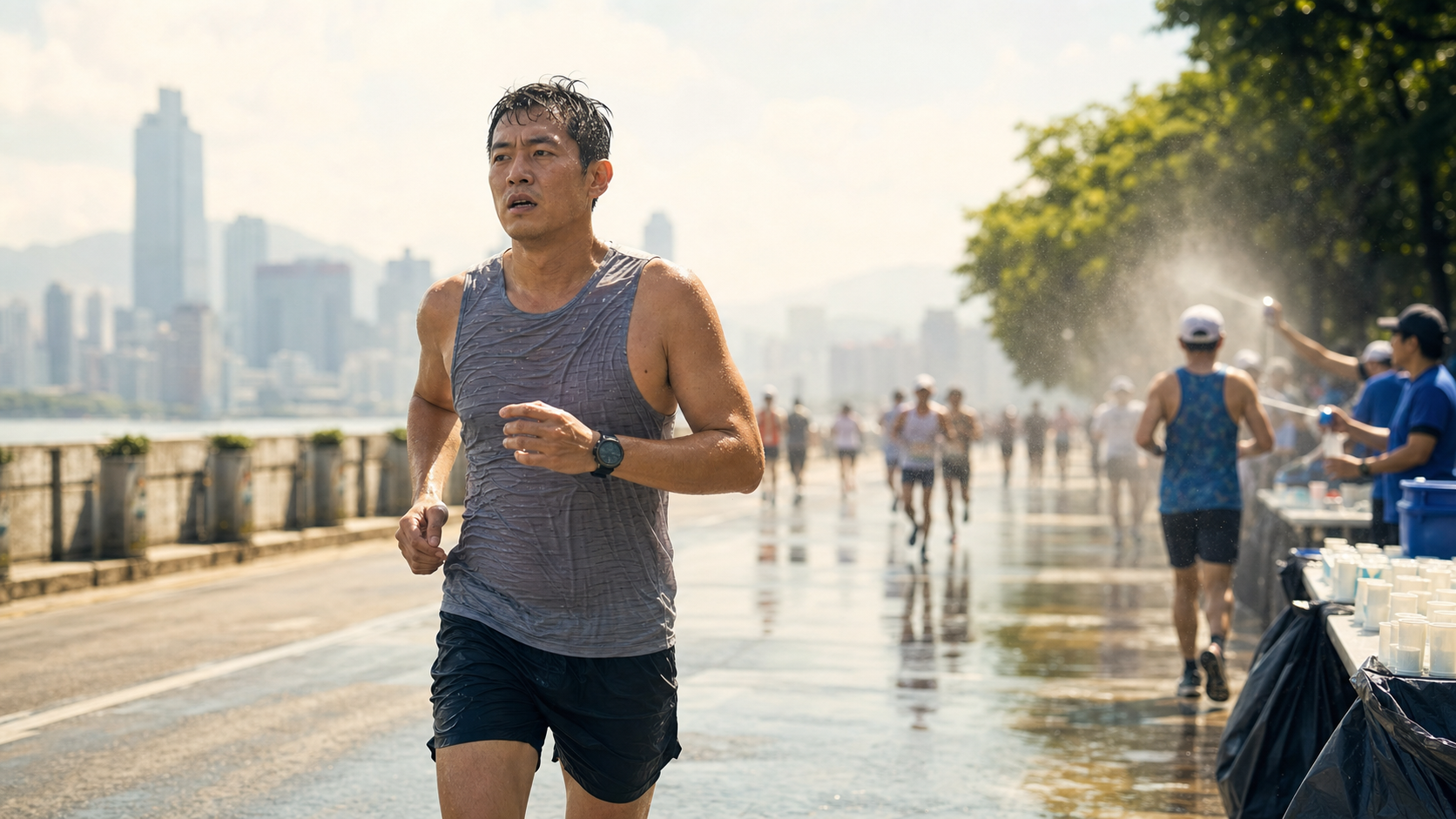
Why Does Temperature Affect Pace?
Running is a high-intensity aerobic exercise, and the heat generated by the human body during a marathon is 15–20 times that of a resting state. In low-temperature environments, the body can dissipate heat effectively; when the ambient temperature rises, heat dissipation efficiency drops, core body temperature rises, and this in turn triggers a series of physiological mechanisms that reduce athletic performance:
- Cardiac output redistribution: More blood flows to the skin for heat dissipation, reducing oxygen supply to muscles
- Accelerated heart rate drift: Heart rate rises faster at the same pace
- Accelerated glycogen depletion: Heat stress increases overall metabolic rate
- Earlier central fatigue: The brain forces a “slow down to survive” response when core body temperature reaches 40°C
Scientific Research on the Temperature-Pace Relationship
Multiple large-scale studies have analyzed over 1 million marathon finish records (including Boston Marathon data from 1897–2016) and reached the following conclusions:
Optimal Marathon Temperature
Studies consistently indicate that the optimal marathon temperature is approximately 7–12°C, slightly lower for elite runners (5–10°C) and slightly higher for recreational runners (10–15°C).
Pace Loss at Various Temperatures
Using a target pace matched to ability at 15°C as the 100% baseline:
| Ambient Temperature | Recommended Pace Adjustment | Additional Full Marathon Time Loss |
|---|---|---|
| 5–10°C | Baseline ±0% | 0 minutes |
| 10–15°C | Baseline, minor fine-tuning possible | 0–2 minutes |
| 15–20°C | Slow down 1.5–2% | 3–6 minutes |
| 20–25°C | Slow down 3–5% | 6–12 minutes |
| 25–30°C | Slow down 5–8% | 12–20 minutes |
| 30–35°C | Slow down 8–12% | 20–30 minutes |
| >35°C | Recommended not to race for time; aim for finishing | 30+ minutes |
Core rule: For every 5°C increase in temperature, slow your pace by approximately 1.5–3.5% (depending on individual heat adaptation)
The Additional Impact of Humidity
High humidity (>80%) significantly reduces sweat evaporation efficiency, equivalent to raising the temperature by another 3–5°C.
Taiwanese runners need to pay special attention to the “Heat Index” (apparent temperature):
| Air Temperature | Relative Humidity | Apparent Temperature |
|---|---|---|
| 28°C | 50% | 28°C |
| 28°C | 70% | 31°C |
| 28°C | 90% | 35°C |
| 32°C | 80% | 40°C |
The Temperature Reality of Taiwanese Races
Taiwanese marathon events are concentrated between October and March, but even in “autumn/winter” races, the temperature at the start can still reach 20–25°C (especially for races in the south).
Temperature Reference for Popular Races
- Taipei Marathon (December): Usually 12–18°C, relatively favorable conditions
- Wan Jin Shi (March): 18–25°C in most years, occasional wind chill effect
- Kaohsiung Marathon (February): 15–22°C, temperatures tend to be on the higher side in most years
- Standard Chartered Taipei Marathon (early March): 20–28°C, has become a high-temperature test in recent years
The Importance of Heat Acclimation Training
If you cannot avoid high-temperature races, doing heat acclimation training in advance can:
- Increase plasma volume by 4–10% (improving cardiac output efficiency)
- Lower core body temperature at the same intensity
- Raise the heat threshold (the core temperature limit that triggers the slowdown response)
Standard heat acclimation protocol: 10–14 consecutive days of 45–60 minutes of moderate-intensity training in a hot environment (or wearing extra layers).
Practical Recommendations
- Check the forecast temperature 72 hours before the race; if the temperature is more than 5°C higher than expected, adjust your pacing plan immediately
- Hydration strategy for hot races: Instead of drinking every 2–3 km (normal), switch to every 1.5–2 km, and prioritize pouring cold water over your head and neck to cool down
- Clothing choices: A white or light-colored moisture-wicking top absorbs 3–5°C less radiant heat than dark clothing
- Start time strategy: If the race offers wave starts, choose an earlier wave to take advantage of the cooler morning temperatures in the first half
- Ice cooling method: In the latter stages of a half marathon, apply ice along the course to your neck and armpits; this can delay heat fatigue by approximately 10–15 minutes
Conclusion
For Taiwanese runners, temperature is almost the most uncontrollable race variable—and the one most often mishandled. Accepting the fact that “today is hot, so I will run slower” is not surrender; it is the scientific decision of a mature runner. A marathon completed at 28°C with steady pacing throughout holds far greater training value than a race where pacing collapses because you refused to acknowledge the heat. Remember: temperature changes your pace, not your ability.
Related Reading
- Pace Adjustment in Hot Weather: How Many Seconds to Slow Down for Every 1°C Increase
- Marathon Weather Strategy: Optimal Temperature and Pace Adjustments for Hot Races
- Hot Weather Pace Adjustment Rules: How Many Seconds to Slow Down for Every 5°C Increase
- Compensating for Slower Running in Heat: Pace Adjustment Strategies for Taiwan Summer Training
#公路車 #Vo2Max #最大攝氧量 測驗 體驗 | 心肺測試
6 年前
武嶺配速表最佳使用方式 #bike
1 年前
#公路車 #Fitting 靠人工智慧APP 幫你調整單車
6 年前
西進武嶺 免費訓練分析服務 Intervals | 練不夠還是練過頭?你哪一種類型選手?AI模型告訴你! | 備戰神器 | 公路車 訓練 | CT Yeh
4 年前
西進武嶺 自製新版AI配速表產生器 x 賽前攻略 抱佛腳! 沒有功率計也可以產生配速表嗎?有什麼其他眉角賽前要注意的呢? | 西進武嶺 / 東進武嶺 KOM 攻略 | 公路車 | CT Yeh
4 年前
西進武嶺各路段 前8000名 大數據分析 配速攻略/功率/心律/推力比/維持率/踏頻/踏瓦比/牽車率 大公開 | 建大盃 NeverStop 可參考 | 公路車 | CT Yeh
5 年前
一日北高/長距離團騎 常見問題補充篇 / 組團或跟團的眉角 / 壯車友容易被瘦車友慢性拉爆 / 原來屁股痛可能是這個原因...? / 風場配速法 / 公路車 / CT Yeh
2 年前
西進武嶺配速器 3.0更新 / NEW 免功率FTP估算! / 大數據xAI體能模型 / 如何模擬人止關前集團效應 / 配速儲存功能 / AI全台自行車賽事行事曆 / 公路車 / CT Yeh
1 年前