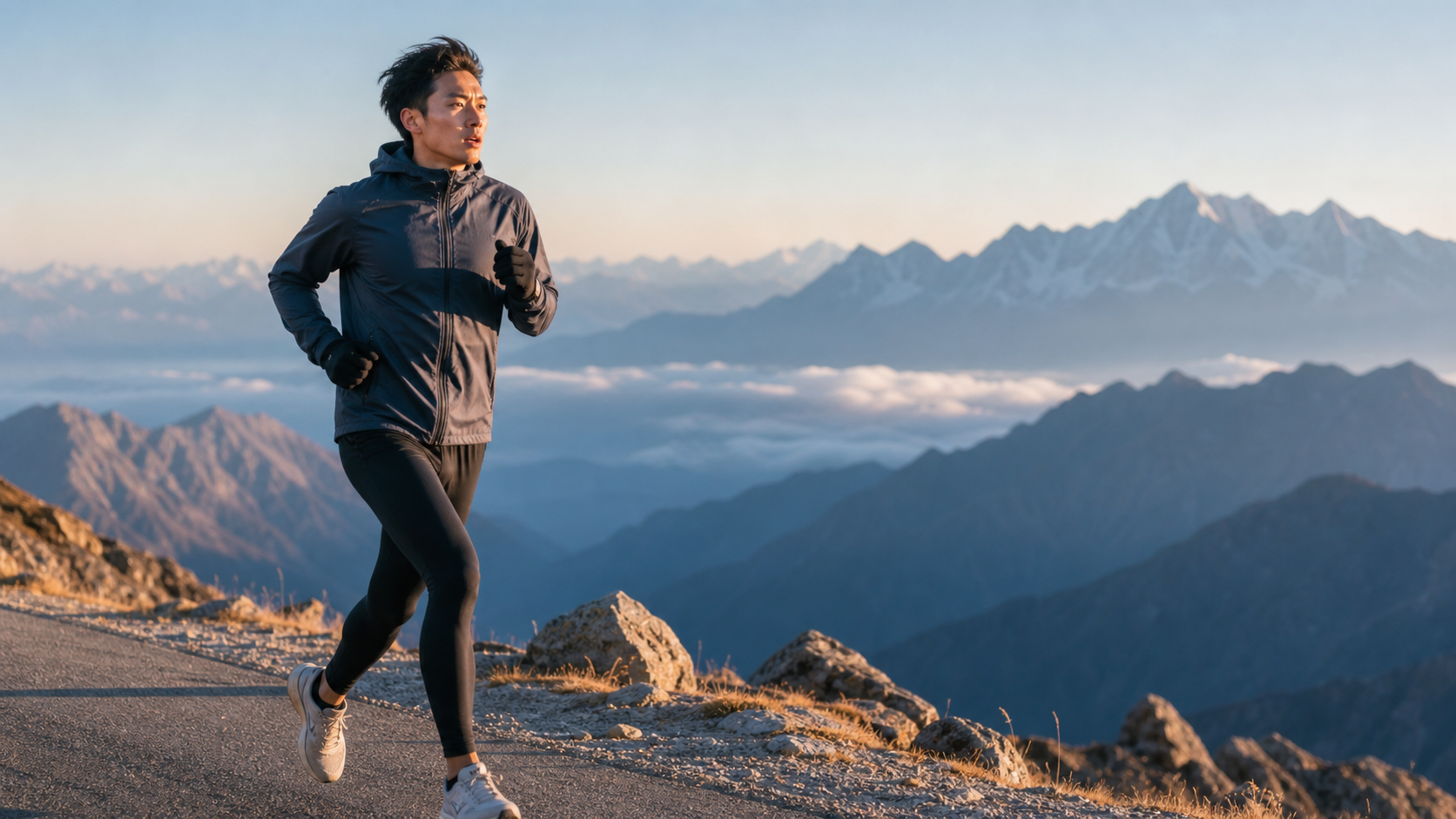
Why Does Altitude Affect Running Performance?
At sea level (0m), the oxygen content in the air is approximately 20.9%, with an atmospheric pressure of about 1013 hPa. As altitude increases, atmospheric pressure decreases. Although the oxygen ratio remains unchanged, the partial pressure of oxygen (PaO2) decreases, reducing the efficiency of oxygen exchange between the alveoli and the blood, leading to:
- Decreased maximal oxygen uptake (VO2max): For every 1000m of elevation gain, VO2max drops by approximately 6–9%
- Increased heart rate: To compensate for the lower oxygen content per heartbeat
- Rapid breathing: Respiratory rate increases to maintain oxygen intake
- Accelerated muscle fatigue: The proportion of anaerobic metabolism increases
Aerobic Capacity Impact at Various Altitudes
| Altitude | Atmospheric Pressure | Oxygen Partial Pressure | VO2max Decline | Equivalent Pace Loss (5:00/km) |
|---|---|---|---|---|
| 0m (Sea Level) | 1013 hPa | 100% | Baseline | Baseline |
| 500m | 955 hPa | 94.2% | -3% | +9 sec/km |
| 1000m | 899 hPa | 88.7% | -6% | +18 sec/km |
| 1500m | 845 hPa | 83.4% | -9% | +27 sec/km |
| 2000m | 795 hPa | 78.5% | -12% | +36 sec/km |
| 2500m | 747 hPa | 73.7% | -15% | +45 sec/km |
| 3000m | 701 hPa | 69.2% | -18% | +54 sec/km |
Core rule: For every 100m of elevation gain, aerobic capacity drops by approximately 0.6–0.9%, with an equivalent pace loss of about 2–3 sec/km
Individual Differences: Altitude Sickness Response
Not everyone responds to high altitude the same way. Influencing factors include:
- Genetic differences: Some people are naturally more tolerant of hypoxia (e.g., Tibetans, indigenous Andean peoples)
- Training status: Runners with high VO2max actually experience a greater decline at altitude (because they rely more heavily on high-intensity aerobic metabolism in daily training)
- Prior altitude training experience: Runners who have already acclimatized to altitude experience smaller losses
Acute Mountain Sickness (AMS) Risk
Non-highland residents are at risk of AMS under the following conditions:
- Rapid ascent above 2500m
- Sleeping above 3000m
- Symptoms: headache, nausea, fatigue (additional physical burden beyond race pace)
High-Altitude Events in Taiwan
Taiwan has several renowned high-mountain trail and road running events:
| Event | Maximum Altitude | Recommended Pace Adjustment |
|---|---|---|
| Taroko Gorge Marathon | Start/finish approx. 80–200m | Minimal impact |
| Wuling Summit Challenge | 3275m (finish) | Average course altitude approx. 2000m, significant pace loss |
| Hehuan Mountain Ultra-Marathon | Above approx. 3000m | Highly conservative pacing required |
| Yushan Summit Run | 3952m | Not a race against time; prioritize safety |
Acclimatization Benefits of Altitude Training
After training at high altitude and returning to sea level, you can gain:
- Increased erythropoietin (EPO): Stimulates red blood cell production, enhancing oxygen-carrying capacity
- Increased hemoglobin concentration: Typically requires 3–4 weeks of altitude training
- The “altitude window”: Weeks 2–4 after descending are the peak performance period
This is why many elite runners choose altitude training 4–6 weeks before a marathon.
Practical Recommendations
- Arrive 1 week before a high-altitude event: Gives your body time for initial acclimatization, reducing AMS risk and partially restoring aerobic capacity
- Pace 10–15% more conservatively than your sea-level target: For events above 2000m, pacing by feel (RPE) is more appropriate than relying on GPS
- Increase hydration: Faster breathing at altitude increases respiratory water loss; supplement an additional 100–150 ml per hour
- Watch your sleep: Sleep quality declines at altitude (hypoxia affects deep sleep stages); insufficient sleep for 2–3 days after arrival is normal—don’t overthink it
- Performance rebound after descending: 1–2 weeks after returning to sea level from a high-altitude event, you may feel unusually light on your feet—this is a temporary supercompensation effect, so make the most of it
Conclusion
High altitude is a fair test—it takes away a portion of oxygen from everyone equally. Understanding and accepting the quantified impact of altitude on aerobic capacity not only helps you make better pacing decisions in mountain events, but also prevents the excessive fatigue—or even danger—caused by stubbornly maintaining sea-level pace. Mountains should be run at a speed that matches their height.
Related Reading
- The Impact of Elevation on Pacing: Adjustment Strategies for Taiwan’s Mountain Races
- High-Altitude Running: Hypoxic Adaptation, Pace Adjustment, and Timing Your Return to Lower Elevations
- The Effect of Course Elevation on Pacing: How Many Seconds Slower per 100m of Climb
- Pace Adjustment for Mid-to-High Altitude Races: Don’t Use Sea-Level Pace to Attack Wuling
#公路車 #Vo2Max #最大攝氧量 測驗 體驗 | 心肺測試
6 年前
西進武嶺 自製新版AI配速表產生器 x 賽前攻略 抱佛腳! 沒有功率計也可以產生配速表嗎?有什麼其他眉角賽前要注意的呢? | 西進武嶺 / 東進武嶺 KOM 攻略 | 公路車 | CT Yeh
4 年前
西進武嶺配速器 3.0更新 / NEW 免功率FTP估算! / 大數據xAI體能模型 / 如何模擬人止關前集團效應 / 配速儲存功能 / AI全台自行車賽事行事曆 / 公路車 / CT Yeh
1 年前
西進武嶺各路段 前8000名 大數據分析 配速攻略/功率/心律/推力比/維持率/踏頻/踏瓦比/牽車率 大公開 | 建大盃 NeverStop 可參考 | 公路車 | CT Yeh
5 年前
#公路車 #Fitting 靠人工智慧APP 幫你調整單車
6 年前
一日北高/長距離團騎 常見問題補充篇 / 組團或跟團的眉角 / 壯車友容易被瘦車友慢性拉爆 / 原來屁股痛可能是這個原因...? / 風場配速法 / 公路車 / CT Yeh
2 年前
#公路車 #西進武嶺 配速配瓦實驗 坡度分析 四小時內攻略 建大盃 NeverStop #西進武嶺攻略
6 年前
一日北高前的高裝檢 | 北高 360 | 挑戰11小時的裝備 | 一日雙塔 | 補給
6 年前