Power Meter Selection and Calibration: Differences Between Static and Dynamic Calibration, and Frequency Recommendations
Introduction
The accuracy of a power meter directly determines the credibility of your training data. A power meter that hasn’t been calibrated for a long time can have readings off by as much as 5–10%, meaning your “280W FTP” could actually be anywhere between 252–296W—and your entire training plan is built on this uncertain foundation.
Calibrating your power meter isn’t something only high-end riders need to do; it’s basic homework for every cyclist who takes training seriously.
How Power Meters Work
Most mainstream power meters on the market use strain gauges to measure the deformation of the pedal stroke, which is then converted into torque, and combined with cadence to calculate power (Power = Torque × Angular Velocity).
Main sources of error:
- Temperature changes causing metal materials to expand and contract
- Differences in deformation based on mounting location (crank arm, pedal, hub)
- Battery voltage drop causing sensor signal drift
- Zero-point drift from long-term wear
Static Calibration (Zero Offset)
Principle: With no force applied, reset the power meter’s output to zero. This is the most basic calibration method, compensating for temperature changes and short-term zero-point drift.
Steps:
- Place the bike on a trainer or keep it stationary
- Keep both feet off the pedals, with the crank arms vertical (3 o’clock and 9 o’clock positions)
- Execute “Zero Offset” or “Calibrate” via your device (Garmin, Wahoo, or mobile app)
- Confirm the displayed Offset value is within a reasonable range (usually within ±100, varies by brand)
Recommended frequency:
- Before every ride (especially outdoors or in conditions with large temperature swings)
- When the temperature difference between storage and riding location exceeds 10°C
- After replacing the battery
Notes: Warm up the power meter for 10–15 minutes before static calibration to allow its temperature to stabilize; otherwise, readings will still drift after riding for a while as temperature changes.
Dynamic Calibration (Slope Calibration)
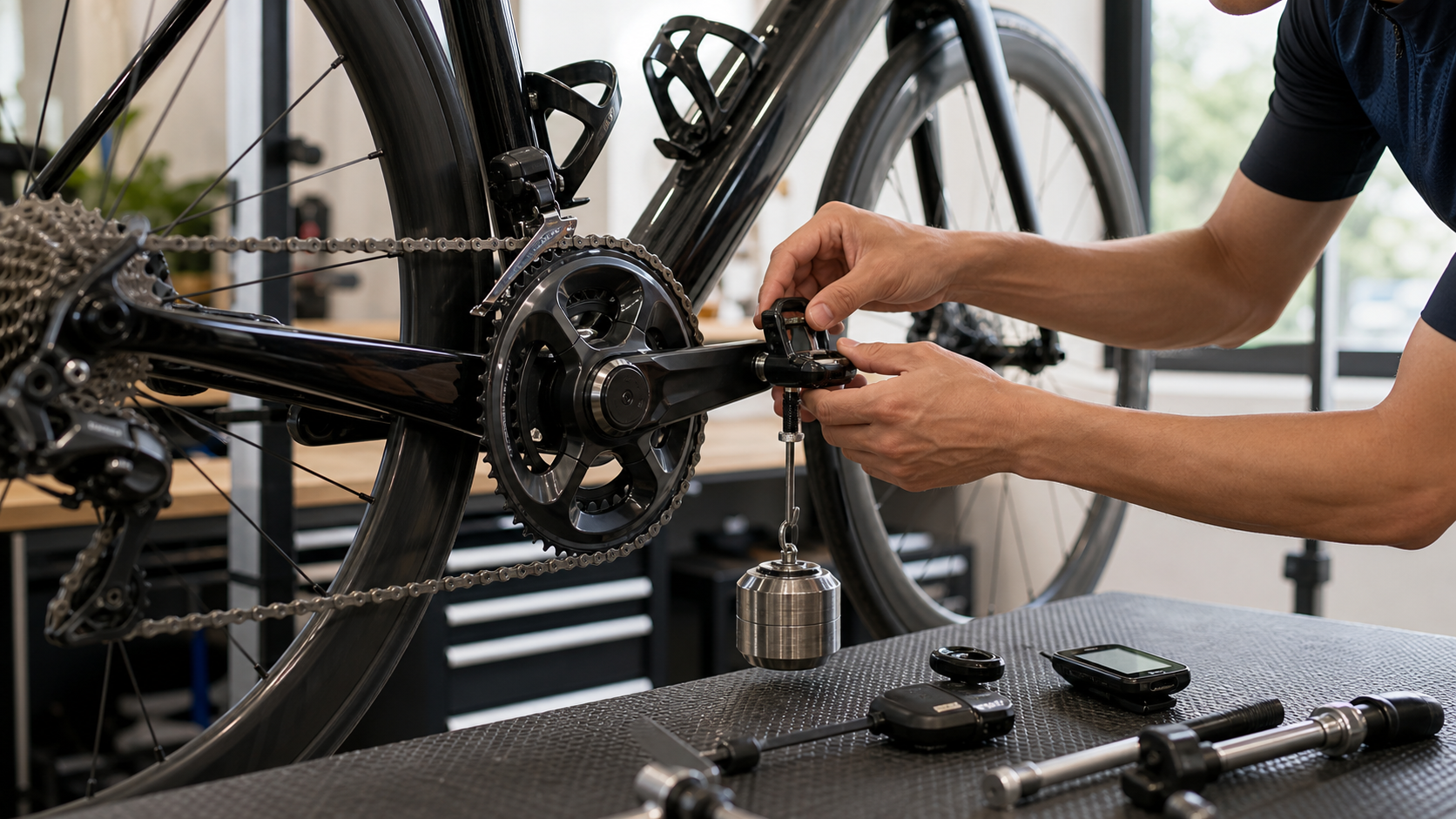
Principle: Under known force conditions (typically using calibration weights or a lever arm with a known weight), verify whether the power meter’s conversion coefficient (slope) is accurate. This is a deeper level of calibration that compensates for long-term drift in sensor sensitivity.
Who needs dynamic calibration:
- Power meter in use for more than 1–2 years
- Suspect that power readings have long been inconsistent with how your body feels
- After replacing the strain gauge or major components
- Precision verification before important races
Dynamic calibration services available in Taiwan: Most original brand distributors (such as Stages, Pioneer, 4iiii) offer factory calibration services, costing approximately NT$500–1500. Some high-end power meters (such as SRM, Quarq) can be connected to a computer for slope reset.
Comparison of Mainstream Power Meter Mounting Locations
| Mounting Location | Representative Brands | Accuracy | Advantages | Disadvantages |
|---|---|---|---|---|
| Spider crank | Quarq, SRM | ±1–1.5% | Measures total output from both legs | Requires reinstallation when changing frames |
| Left crank arm | Stages, 4iiii | ±1.5–2% | Lower price | Measures only left leg (estimated ×2) |
| Pedal-based | Garmin Rally, Favero | ±1–1.5% | Easy to switch between bikes | Heavier, pedal axles require maintenance |
| Hub | PowerTap G3 | ±1% | High accuracy | Inconvenient when changing wheelsets |
| Chainring | Shimano Dura-Ace | ±1.5% | High integration | Locked into Shimano groupsets |
Buying Recommendations
Entry-level riders (budget NT$8,000–15,000): Stages left crank arm models, 4iiii Precision—accuracy is sufficient for daily training, and installation is convenient.
Intermediate riders (budget NT$15,000–30,000): Favero Assioma pedal-based power meters—dual-sided measurement, can be swapped between multiple bikes, excellent value for money.
Competitive riders (budget NT$30,000 and above): Quarq DZero or Shimano Dura-Ace integrated models—highest accuracy, pairs well with competitive training systems.
Common Misconceptions
Myth 1: Power meters of the same brand on different bikes can be used to compare training data between the two bikes
Even with the same brand of power meter, there can be up to ±3% difference across different bikes and mounting conditions. Be aware of systematic errors when comparing FTP across bikes.
Myth 2: The more expensive the power meter, the more accurate it is
The ±1% accuracy claims on the market are not based on a consistent testing standard. What matters most is repeatability—whether readings are stable under identical conditions—which is more important than single-measurement accuracy.
Practical Recommendations
- Keep a calibration log: Record the Offset value from each static calibration. If the Offset is unusually high on a given day, it could be an early warning sign of battery or strain gauge issues.
- Special attention for outdoor riding in Taiwan: After parking in a hot car in summer, the power meter temperature can exceed 50°C. Be sure to warm up and recalibrate after retrieving the bike.
- Seasonal temperature differences: In northern Taiwan during winter, the temperature difference between 10°C in the morning and 22°C in the afternoon is significant. It’s recommended to perform a zero offset again mid-ride during long-distance training.
Conclusion
The value of a power meter lies in providing reliable training data, and reliability must be maintained through proper calibration procedures. Develop the habit of static calibration before every ride, and periodically perform dynamic calibration to confirm long-term accuracy—only then can your power meter truly deliver on its investment and become a dependable partner in your training progress.
Related Reading
- Power Meter Selection and Calibration: The Impact of Accuracy Error on Training Data
- Power Meter Calibration and Maintenance: Ensuring Your Wattage Data Is Accurate and Reliable
- The Complete 2025 Power Meter Buying Guide: Best Choices from Entry-Level to Advanced
- The Science of Power Meter Measurement: Strain Gauge Placement, Zero-Point Drift, and the True Meaning of ±1% Accuracy
西進武嶺配速器 3.0更新 / NEW 免功率FTP估算! / 大數據xAI體能模型 / 如何模擬人止關前集團效應 / 配速儲存功能 / AI全台自行車賽事行事曆 / 公路車 / CT Yeh
1 年前
全台首發!邁金P715踏板功率計!市場價格撼動者再出招 / 功率對比實測 / FAVERO ASSIOMA 可參考! / 公路車 / CT Yeh
1 年前
西進武嶺 自製新版AI配速表產生器 x 賽前攻略 抱佛腳! 沒有功率計也可以產生配速表嗎?有什麼其他眉角賽前要注意的呢? | 西進武嶺 / 東進武嶺 KOM 攻略 | 公路車 | CT Yeh
4 年前
西進武嶺 8000名單車友數據分析 PART1 | 從新手到高手數量/瓦數/推力比/FTP推力比/功率計使用率 大解析 | 公路車 | CTYeh
5 年前
Fitting訓練兩用功率車 ! Thinkrider ST900 完整實測!/ 坡度升降 / 鄰居測試/ smart bike/公路車/ CT Yeh
2 年前
Stages功率計 和 智騎 X7 Pro 訓練檯同時騎兩個 Rouvy 角色會一起進終點嗎?最後來點數據分析 | 公路車
5 年前
西進武嶺 免費訓練分析服務 Intervals | 練不夠還是練過頭?你哪一種類型選手?AI模型告訴你! | 備戰神器 | 公路車 訓練 | CT Yeh
4 年前
#公路車 #Fitting 靠人工智慧APP 幫你調整單車
6 年前