Time Trial (TT) Power Strategy: Power Distribution Across the First and Second Halves of a Flat TT
Introduction
The Time Trial (TT) is known as the “race of truth” because there is no pack to draft behind, no tactical shelter—just you and the clock. In a pure individual time trial, power strategy determines everything: ride too hard and you’ll blow up in the second half; ride too conservatively and you’ll waste precious energy.
The widespread availability of modern power meters has made TT power strategy precisely executable. But the question of “how to distribute power” has answers from sports science that are more nuanced than most riders imagine.
The Scientific Basis of Constant Power Pacing
Core principle: Since air resistance is proportional to the cube of speed, at a fixed average power, constant power pacing consumes less energy and yields a higher average speed than strategies that start fast and fade, or start slow and surge.
For example: If your TT power is 250W (fixed), compared to a 30 km TT at a constant 250W:
- If you ride the first 15 km at 280W and the last 15 km at 220W (same 250W average), total time increases by 0.5–1.5%
- This is because the air resistance created by the higher speed in the first half far exceeds the resistance saved by the slower speed in the second half
Conclusion: Constant power pacing is the optimal strategy for a flat TT, or a slight “negative split” (second half slightly higher than the first).
Recommended Power Ranges for Flat TTs
| TT Distance | Recommended Power (% of FTP) | Intensity Characteristics |
|---|---|---|
| 10 km | 110–120% FTP | Partial contribution from anaerobic capacity |
| 20 km | 100–108% FTP | Near or slightly above FTP |
| 40 km | 96–103% FTP | Slightly below to slightly above FTP |
| 60 km | 90–97% FTP | Primarily below FTP |
Power Segment Strategy for an Actual TT
40 km Flat TT (using FTP = 250W as an example)
Start segment (0–2 km): 120–130% FTP (300–325W)
Reason: The energy for the starting surge comes primarily from the phosphocreatine system and does not deplete aerobic reserves for the later stages. Accelerating hard immediately after the start helps you quickly reach target speed, saving time lost to air resistance.
First 1/3 (2–15 km): 98–103% FTP (245–258W)
Adrenaline is still high and the body feels fresh, so the most common mistake is letting power spike to 115–120% FTP, paying a heavy price later. You must rely on the power meter to enforce control.
Middle segment (15–30 km): 100–105% FTP (250–263W)
The body settles into a rhythm, allowing a slight increase in power, but the margin is limited. This segment is the psychological crux of the race—maintaining stable power is the top priority.
Final 5 km (35–40 km): 105–115% FTP (263–288W)
Knowing there is no “later” to save energy for, you can begin gradually increasing the effort. In the last 1–2 km, go all out, with power reaching 130–150% FTP.
Recommended Coefficient of Variation (CV) Target
For excellent TT power distribution, the Variability Index (VI) should be between 1.00–1.05:
- VI = 1.00: Perfectly constant power
- VI 1.05: Slight fluctuation (acceptable)
- VI > 1.10: Power fluctuation too large; strategy needs improvement
Wind Effects and Adjustments
Headwinds dramatically increase air resistance, while tailwinds dramatically reduce it. For a TT course with changing wind conditions, the optimal strategy is:
Lower power into headwinds, raise power with tailwinds (but not beyond the upper limit)
Specific recommendations:
- Headwind sections: 5–8% below target power
- Tailwind sections: 5–10% above target power (but not exceeding 110% FTP)
Reason: In a headwind, forcing target power costs far more energy than the benefit gained; in a tailwind, moderately increasing power yields a greater speed gain per unit of power expenditure than in a headwind.
The Supporting Role of Heart Rate in a TT
Power is the primary execution metric, but heart rate provides an important fatigue warning:
| Phenomenon | Possible Meaning | Recommended Action |
|---|---|---|
| Heart rate lower than target but power on target | Good physical condition | May conservatively increase power in the later stages |
| Heart rate higher than target but power on target | Fatigue accumulation or weather effects | Maintain power; do not add more |
| Heart rate steadily rising (heart rate drift) | Normal phenomenon, especially beyond 30 minutes | Accept it; rely on power as the reference |
Common Time Trial Mistakes
Mistake 1: Riding by feel for the first 5 km after the start
Freshness and adrenaline make the start feel “easy,” so power often runs 15–20% higher than it should, guaranteeing a blow-up later. You must force control using the power meter numbers.
Mistake 2: Not adjusting power on climbs
Even a “flat” TT has minor undulations along the way. Power naturally rises on climbs; if you don’t actively reduce it, your overall VI will exceed the target.
Practical Recommendations
- Do 1–2 TT simulation workouts before race day: Practice holding your target power for 20–40 minutes to confirm your rhythm
- Special note for Taiwan courses: Many Taiwanese TT courses (such as the Taroko loop) are not purely flat and feature terrain undulations—recon the course in advance and design segment-specific target powers
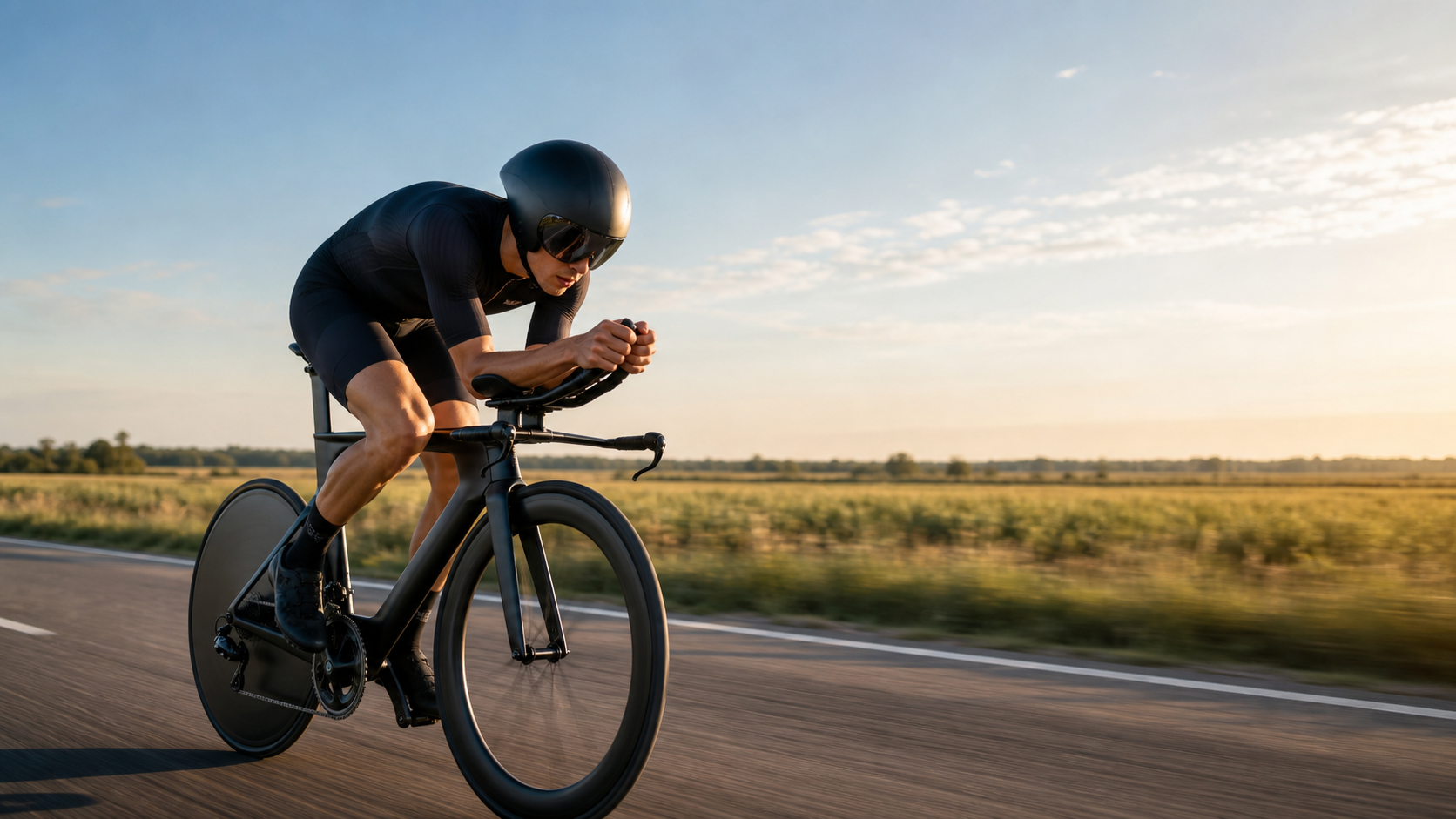
- Aerodynamic position matters: A TT bike has 30–40% lower air resistance than a standard road bike; good TT position training is just as important as power strategy
Conclusion
TT power strategy is not intuition—it’s science. Constant power, careful control in the start segment, and dynamic wind adjustments: the combination of these three principles lets you ride the fastest possible time within your finite energy reserves. Before your next time trial, bring your power meter and a clear segment-by-segment plan, and let the numbers guide you to your best result.
Related Reading
西進武嶺 8000名單車友數據分析 PART1 | 從新手到高手數量/瓦數/推力比/FTP推力比/功率計使用率 大解析 | 公路車 | CTYeh
5 年前
西進武嶺 免費訓練分析服務 Intervals | 練不夠還是練過頭?你哪一種類型選手?AI模型告訴你! | 備戰神器 | 公路車 訓練 | CT Yeh
4 年前
西進武嶺 自製新版AI配速表產生器 x 賽前攻略 抱佛腳! 沒有功率計也可以產生配速表嗎?有什麼其他眉角賽前要注意的呢? | 西進武嶺 / 東進武嶺 KOM 攻略 | 公路車 | CT Yeh
4 年前
CT 喇低賽) 武嶺牽車 才是王道 西進牽車四小時內秘訣 攝手位置 如何判斷 防抽筋小秘訣
7 年前
如果Pogačar騎西進武嶺可以多快?會破2嗎?各種情況深度推估探討 / 公路車 / CT Yeh
2 年前
Fitting訓練兩用功率車 ! Thinkrider ST900 完整實測!/ 坡度升降 / 鄰居測試/ smart bike/公路車/ CT Yeh
2 年前
全台首發!邁金P715踏板功率計!市場價格撼動者再出招 / 功率對比實測 / FAVERO ASSIOMA 可參考! / 公路車 / CT Yeh
1 年前
ThinkRider 智騎 XXPRO 訓練台,高階機種功能 只要 1/3價格!? 實測功率對比、噪音實測 / 公路車 / CT Yeh
1 年前