Nutrition Strategies for Long-Distance Swimming: Differences Between Pool and Open Water Fueling
Do Swimmers Need Nutrition?
“Swimmers don’t sweat, so they don’t need nutrition” is a common misconception. Swimmers indeed don’t feel sweat due to heat dissipation in water, but they actually sweat profusely in water—hourly sweat loss during water training is approximately 0.5–1.5 liters, close to light running levels. Additionally, swimming is a full-body aerobic exercise, with glycogen consumption of around 50–80g per hour (depending on intensity).
For long-distance swimmers (training or racing over 3000m/60 minutes), nutrition strategy directly affects:
- Pace maintenance in the latter half (adequate glycogen vs. premature depletion)
- Electrolyte balance (hyponatremia is a real risk in long-distance open water swimming)
- Recovery speed after training
Pool Nutrition Strategy
Nutrition in a pool environment is relatively easy because there are turn points every 25–50m where you can stop at the wall to refuel.
Timing principles for pool nutrition:
- Training under 60 minutes: Food is generally not needed, but you should consume 200–300ml of water 30 minutes before entering the water.
- 60–90 minute training: Replenish water every 20–30 minutes (about 100–200ml), with optional carbohydrate intake (sports drinks or energy gels).
- Training over 90 minutes: Nutrition must be planned; it’s recommended to replenish water + carbohydrates every 30 minutes (20–30g per 30 minutes).
Practical methods for pool nutrition:
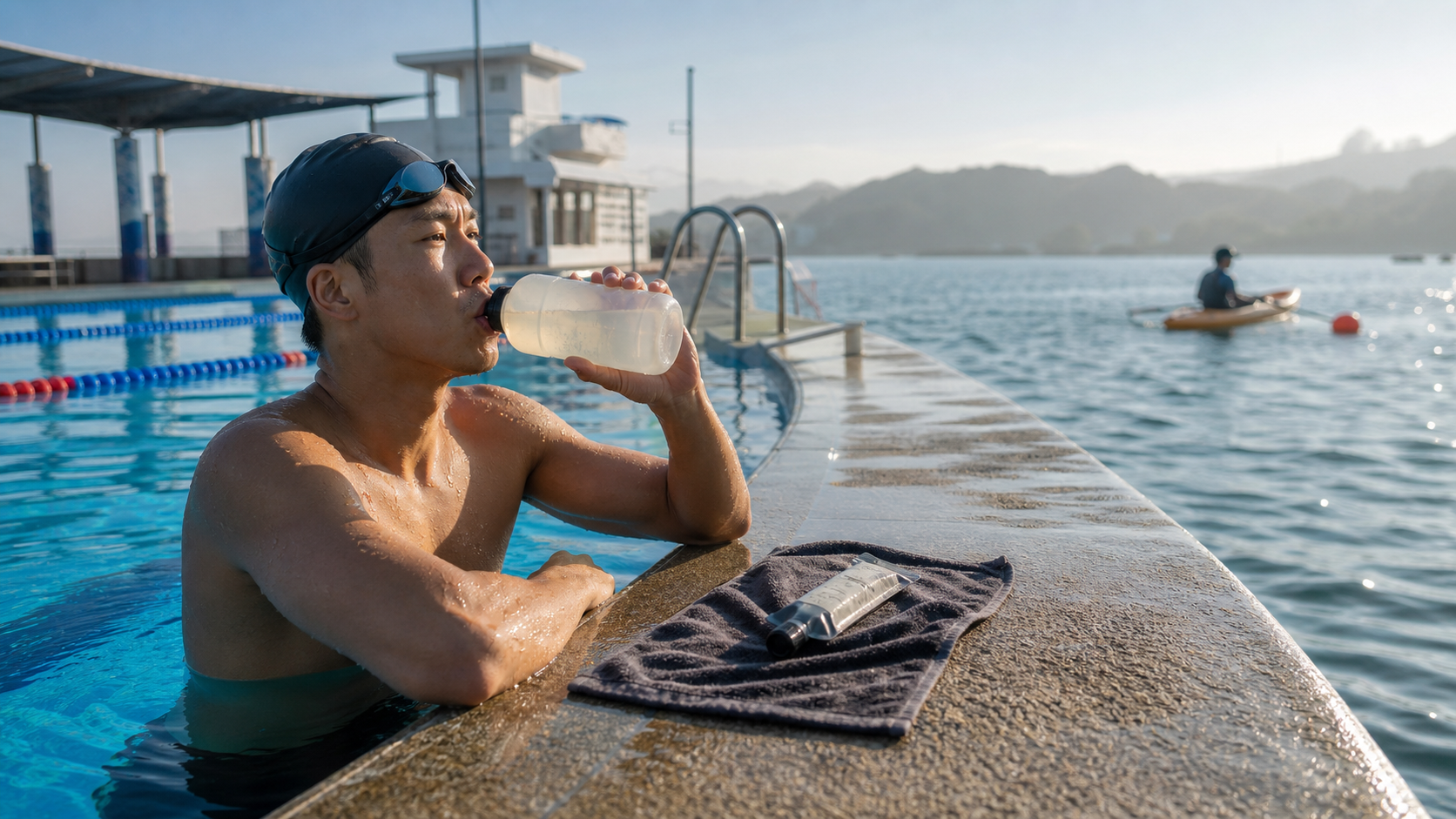
- Place a water bottle (sports drink or salted lemon water) at the pool edge, taking 1–2 sips each time you stop at the wall every few laps.
- Keep energy gels on a towel, consuming one packet every 30–45 minutes (21–25g carbohydrates).
- Avoid large intakes: consuming more than 100ml of fluid at once or large solid foods may cause gastrointestinal discomfort.
Open Water Nutrition Strategy
Open water nutrition is more challenging because opportunities to stop or pull aside for refueling are limited (marathon swimming races typically set up feeding stations every 1–2km).
Comparison of differences between open water and pool nutrition:
| Aspect | Pool | Open Water |
|---|---|---|
| Timing of nutrition | At any turn point against the wall | Only at feeding stations (fixed distances) |
| Water temperature impact | Usually 27–30°C, stable | May be 15–28°C, affects metabolic rate |
| Electrolyte loss | Less (relatively shorter training duration) | More (long duration; cold water may mask thirst) |
| Nutrition methods | Water bottles, energy gels | Feeding poles, hanging water bottles, support boats |
| Risk of choking on water | Low | High (waves, other swimmers) |
| Hyponatremia risk | Extremely low | Moderate (swallowing large amounts of water over long distances) |
Special considerations for open water nutrition:
- Electrolytes are especially important: Open water swimming lasts longer, and you may unconsciously swallow fresh water (lakes/rivers). Blood sodium levels may drop after prolonged swimming, so sodium-containing electrolytes must be replenished.
- Carbohydrate intake frequency: Replenish carbohydrates every 1000–1500m (about 15–25 minutes), even if you don’t feel hungry—stick to a schedule.
- Feeding station technique: In races, feeding stations typically provide water bottles suspended on poles (with bent straws). You don’t need to stop completely—swim over, grab the pole, and pause briefly to drink.
Recommendations for Nutrition Content
| Nutrition Type | Carbohydrate Content | Suitable Scenarios | Notes |
|---|---|---|---|
| Isotonic sports drinks | 6–8g/100ml | 60–90 minutes | Most convenient, first choice for pool |
| Energy gel + water | 20–25g/packet | Over 90 minutes | Must be taken with water to avoid GI discomfort |
| Banana (1/4 piece) | 7g | Long-distance open water | Easy to handle, natural potassium source |
| Electrolyte tablets + water | 0–3g | Over 1 hour (electrolyte replenishment) | Especially suitable for low-sodium risk scenarios |
Nutrition Before and After Swimming
Nutrition isn’t just about during the swim—what you consume before and after is equally important:
Before swimming (1–2 hours):
- Main meals should focus on easily digestible carbohydrates (white rice, bread, bananas), avoiding high-fat and high-fiber foods
- Consume 400–500ml of water to avoid starting the swim dehydrated
After swimming (within 30 minutes):
- Replenish carbohydrates + protein (e.g., milk, yogurt, egg sandwiches)
- Goal: 1–1.2g carbohydrates per kg of body weight + 20–25g protein
- Replenish adequate fluids (for every 1kg of body weight lost after swimming ≈ 1.5 liters of water needed)
Practical Tips
- Confirm nutrition preparation before long-distance training: Before sessions exceeding 60 minutes, make sure water bottles and energy gels are ready at the poolside.
- Practice refueling while swimming: Refueling during open water races requires skill—practice stopping at the wall regularly during pool training so the motion becomes a natural habit.
- Never try new nutrition products for the first time in a race: Your gut’s reaction to new foods is unpredictable; all nutrition strategies should be tested during training first.
- Be proactive with nutrition in cold water: When swimming in cold water (<20°C), thirst sensation is significantly reduced—you must refuel on a schedule (not based on thirst).
Conclusion
Nutrition strategy is “the most overlooked competitive advantage” in long-distance swimming. Pool training’s wall-side hydration and energy gel intake, open water’s electrolyte management and feeding station techniques—these are all skills that need repeated practice before race day. Treat nutrition as part of your training plan, and your long-distance swimming endurance will see a qualitative improvement.
Related Reading
- Open Water Energy Intake: How to Eat During Long-Distance Swim Races
- Long-Distance Swim Race Nutrition: No Refueling for 1500m+ vs. Mid-Race Feeding Strategies in Open Water
- Open Water Nutrition Strategy: Energy Replenishment for Long-Distance Sea Swimming
- Hydration and Electrolytes for Swimmers: Replenishment Strategies for Prolonged Swimming
西進武嶺 免費訓練分析服務 Intervals | 練不夠還是練過頭?你哪一種類型選手?AI模型告訴你! | 備戰神器 | 公路車 訓練 | CT Yeh
4 年前
一日北高前的高裝檢 | 北高 360 | 挑戰11小時的裝備 | 一日雙塔 | 補給
6 年前
FTL 與 SYB 車隊專訪 西進武嶺 實用攻略分享! 2小時 如何練?!你不知道的眉角!新手準備武嶺必看 EP1 | 實力派女車友 | 精華版 | 公路車 | CTYeh
4 年前
靠單車減肥35公斤 心得分享與整理
7 年前
CT暗黑廚房) 車友必備 宇宙無敵鮮蚵湯 幫助訓練恢復 天然食補 好市多 超肥鮮蚵 破PR
7 年前
live) 超越北高 之一日北高12小時 策略
7 年前
Live) 備戰2019彰化經典百K 賽前攻略 (已完賽請看新影片
7 年前
一日北高/長距離團騎 常見問題補充篇 / 組團或跟團的眉角 / 壯車友容易被瘦車友慢性拉爆 / 原來屁股痛可能是這個原因...? / 風場配速法 / 公路車 / CT Yeh
2 年前