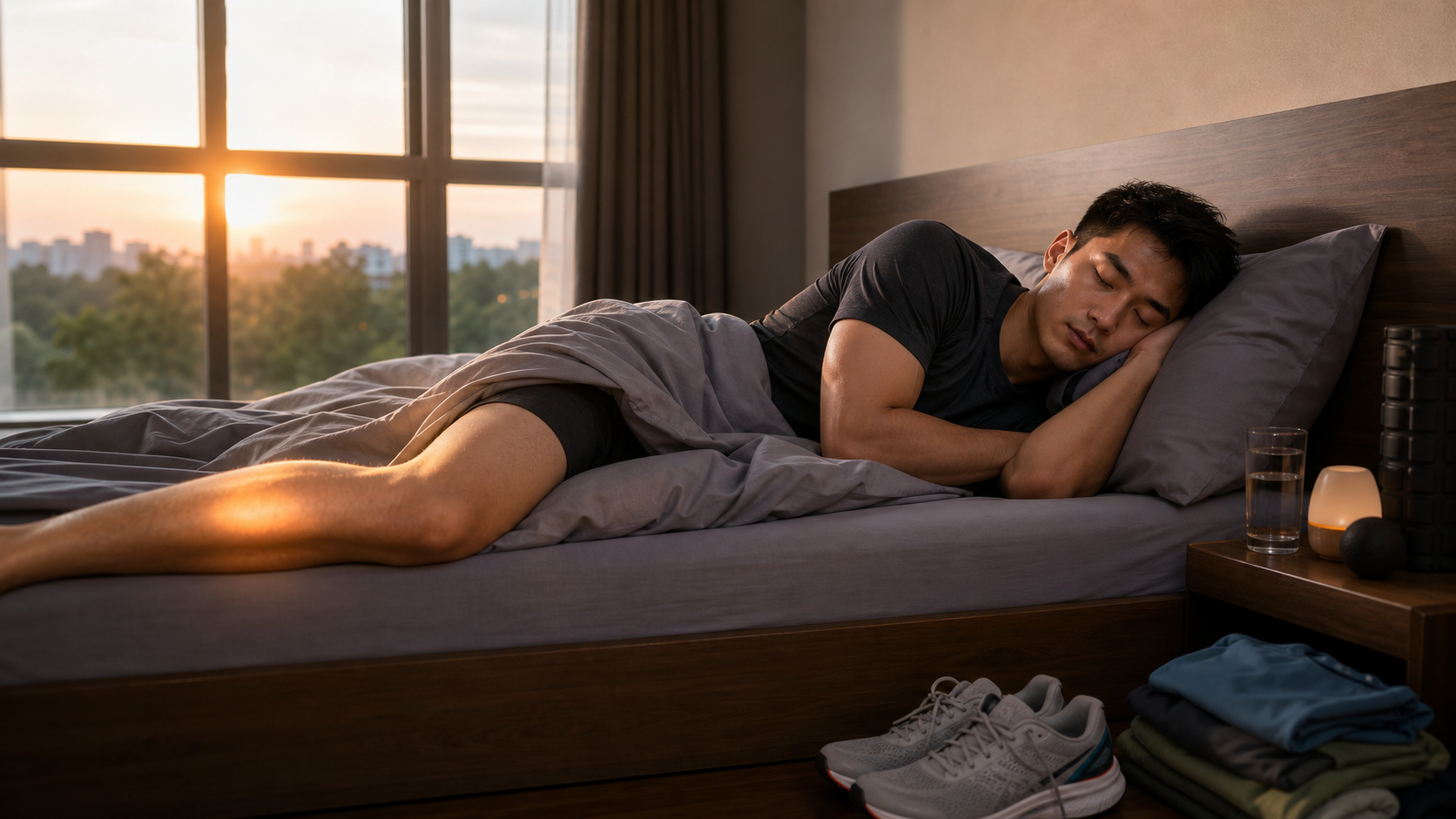
Sleep and Running Recovery: Growth Hormone Secretion and Muscle Repair During Deep Sleep
Introduction
You can have the most perfect training plan, the most precise nutrition strategy, and the most expensive recovery tools—but if you don’t get enough sleep, all of that investment will be severely diminished. Sleep is not merely “passive rest”; it is the body’s most active and complex recovery mechanism, and many runners underestimate its importance.
Research shows that the impact of sleep deprivation on running performance is far greater than most people realize: after just two consecutive nights of sleeping fewer than 6 hours, VO₂max declines, sprint speed drops, running economy worsens, and injury risk rises. In other words, those 8 hours you spend in bed are just as important as the training you do on the track.
Sleep Cycles and Recovery Mechanisms
Human sleep consists of multiple 90-minute cycles, each containing the following stages:
- NREM Stages 1–2 (Light Sleep): Transition phase; body temperature drops, heart rate slows
- NREM Stage 3 (Deep Sleep/Slow-Wave Sleep): The core stage of repair
- REM Sleep: Dream phase; nervous system reorganization and psychological recovery
The Remarkable Role of Deep Sleep (Slow-Wave Sleep)
Slow-Wave Sleep (SWS) is the most critical sleep stage for runner recovery. During this stage:
Growth Hormone (HGH) is secreted in large amounts: Research shows that 70–80% of the day’s total growth hormone secretion is concentrated in deep sleep, particularly in the first 90-minute cycle after falling asleep. Growth hormone directly stimulates muscle protein synthesis, promotes fat breakdown (providing energy for repair), and accelerates connective tissue repair.
Muscle glycogen resynthesis: During deep sleep, muscles continue absorbing glucose, replenishing the energy stores depleted by training.
Immune system activation: Cytokines are released during deep sleep, regulating post-exercise inflammatory responses and promoting tissue repair.
REM Sleep and Neuromuscular Connections
REM sleep is crucial for the consolidation of neuromuscular patterns. Research shows that after learning new running techniques or movement patterns, adequate REM sleep significantly improves the fluidity and efficiency of performing the same movements the next day.
Quantified Impact of Sleep Deprivation on Running
| Sleep Duration | Impact on Running Performance | Injury Risk | Subjective Fatigue |
|---|---|---|---|
| 9+ hours | Optimal | Lowest | Lowest |
| 7–8 hours | Normal | Normal | Normal |
| 6–7 hours | Slightly reduced (approx. 3–5%) | Slightly elevated | Increased |
| 5–6 hours | Markedly reduced (5–10%) | Elevated by 50%+ | Significantly increased |
| <5 hours | Severely impaired | Elevated by 120%+ | Extreme fatigue |
A 2011 Stanford University study extended basketball players’ nightly sleep to 10 hours, resulting in a 9% improvement in sprint speed and a 9.2% improvement in shooting accuracy. Although this was a study on basketball players, similar benefits exist for endurance athletes.
Factors Affecting Runner Sleep Quality
Factors That Promote Good Sleep
- Consistent bedtime: The body’s internal clock (circadian rhythm) thrives on a stable routine
- Moderate training volume: Moderate exercise significantly improves sleep quality, but overtraining can actually cause insomnia
- Timing of high-intensity training: Complete high-intensity sessions before 5 p.m.; otherwise, elevated cortisol will delay sleep onset
Common Issues That Harm Runner Sleep
- Late-evening high-intensity training: Core body temperature and adrenaline remain elevated for 2–3 hours after exercise, making it harder to fall asleep
- Alcohol consumption after training: Although alcohol helps you fall asleep, it severely suppresses deep sleep and REM sleep
- Caffeine intake: Caffeine has a half-life of approximately 5–6 hours; caffeine consumed after 2 p.m. is still half-present in your body at midnight
- Excessive use of digital devices: Blue light suppresses melatonin secretion and delays sleep onset
Practical Strategies for Improving Runner Sleep Quality
Environment setup:
- Keep the room temperature at 18–20°C (a drop in core body temperature is the signal that initiates deep sleep)
- Use blackout curtains to maintain a dark environment
- Use earplugs or a white noise machine to reduce environmental disturbances
Behavioral habits:
- Establish a “pre-sleep ritual”: take a hot shower (1 hour before bed—the subsequent drop in body temperature aids sleep onset), light reading, deep breathing
- Stop using screens 1 hour before bed, or use blue-light-blocking glasses
- Avoid high-intensity activity within 4 hours after training
Nutritional support:
- Magnesium: Taiwanese runners are commonly deficient in magnesium; supplementing with 300–400 mg of magnesium citrate before bed can help relax muscles and promote sleep onset
- Tryptophan: Found abundantly in milk, bananas, turkey, and other foods; it is a precursor to melatonin
- Avoid high-sugar foods before bed: Blood sugar fluctuations can trigger nighttime awakenings
Conclusion
In the investment portfolio of running training, sleep offers the highest rate of return. It costs nothing and requires no special equipment, yet it is the central venue for growth hormone secretion, muscle repair, and nervous system recovery.
If you currently sleep 6 hours per night, try increasing it to 7.5–8 hours. After maintaining this for 4 weeks, you will likely see more significant performance improvements than from any training adjustment. Treat sleep as your most important workout—and then execute it well.
Related Reading
- Sleep and Road Running Recovery: The Scientific Impact of Sleep Quality on Repair
- Deep Sleep Optimization for Runners: The Relationship Between Slow-Wave Sleep and Muscle Repair
- The Science of Sleep for Road Runners: The Connection Between Deep Sleep and Training Adaptation
- The Science of Sleep in Road Running: How Deep Sleep Accelerates Muscle Synthesis and Motor Memory Consolidation
CT暗黑廚房) 車友必備 宇宙無敵鮮蚵湯 幫助訓練恢復 天然食補 好市多 超肥鮮蚵 破PR
7 年前
西進武嶺 免費訓練分析服務 Intervals | 練不夠還是練過頭?你哪一種類型選手?AI模型告訴你! | 備戰神器 | 公路車 訓練 | CT Yeh
4 年前
摔車後補裝備: 好市多新款單車安全帽& Specialized Romin 北高整路屁股都不痛的坐墊 | 一千元居然有MIPS | CT Yeh | 公路車
4 年前
iPhone 13 Pro 電影級 VLOG 實拍測試!優缺點 原理分析! 夜間效果對決 GoPro10!蘋果沒有說的超強錄影體驗!? | CT Yeh
4 年前
iPhone 12 Pro 夜間騎車動態錄影 效果屌打 GoPro Hero 9 | 公路車 團練
5 年前
#公路車 #Fitting 靠人工智慧APP 幫你調整單車
6 年前
[教學] Premiere 影片 手震 修正 教學 防抖 單眼 影像 GoPro 穩定 Video Stabilization
8 年前
一日北高 11小時 賽後心得分享篇 | TWB北高360 | 一日雙城 | 單車 | 公路車
6 年前