Electric-Assist Bicycle (e-bike) Round-Island Tour: Charging Station Distribution and Mileage Planning
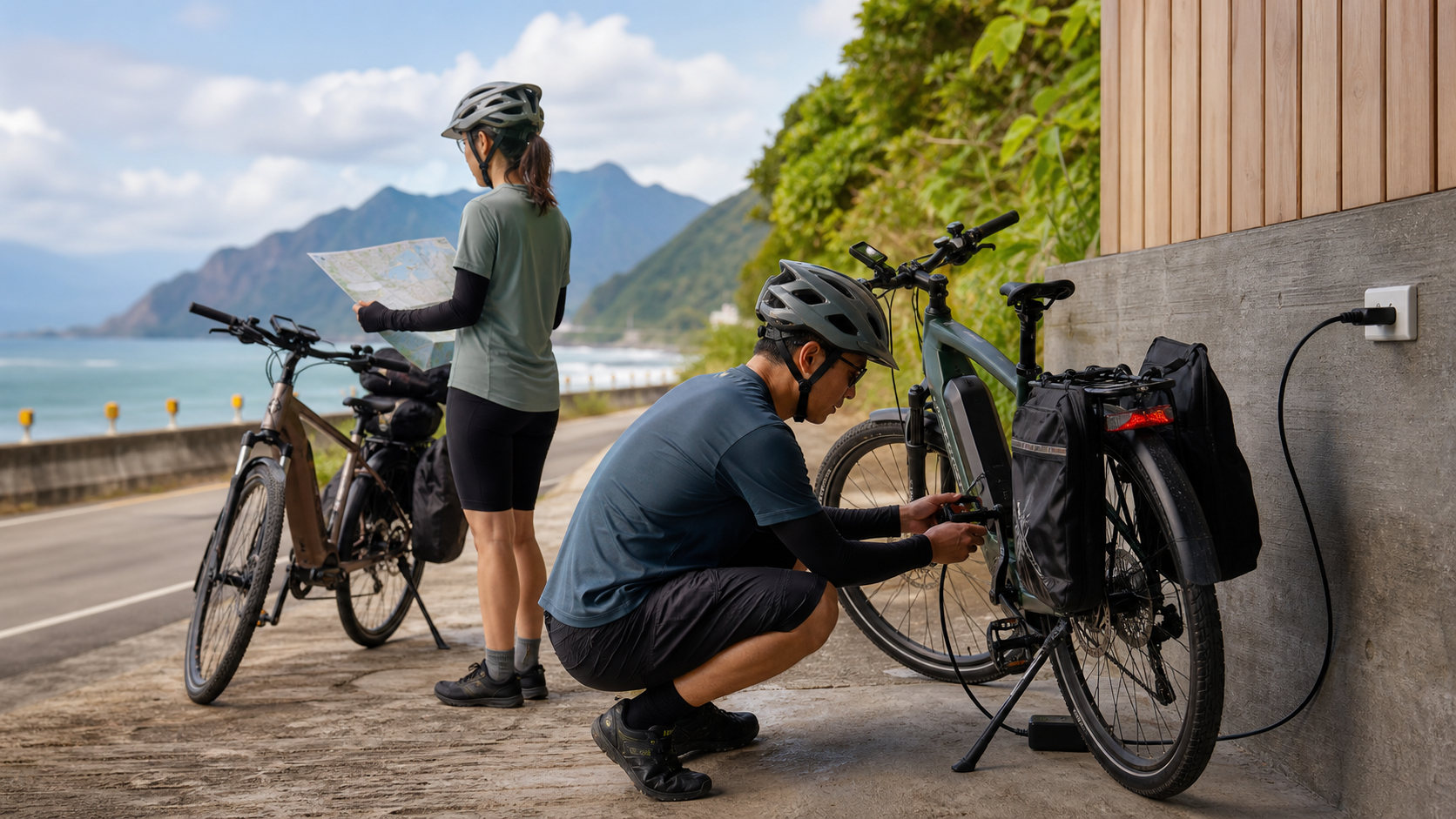
E-bike Around-the-Island Tour: Charging Station Distribution and Mileage Planning
Introduction
The popularity of e-bikes (electric-assist bicycles) has significantly lowered the barrier to cycling around Taiwan. What once required three months of training to build up the physical fitness for, can now be completed in 10 to 12 days even by people over 50 who haven’t exercised in a long time, thanks to assist power.
But an e-bike around-the-island tour has one fundamental difference from a regular bicycle tour: the battery is your lifeline. An e-bike without power is heavier than a regular bicycle, and riding it under your own strength alone would be extremely painful. Therefore, the core strategy for an e-bike around-the-island tour is “charging planning takes priority over mileage planning.”
Basic Understanding of E-bike Performance
| Battery Spec | Rated Range | Actual Mountain Range | Charging Time |
|---|---|---|---|
| 250Wh | Approx. 60–80 km | Approx. 40–55 km | Approx. 2.5–3.5 hours |
| 400Wh | Approx. 80–110 km | Approx. 60–80 km | Approx. 3.5–5 hours |
| 500Wh | Approx. 100–130 km | Approx. 75–95 km | Approx. 4–6 hours |
| 630Wh | Approx. 130–160 km | Approx. 90–120 km | Approx. 5–7 hours |
Mountain range refers to sections with climbs exceeding 500 meters (such as Shouka and the rolling sections of the Suhua Highway), where actual consumption is significantly higher than the rated flat-terrain figures.
Current E-bike Charging Resources in Taiwan
Taiwan’s e-bike charging environment has improved significantly over the past 3 years, but advance planning is still necessary:
Types of Places Where You Can Charge
- Cycling-friendly accommodations: Many lodgings certified as “cyclist-friendly stays” already have e-bike charging outlets (either 220V or 110V standard sockets)
- Convenience stores (7-Eleven/FamilyMart): Some locations offer external outlets (ask the staff), and it’s polite to make a small purchase or leave a tip as thanks
- E-bike brand stores: Service centers of brands like Giant and Merida across the country can charge your bike
- Cycling rest stops: Some of the “Cycling Tourism Service Stations” set up by the Tourism Administration offer charging services
- Temples and community centers: Taiwan’s temple culture is welcoming—asking to borrow an outlet has a fairly high success rate
Things to Confirm Before Charging
- Bring the original charger (e-bike chargers are not universal and cannot be purchased as replacements on the road)
- Confirm the plug type (Taiwan’s standard is 110V)
- Prepare an extension cord (about 5 meters, so you can still charge even if the outlet isn’t in an ideal location)
Mileage Planning Principles for an E-bike Around-the-Island Tour
Core Principle: Daily Mileage Should Not Exceed 80% of the Battery’s Safe Capacity
Don’t ride until the battery is completely drained before charging. Instead, maintain the habit of “setting off at 80–90% charge” and add a 30-to-60-minute top-up charge mid-day (during lunch).
Suggested Daily Planning
- Western Taiwan (Taipei to Kaohsiung): Mostly flat, plan 75 to 90 km per day with low charging demand
- Southern East Coast (Kaohsiung to Taitung): The South Link mountain roads consume a lot of power; keep daily mileage under 80 km and confirm charging points before and after Shouka
- Huatung Valley: Relatively flat, 70 to 90 km per day, with abundant charging points (Taitung City, Hualien City)
- Suhua Highway: Severe elevation changes and few charging points (especially scarce between Heping and Su’ao); it is strongly recommended to depart with a full battery and look for a top-up opportunity in Heping or Hanben along the way
Coping Strategies for the Suhua Highway Charging Crisis
Battery management on the Suhua Highway is the biggest challenge of an e-bike around-the-island tour. The route from Hualien City to Su’ao is about 105 km with multiple climbs; with a 500Wh battery, it may not be possible to complete it on a single charge:
Suggested Plan:
- Ensure the battery is at 100% before departing from Hualien City
- At Heping (about 40 km in), ask a local convenience store or gas station if you can charge briefly for 30 minutes
- Use “Eco/Power-Saving Mode” for battery management through the Suhua Highway, saving assist power for the critical climbs
- If the battery truly runs low, consider hitching a ride before one of the tunnels on the Suhua Improvement Project to get through the longest stretch
Cost Differences: E-bike vs. Regular Bicycle Around-the-Island Tour
| Cost Item | Regular Bicycle Around-the-Island | E-bike Around-the-Island |
|---|---|---|
| The bike itself | No extra cost | E-bike rental approx. NT$600–1,200 per day (if you don’t own one) |
| Electricity | None | Approx. NT$2–5 per charge (usually included in accommodation rates) |
| Repair costs | Standard | Slightly higher (e-bike drivetrain repairs are more expensive) |
| Physical training cost | High (requires 3+ months of training) | Low (can be shortened to 1 month of training) |
Conclusion
An e-bike around-the-island tour is not “cheating”—it’s a tool that gives more people the chance to complete this journey. That 60-year-old retiree, that rider with a knee injury, that adult child bringing along their elderly parents—e-bikes turn their around-the-island dream from “maybe someday” into “let’s go this month.” What matters is every pedal stroke you take, whether or not it has assist power—it’s a real around-the-island tour.
Related Reading
- E-bike Range Optimization Guide: Making Every Kilowatt-Hour Go Further
- Energy Refueling Plan for Cycling Around Taiwan: Precise Carbohydrate Calculations and Practical Strategies for 150 km Per Day
- Cycling Around Taiwan: 9-Day Itinerary Planning and Supply Stops
- Electric-Assist Bicycles (E-bikes): Who Are They Suitable For
金門 ! 我騎過最棒的離島了 / 最後可以騎車上金門大橋的機會!?/ 公路車 / CT Yeh
1 年前
單車 一日北高 ( 雙城 ) 肥宅雙人瘋狂行 紀錄片 REACTO
10 年前
半日 小台灣 極限單車路線挑戰實錄
7 年前
大家都在開箱的...單車用藍芽對講耳機真的有幫助嗎? SENA BiKom 20 長距離旅遊 & 海鷗繞圈賽 實際體驗心得 / 公路車 / CT Yeh
9 個月前
靠單車減肥35公斤 心得分享與整理
7 年前
元宇宙運動 ! RouvyAR 虛擬實境約騎! 台灣路段開箱 帶你日月潭環潭一圈 | 團騎競賽參加教學 | 常見小問題整理 三人共享一年不用一千 | 公路車 | 訓練台 | CTYeh
5 年前
高雄綠園道鐵路自行車道 / 外地人能輕鬆駕馭 還是整路崩潰? / 2025 全線開通 春節實地探索一次!(附GPS連結)/ 公路車 / CT Yeh
1 年前
2023自行車展!與環台賽選手一同表演賽 / 全自動AI Fitting?/ TIME新車發表/神秘充電桌等 精華分享 VLOG | CT Yeh | 公路車
3 年前