Pre-Race Anxiety Management: Cognitive Restructuring Methods for Sleepless Nights Before Competition
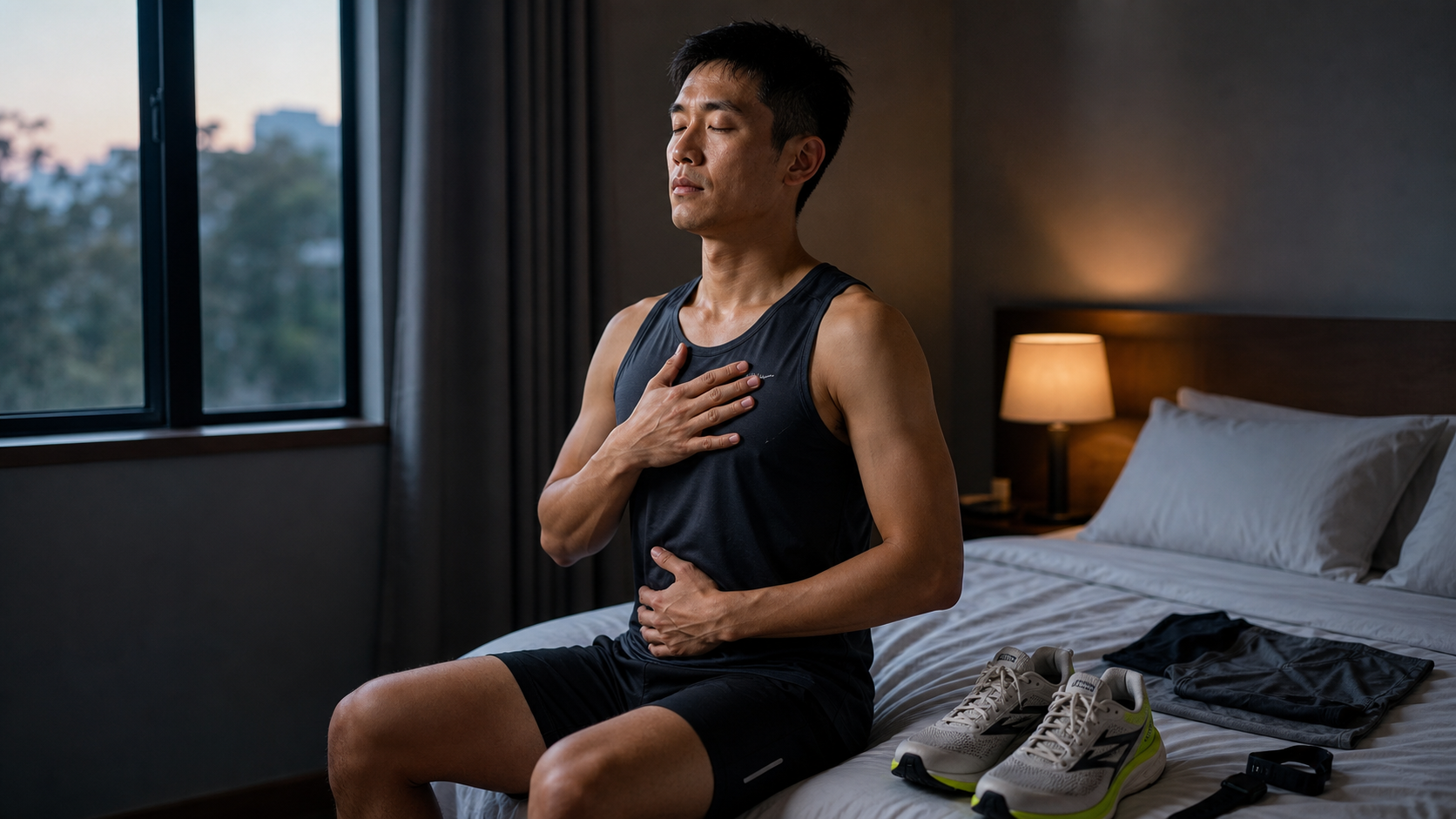
Pre-Race Anxiety Management: Cognitive Restructuring for the Night Before a Race
Introduction
You’ve trained for months, your fitness is in peak condition, and your nutrition strategy is dialed in—but the night before the race, you’re lying in bed staring at the ceiling, your mind racing: “Is my pace good enough? What if it’s too hot? What if I cramp up mid-race?”
This kind of pre-race anxiety is not only normal, but to some extent necessary—it shows you care about the race. The problem is that when anxiety crosses a certain threshold, it shifts from “beneficial arousal” to “harmful interference.” Sports psychology calls this the “inverted-U curve of arousal and performance”: moderate nervousness can enhance performance, but excessive anxiety undermines it.
Understanding the Nature of Pre-Race Anxiety
The core tenet of cognitive behavioral therapy (CBT) is: what distresses us is not the event itself, but our interpretation of the event.
Behind pre-race anxiety, several distorted thinking patterns are typically hidden:
| Type of Cognitive Distortion | Common Automatic Thought | Objective Reality |
|---|---|---|
| Catastrophizing | “I’m definitely going to blow up” | This is only one possibility, not a certainty |
| Mind Reading | “Everyone is watching and judging me” | Most runners only care about their own race |
| All-or-Nothing | “Not hitting a PB means failure” | Simply finishing the race has value in itself |
| Overexpectation | “I must execute every single detail perfectly” | No race is perfect |
| Illusion of Control | “I should be able to control all variables” | Weather and course conditions are inherently uncontrollable |
Three Core Cognitive Restructuring Techniques
1. Socratic Questioning
When anxious thoughts arise, don’t try to suppress them—gently question them instead:
Steps:
- Write down the thought that’s making you anxious (e.g., “I’m definitely going to run poorly tomorrow”)
- Ask yourself: “What evidence supports this thought?”
- Then ask: “What evidence contradicts this thought?”
- Finally: “What is a more balanced way to interpret this?”
Practical Exercise:
- Original thought: “I haven’t trained enough; I’ll fall apart tomorrow”
- Contradicting evidence: “I completed a 16-week training plan and ran up to 32 km”
- Balanced interpretation: “My preparation is sufficient, and I have the ability to finish this race”
2. Anxiety Reappraisal
Research by Harvard Business School scholar Alison Wood Brooks found that telling yourself “I’m excited” is more effective than trying to calm down—because anxiety and excitement share similar physiological states (elevated heart rate, adrenaline surge), differing only in subjective interpretation.
How to do it:
- When you notice the physical signs of anxiety, deliberately tell yourself: “What I’m feeling is excitement; my body is preparing for tomorrow”
- Speak to yourself in the third person: “[Your name], you’re ready, and this feeling is normal”
3. Worry Time Scheduling
Trying to “not think about” something before bed often backfires (the “don’t think about a pink elephant” paradox). A better approach is to give your worries a fixed time and space:
- The afternoon before the race, set aside 20 minutes of “worry time”
- Write down all your worries on paper, and for each one, write out a coping plan
- When worry time ends, tell yourself: “I’ve already dealt with these; I don’t need to think about them now”
- If worries resurface at night, remind yourself: “I already handled this in the afternoon”
Practical Pre-Sleep Tips: A 10-Step Pre-Race Eve Ritual
- By 7:00 PM: Complete your final light stretching session and confirm your gear is packed
- 7:00 PM: Do 20 minutes of “worry time”—write down all concerns and address each one
- 8:00 PM: Have a light dinner, avoiding high-sugar foods and caffeine
- 9:00 PM: Do 10 minutes of relaxation breathing (4-second inhale, 7-second hold, 8-second exhale)
- 9:30 PM: Read something light or listen to soothing music
- Before bed: Do a 5-minute body scan meditation, relaxing each part from your toes to the top of your head
- If you can’t sleep: Get up and sit, don’t lie there feeling anxious—do 10 minutes of diaphragmatic breathing before returning to bed
- Remember: Sleep quality the night before the race has far less impact on performance than the sleep from the two nights prior
- Accept insomnia: Tell yourself, “Even if I don’t sleep well tonight, I can still finish the race” (and this is true)
- Final thought: Mentally replay your best run from training, and fall asleep with that image in mind
Conclusion
Pre-race anxiety is not your enemy—it’s proof that you care about this race. The key isn’t to eliminate anxiety, but to learn to coexist with it, turning it into a driving force rather than an obstacle.
Cognitive restructuring isn’t the hollow comfort of telling yourself “don’t be nervous.” It’s about consciously adjusting your thinking patterns so your brain can still function clearly under pressure. Practice these techniques just as you practice your running skills—it takes time, but once mastered, they’ll become one of the most valuable tools in your race-day toolkit.
Related Reading
- Race Anxiety in Running: Psychological Coping for Pre-Race Insomnia and GI Discomfort
- Race Anxiety Management: The Psychological Shift from Fear to Focus
- The Impact of Pre-Sleep Anxiety on Athletes’ Sleep Quality: A Study on Cognitive Arousal
- Race Anxiety Management: Breathing and Relaxation Techniques Before the Start
西進武嶺 免費訓練分析服務 Intervals | 練不夠還是練過頭?你哪一種類型選手?AI模型告訴你! | 備戰神器 | 公路車 訓練 | CT Yeh
4 年前
[教學] Premiere 影片 手震 修正 教學 防抖 單眼 影像 GoPro 穩定 Video Stabilization
8 年前
西進武嶺 自製新版AI配速表產生器 x 賽前攻略 抱佛腳! 沒有功率計也可以產生配速表嗎?有什麼其他眉角賽前要注意的呢? | 西進武嶺 / 東進武嶺 KOM 攻略 | 公路車 | CT Yeh
4 年前
FTL 與 SYB 車隊專訪 西進武嶺 實用攻略分享! 2小時 如何練?!你不知道的眉角!新手準備武嶺必看 EP1 | 實力派女車友 | 精華版 | 公路車 | CTYeh
4 年前
CT Talk) 數據面窺看 武嶺大神們 平時的備戰 共通點 (娛樂性質XD)
7 年前
CT 喇低賽) 武嶺牽車 才是王道 西進牽車四小時內秘訣 攝手位置 如何判斷 防抽筋小秘訣
7 年前
CT 喇低賽) 單車 比賽總是沒照片? 攝影師的觀點大公開 姿勢就是力量! 請加速1.25倍收看
7 年前
一日北高前的高裝檢 | 北高 360 | 挑戰11小時的裝備 | 一日雙塔 | 補給
6 年前