Introduction
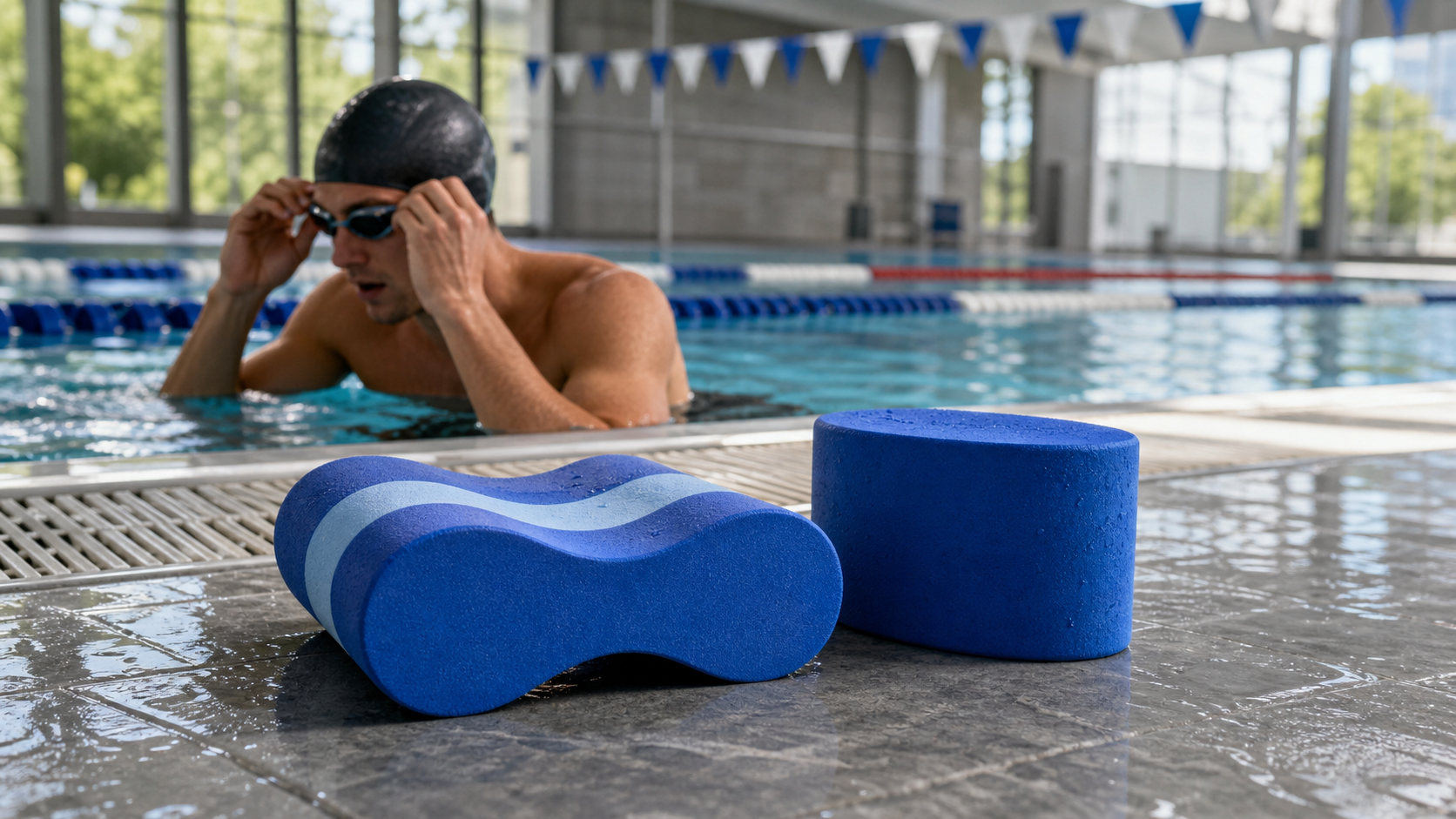
The pull buoy is a core tool for pull training. By placing the buoy between your legs, your legs gain buoyant support, allowing you to focus entirely on the efficiency and power of your stroke. Despite its simple appearance, the shape and size of this training tool deliver completely different training experiences for swimmers of different body types.
Core Comparison of the Two Types
| Comparison Item | Figure-8 Buoy | Cylinder Buoy |
|---|---|---|
| Shape | Figure-8 with a narrowed waist | Long cylindrical shape |
| Thigh grip stability | ★★★★★ Excellent | ★★★☆☆ Moderate |
| Hip/waist rotation space | More restricted | More freedom |
| Suitable body types | Adjustable for all body types | More stable for those with thicker thighs |
| Standard sizes | Mostly fixed figure-8 shape | Available in long and short variants |
| Suitable training intensity | Intermediate to advanced | Beginner to intermediate |
| Taiwan market price | NT$200–700 | NT$150–400 |
Figure-8 Buoy
Design Principle
The waist design of the figure-8 buoy allows it to naturally sit in the mid-thigh area (approximately 10–15 cm above the knee) without slipping, and without requiring excessive squeezing. Swimmers simply need to let their thighs gently hold the narrowest middle section.
Advantages
- High stability: The waist design effectively prevents the buoy from sliding forward or backward during swimming
- Even buoyancy distribution: The two bulbs provide buoyancy at both ends, improving horizontal body alignment
- Frees up attention: No need to constantly focus on gripping, allowing greater focus on stroke technique
- Widely available across brands: Most brands on the market (Speedo, Arena, TYR, Finis) offer this style
Things to Note
- Squeezing the buoy too hard creates unnecessary hip tension and reduces the range of body roll
- Some figure-8 buoys come in a fixed size, making it difficult for swimmers with very thin or very thick thighs to grip them stably
Cylinder Buoy
Design Principle
Cylinder buoys are typically longer (25–30 cm), with the grip area extending from the top of the thigh to above the knee. The larger contact surface makes them especially suitable for swimmers with thicker thighs.
Advantages
- Suitable for those with larger thigh circumference: The larger contact area allows for easy gripping without applying force
- More freedom for body roll: The circular cross-section permits a greater range of hip rotation, closer to actual swimming movement
- Single-leg grip training: Some advanced drills require gripping the cylinder buoy with one leg, increasing core challenge
Things to Note
- For swimmers with slender thighs, the cylinder buoy is harder to grip stably and may keep slipping off, interrupting the session
- Buoyancy is slightly lower than the figure-8 buoy, so the hips may sink more noticeably
Size Selection Principles
Pull buoys generally come in a standard size (suitable for adults 155–185 cm tall) and an oversized version, but in practice, thigh circumference is the main factor to consider:
- Thigh circumference under 45 cm: Standard figure-8 buoy; try it before buying to confirm stability
- Thigh circumference 45–55 cm: Either standard figure-8 or cylinder works, depending on personal preference
- Thigh circumference above 55 cm: Cylinder buoy is more stable, or choose an oversized figure-8
- Junior swimmers (under 14): Choose children’s/junior sizes to avoid excessive buoyancy from adult models causing the hips to float too high
Proper Pull Buoy Technique
When using a pull buoy, the following points ensure training effectiveness:
- Grip position in the mid-thigh: Avoid placing it on the lower leg, which creates an unnatural knee bend angle
- Light grip principle: Only grip enough to keep the buoy from falling; do not squeeze hard, to avoid hip tightness
- Maintain a horizontal body line: The buoyancy should keep the hips level with the shoulders
- Maintain normal body roll: Do not limit your rotation range out of fear that the buoy will slip
Combined Training with a Pull Buoy and Paddles
Pull buoy + hand paddles is the most classic upper-body training combination in swimming:
- The buoy provides leg buoyancy: Allowing swimmers to ignore the legs and fully feel the resistance and rhythm of the upper-body pull
- Paddles increase the pulling surface area: Strengthening pulling power and technical awareness
- Training intensity: Swimming the same distance is typically 10–15% slower than without equipment, but upper-body training intensity increases significantly
Conclusion
The figure-8 buoy is the first choice for most swimmers, offering excellent stability and intuitive use; the cylinder buoy shows unique advantages for specific body types or advanced technical training. Buying advice: if it’s your first purchase, choose a standard figure-8 buoy from a trusted brand (such as Speedo or Arena) to ensure sufficient material density and resistance to deformation. If possible, try it in-store to confirm your thighs can grip it stably without excessive force—that will be the best choice for you.
Related Reading
- Kickboard Buying Guide: In-Depth Comparison of Training Effects Between Standard and Streamline Kickboards
- When to Use a Pull Buoy: Core Stability and Stroke Decomposition in Swim Training
- Using Buoys in Open Water Swimming: Safety Aids and Competition Rules
- Swim Pull Buoy: In-Depth Analysis of the Best Aid for Isolated Upper-Body Training
鉅齒紋輪組!? ControlTech MEG-T50 EVO 碳纖維幅條輪組/ 功率對比實驗 / 公路車 / CT Yeh
2 年前
Nepest NOVA 碳條輪組:輕量、空力、舒適一次滿足!/ 公路車 / CT Yeh
7 個月前
類空拍神器 Feiyu Pocket 2s (有優惠連結)三軸穩定 運動攝影機 開箱!比GoPro 還強的滑順視角!三小時長時間錄影 行車記錄器 | 環花東365實測 | 公路車 CT Yeh
4 年前
一日北高 實用 單車手機架!Bone蹦克磁吸單車手機綁 //環島/室內訓練 / 導航的APP推薦 / 日本島波海道取景 / 公路車 / CT Yeh
2 年前
Fitting訓練兩用功率車 ! Thinkrider ST900 完整實測!/ 坡度升降 / 鄰居測試/ smart bike/公路車/ CT Yeh
2 年前
碟煞公路車 銑面器 !? 原來銑完差這麼多! 降低蹭碟機率! | TIME 公路車 保養小記錄 | CT Yeh
3 年前
訓練台體驗) 2019台北自行車展 三大家 訓練台體驗 Tacx Neo Flux 2 Xepdo Apx Wahoo Kickr
7 年前
CT 喇低賽) 武嶺牽車 才是王道 西進牽車四小時內秘訣 攝手位置 如何判斷 防抽筋小秘訣
7 年前