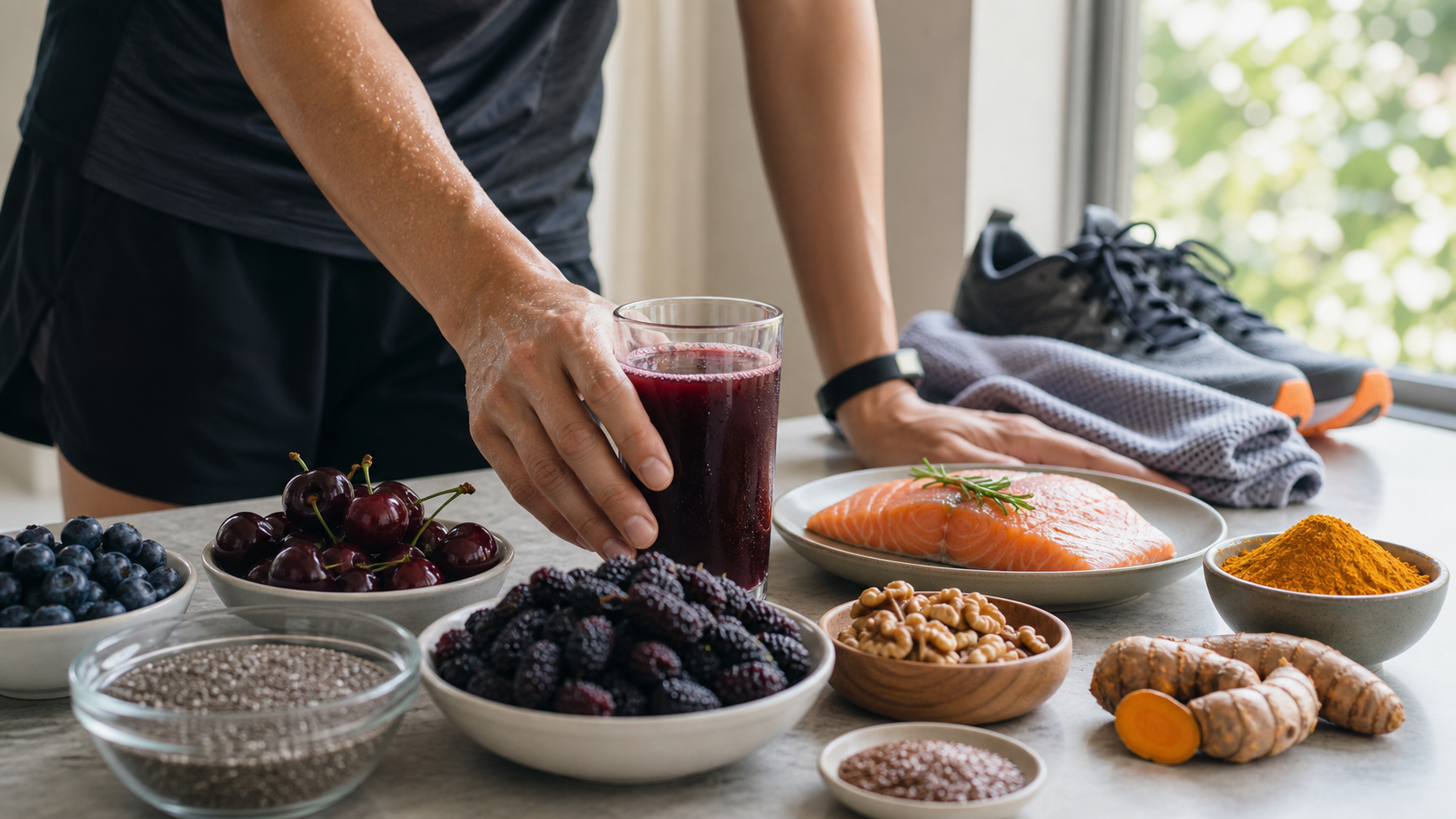
Runner’s Antioxidant Diet: The Recovery Benefits of Anthocyanins, Turmeric, and Omega-3
Introduction
Running is a healthy exercise, but it is also a form of oxidative stress. After every high-intensity run, the body generates a large amount of reactive oxygen species (ROS). These free radicals attack the cell membranes and DNA of muscle cells, serving as the molecular-level root cause of muscle damage, inflammatory responses, and fatigue.
Moderate oxidative stress is a necessary stimulus for training adaptation, but excessive free radicals can worsen damage, delay recovery, and even impair the immune system over the long term. The goal of an antioxidant diet is to eliminate excess free radicals and accelerate recovery without hindering training adaptation.
This article focuses on three of the most well-researched natural antioxidant and anti-inflammatory components: anthocyanins, curcumin, and omega-3 fatty acids.
Anthocyanins: Potent Antioxidants from Natural Fruits
What Are Anthocyanins
Anthocyanins are blue-purple pigments in plants that give blueberries, cherries, purple grapes, mulberries, and other foods their vivid colors. They are among the most extensively studied plant compounds, with powerful antioxidant and anti-inflammatory activity.
Specific Research Evidence for Running Recovery
Cherry juice research: Multiple randomized controlled trials using tart cherry juice (rich in anthocyanins) found that consuming 400 to 600 ml daily for 7 consecutive days can:
- Reduce the rise in muscle damage markers (creatine kinase) after a marathon by up to 20%
- Lower DOMS pain scores by approximately 15 to 25%
- Shorten muscle strength recovery time by about 2 to 4 hours
Blueberry research: Studies from Australia show that consuming 250 g of blueberries 1 to 2 hours before exercise and immediately after exercise can significantly reduce oxidative stress markers 24 hours post-exercise.
Local Taiwanese Sources of Anthocyanins
| Food | Anthocyanin Content | Recommended Intake | Availability |
|---|---|---|---|
| Blueberries | High | 100–150 g daily | Frozen blueberries available year-round in supermarkets |
| Mulberries | High | 80–100 g daily | Abundant in summer season |
| Purple grapes | Medium-high | 150–200 g daily | Available year-round |
| Taiwanese strawberries | Medium | 150–200 g daily | Winter-spring season |
| Black soybeans | Medium | 2–3 times per week | Available year-round |
Curcumin: Nature’s Anti-Inflammatory Staple
Curcumin’s Anti-Inflammatory Mechanism
Curcumin is the active compound in turmeric root. It inhibits multiple inflammatory signaling pathways, including NF-κB (nuclear factor kappa-B) and COX-2 (cyclooxygenase-2), both of which are core regulators of the acute inflammatory response after exercise.
Applied Research on Running Recovery
Research shows that taking 400 to 1000 mg of curcumin supplements daily (for 5 to 7 consecutive days) can:
- Reduce the rise in inflammatory markers (IL-6, TNF-α) after intense exercise
- Improve DOMS scores and subjective discomfort
- Accelerate the recovery of functional muscle strength
Bioavailability is key: The bioavailability of curcumin in natural turmeric is extremely low (approximately 1 to 3%). The following methods can significantly enhance absorption:
- Pair with black pepper (piperine): Can increase curcumin absorption by up to 2000%
- Pair with fat (oils): Curcumin is fat-soluble; pairing it with coconut oil or olive oil enhances absorption
- Use liposomal curcumin supplements: The supplement form with the highest bioavailability
Turmeric Intake Recommendations for Taiwan
- Add turmeric powder to cooking (curry, scrambled eggs, turmeric soy milk)
- Make turmeric lattes: turmeric powder + black pepper + coconut milk, consumed after training
- Curcumin supplements (500–1000 mg/day) may be considered during training cycles, but consult a physician before long-term high-dose intake
Omega-3 Fatty Acids: Guardians of the Cell Membrane
Why Runners Need Omega-3
Omega-3 fatty acids (particularly EPA and DHA) are important components of cell membranes and are precursors for synthesizing “resolvins” and “protectins.” These substances actively “resolve” inflammatory responses rather than merely suppressing them, representing more comprehensive anti-inflammatory protection.
Recovery Benefits Shown in Research
- Reduced DOMS: 3–4 g of EPA+DHA daily for 8 consecutive weeks significantly reduces DOMS scores after eccentric exercise
- Reduced muscle damage: Oxidative stress and muscle damage markers are significantly lowered
- Improved neuromuscular function: Omega-3 supplementation enhances the recovery speed of reaction time and coordination after exercise
- Improved heart rate variability: Long-term omega-3 supplementation improves HRV, contributing to overall recovery capacity
Omega-3 Intake Guidelines for Taiwanese Runners
Food sources (priority choice):
- Deep-sea fish: mackerel (2–3 times per week), salmon, sardines
- Flaxseed: rich in ALA (an omega-3 precursor); grind and add to oatmeal or yogurt
- Chia seeds: 2 tablespoons daily provides approximately 3.5 g of omega-3
Supplement recommendations (when it is difficult to get enough from food):
- Choose products with a combined EPA+DHA of at least 1000 mg/day
- Choose fish oil brands with third-party certification (IFOS or NSF certification)
- Algal oil is the preferred choice for vegan runners, as it directly contains EPA and DHA
Combined Usage Recommendations for the Three Components
| Training Phase | Anthocyanins | Curcumin | Omega-3 |
|---|---|---|---|
| Regular training week | Daily dietary intake | Daily cooking intake | 1–2 g EPA+DHA daily |
| High-intensity preparation week | Increased intake (blueberries + tart cherry juice) | Consider 500 mg/day supplements | Increase to 2–3 g daily |
| 1 week before and after race | Tart cherry juice 200 ml, once in the morning and once in the evening | Curcumin supplement + black pepper | Maintain 2–3 g daily |
Conclusion
An antioxidant diet is not about taking large amounts of supplements, but rather providing the body with natural anti-inflammatory and antioxidant support through smart food choices. The three natural components—anthocyanins, curcumin, and omega-3—combined with mindful dietary intake, adequate sleep, and proper training planning, constitute the most comprehensive recovery strategy for runners. Food is the best medicine, and a runner’s kitchen is the best sports laboratory.
Related Reading
- Fruit and Vegetable Intake for Swimmers: Antioxidants and Post-Training Repair
- The Benefits of Polyphenol-Rich Foods for Post-Exercise Recovery: Research on Blueberries, Pomegranates, and Turmeric
- The Benefits of Curcumin for Post-Exercise Inflammation and Muscle Soreness: A Systematic Review of Dosage Recommendations
- Antioxidant Diet for Cyclists: Food Strategies to Reduce Training Oxidative Stress
CT暗黑廚房) 車友必備 宇宙無敵鮮蚵湯 幫助訓練恢復 天然食補 好市多 超肥鮮蚵 破PR
7 年前
西進武嶺 免費訓練分析服務 Intervals | 練不夠還是練過頭?你哪一種類型選手?AI模型告訴你! | 備戰神器 | 公路車 訓練 | CT Yeh
4 年前
2022 環花東挑戰賽 Day1 全記錄! 4K穿越機美景 x 髮香團 | 廢物伙伴軍團騎聚|花蓮-台東 |公路車 | CT Yeh
4 年前
單車 一日北高 ( 雙城 ) 肥宅雙人瘋狂行 紀錄片 REACTO
10 年前
摔車後補裝備: 好市多新款單車安全帽& Specialized Romin 北高整路屁股都不痛的坐墊 | 一千元居然有MIPS | CT Yeh | 公路車
4 年前
2018 空拍 北橫櫻花勇士 單車 挑戰
8 年前
4K 東眼山 x 水蜜桃冰沙 百人單車約騎! 操完再吃冰 多爽快
7 年前
水金九不厭五分 10度寒流冷到不願停!feat. 卡卡 / 公路車 / CT Yeh
6 個月前