Cycling Neck and Shoulder Pain: Symptoms of Cervical Hyperextension and Handlebar Height Adjustment
Introduction
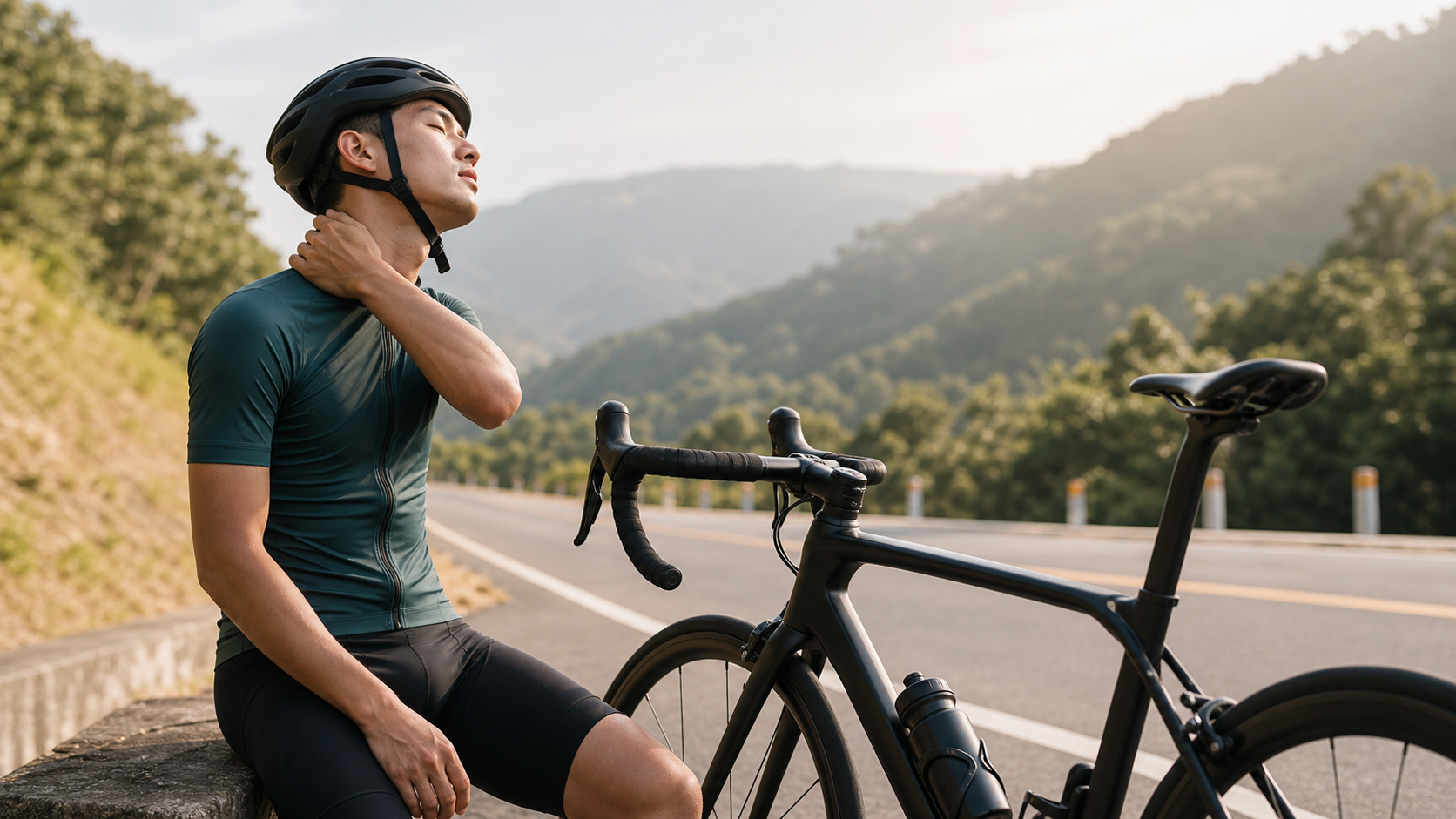
To maintain forward visibility, road cyclists must extend their heads upward relative to their forward-leaning torso. The lower the handlebar and the longer the ride, the greater this extension angle becomes, and the higher the stress placed on the cervical spine. Research estimates that for every 15 degrees the head tilts forward, the equivalent weight exerted on the cervical spine increases by about 12 kg (normal head weight is approximately 5 kg). Over time, the cervical spine and its surrounding muscles, ligaments, and intervertebral discs endure tremendous chronic stress.
Anatomy: Why Cycling Is Particularly Hard on the Neck?
The cervical spine consists of 7 vertebral bodies, with a natural curve exhibiting lordosis. The biomechanical challenges of cycling are:
- Torso forward lean: The cervical spine is forced from lordosis into relative straightening, or even kyphosis
- Head extension: To see ahead, the head hyperextends from the end of the cervical spine
- Prolonged isometric contraction: The extensor muscles at the back of the neck (semispinalis capitis, splenius capitis, cervical trapezius) sustain continuous static effort
This combination causes fatigue in the posterior neck muscles, spasms in the suboccipital muscles, and increased pressure on the posterior intervertebral discs and facet joints.
Common Symptoms
| Symptom Type | Presentation | Possible Structure |
|---|---|---|
| Posterior neck soreness | Heavy, fatigued feeling in the neck after riding | Neck extensor muscle fatigue |
| Suboccipital headache | Tightness and headache at the base of the skull | Suboccipital muscle spasm |
| Heavy shoulders | Tight upper trapezius | Muscles at the neck-shoulder junction |
| Radiating arm numbness | Numb fingers, forearm weakness | Cervical nerve root compression (C5-C7) |
| Dizziness and tinnitus | Brief vertigo after riding | Mild compression of the vertebral artery |
Equipment Factors Affecting Cervical Spine Load
Handlebar Height (Most Critical)
- The lower the handlebar (relative to the saddle), the greater the torso forward lean angle, and the more severe the cervical extension
- Recreational riders are advised to set handlebar height near saddle level or 1–3 cm lower
- Competitive riders should not force an aggressive “aero” position before fully adapting
Stem Length
- An overly long stem forces excessive torso extension, indirectly increasing the degree of cervical extension
- Shortening the stem makes the upper body more upright and can significantly reduce cervical spine load
Helmet Design
- Heavier helmets increase neck load (lightweight helmets can differ by 150–200 g in weight)
- An overly long brim or helmet shape can affect the degree of cervical extension
Eyeglass Prescription
- Insufficient prescription causes the eyes to unconsciously move closer to the handlebar, worsening posture
- It is recommended to update your glasses regularly or use photochromic lenses to maintain clear vision
Handlebar Height Adjustment Guidelines
- Assess the current state: Have someone take a side-view photo of you riding to observe the cervical extension angle
- Target angle: Cervical extension relative to the horizontal plane should not exceed 30 degrees
- Adjustment steps: Adjust handlebar height by no more than 5 mm at a time, observe for 1–2 weeks before deciding whether to continue adjusting
- Consider handlebar type: Ergo bars (drop bars) allow the wrists to relax more, indirectly improving cervical posture
Cervical Spine Strengthening and Stretching Exercises
Daily Stretching (Before and After Rides)
- Neck lateral flexion stretch: Bring the ear toward the shoulder, hold for 20–30 seconds, 3 times per side
- Neck rotation: Slowly rotate left and right to the limit, 10 times each direction
- Chin Tuck: Retract the chin backward (double-chin motion), hold for 5 seconds, repeat 10 times to strengthen the deep neck flexors
- Upper trapezius stretch: Laterally pull the neck with gentle pressure, hold for 30 seconds
Strength Training (2–3 Times per Week)
- Neck isometric resistance training: Press the palm against the forehead, back of the head, and both sides, performing 10-second isometric contractions, 3 sets in each direction
- Prone neck extension: Lying face down, lift the head to a neutral position to train neck extensor endurance
- Scapular stabilization training: Strengthen the middle and lower trapezius to improve force balance at the neck-shoulder junction
Riding Technique Recommendations
- Periodically change head position: On long straight sections, occasionally lower the head to stretch the cervical spine; do not maintain the same extension angle for extended periods
- Shorten individual ride duration: If symptoms are present, start by reducing ride time, then gradually increase distance after adapting
- Adaptation period concept: After a new bike fitting or modifications, the cervical muscles require a 4–8 week adaptation period
When to Seek Medical Attention
- Neck pain accompanied by radiating arm numbness or weakness lasting more than 2 weeks
- Dizziness symptoms that persist or worsen
- Pain affecting daily life and sleep
Conclusion
Neck and shoulder pain is a problem many road cyclists “endure in silence,” but long-term neglect may evolve into more serious cervical spine conditions. Through proper handlebar adjustment combined with cervical spine strengthening training, you can balance riding efficiency with physical health, making every ride an enjoyment rather than a drain.
Related Reading
- Cyclist Neck and Shoulder Pain: Handlebar Height, Forward Lean Angle, and Muscle Balance
- Cervical Spine and Neck-Shoulder Issues in Cyclists: A Complete Guide to Posture Correction
- Neck Pain in Cyclists: Complete Solutions from Riding Biomechanics to Rehab Training
- Neck Stiffness in Cycling: Stretching and Strengthening for Cervical Load Under Forward-Lean Posture
一日北高/長距離團騎 常見問題補充篇 / 組團或跟團的眉角 / 壯車友容易被瘦車友慢性拉爆 / 原來屁股痛可能是這個原因...? / 風場配速法 / 公路車 / CT Yeh
2 年前
一日北高常見問題大集合 | 攻略 | 路線 | 訓練 | 補給 | 自行車 單車 | 一日雙城 | 雙塔 | TWB北高360 | 屁股痛
6 年前
CT 喇低賽) 武嶺牽車 才是王道 西進牽車四小時內秘訣 攝手位置 如何判斷 防抽筋小秘訣
7 年前
CT 喇低賽) 單車 比賽總是沒照片? 攝影師的觀點大公開 姿勢就是力量! 請加速1.25倍收看
7 年前
Insta 360 One 超級防手震技術實測
7 年前
Canyon 公路車斷把手 五年老車特規還能修嗎? 維修保養全記錄 feat. 501單車監理站 | 公路車 | CT Yeh
4 年前
#公路車 #Fitting 靠人工智慧APP 幫你調整單車
6 年前
騎單車去大屯山賞雪! 助航台滑冰 全記錄 | 台北R友大集合 | 下雪打雪仗囉 | 4K超高畫質
5 年前