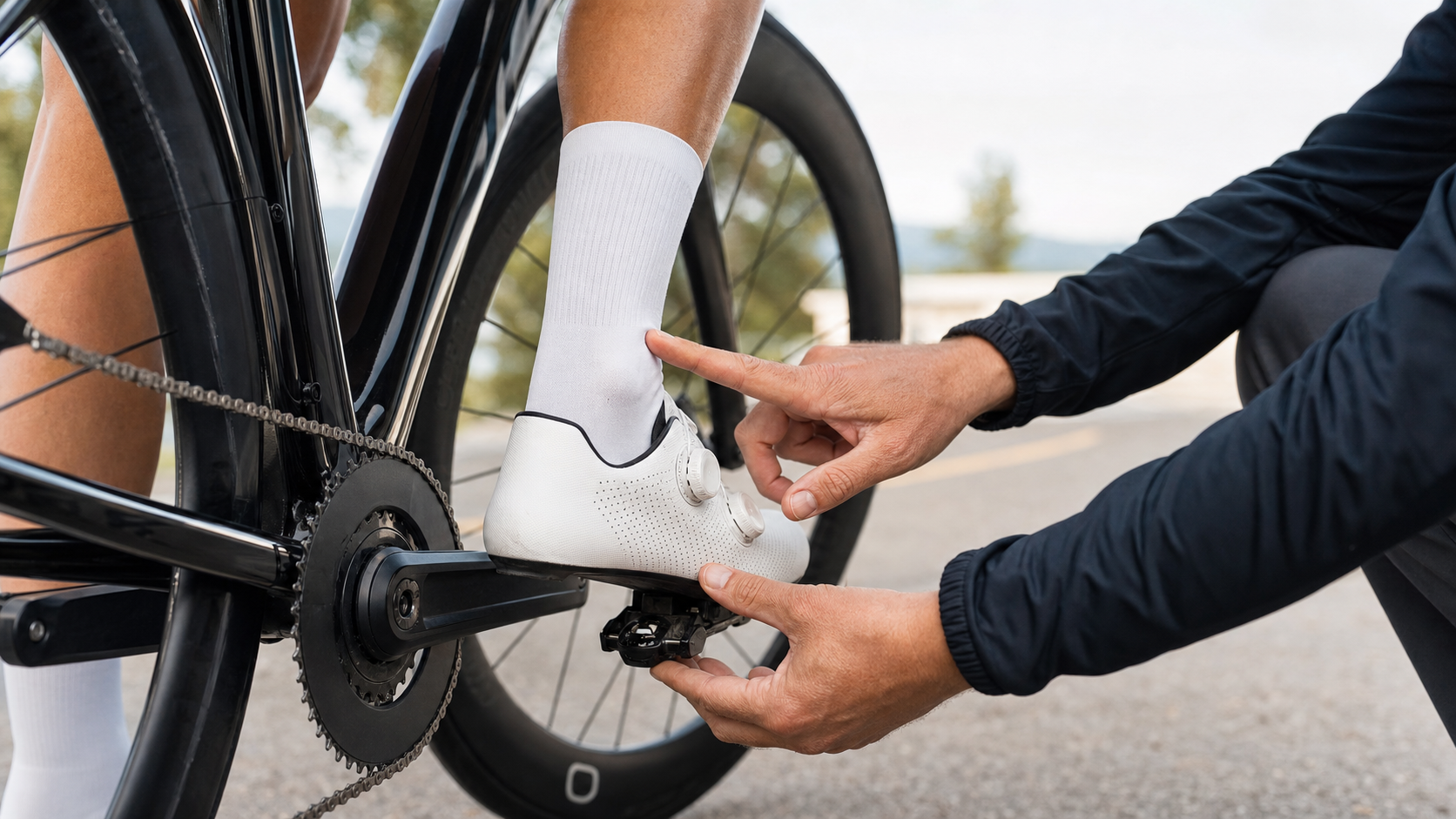
Introduction
Clipless pedals secure the rider’s feet to the pedals, theoretically improving pedaling efficiency by about 5–10%, but the cost of being “locked in” is this: if the angle settings do not match individual biomechanics, the feet, ankle joints, and knee joints must endure unnatural torsional forces over long periods. In a single ride, a cleat angle deviation of 2–3 degrees, multiplied over tens of thousands of pedal strokes, accumulates into considerable microtrauma.
Fundamentals of Cleat Systems
The mainstream cleat systems on the market today fall into three main categories:
| System Type | Representative Brands | Float Range | Suitable Applications |
|---|---|---|---|
| Three-bolt (Road Cleat) | Shimano SPD-SL, Look KEO | 0–9 degrees | Road racing |
| Two-bolt (MTB Cleat) | Shimano SPD, Crankbrothers | 0–13 degrees | Mountain biking, commuting |
| Fixed (Fixed Cleat) | Look fixed models | 0 degrees | Time trial events |
Float refers to the range of side-to-side rotation of the foot after clipping in. The greater the float, the more freedom the ankle and knee joints have for natural tracking, and the lower the injury risk typically is.
Cleat Position Setup: Three Key Parameters
1. Fore-Aft Position (Most Important)
- Standard setup: The first metatarsal head (the bony prominence at the base of the big toe) should align with the pedal axle
- Too far forward (pedaling on the toes): increases ankle joint instability, similar to a high-heel effect
- Too far back (pedaling on the heel): overuse of the gastrocnemius muscle, increased risk of Achilles tendon strain
2. Lateral Angle (Toe-out/Toe-in)
- The ideal is to make the cleat angle match the individual’s natural foot angle (Natural Foot Angle, Q-Angle)
- Assessment method: Stand naturally and relaxed, observe the natural toe-out angle of both feet; the cleat setup should be as close to this angle as possible
- Forcing a toe-in or toe-out position creates rotational stress on the ankle joint
3. Pedal Wedges (Varus/Valgus Wedge)
- Used to correct over-pronation or over-supination of the arch, allowing pedaling force to be transmitted more evenly
- Those with excessive arch pronation (flat feet) can add a lateral wedge
Common Cleat-Related Ankle Problems
Plantar Fasciitis
- Mechanism: Cleat fore-aft position too far back, causing the heel to absorb excessive impact; or cleats that are too stiff, leaving the arch without adequate support
- Symptoms: Pain at the front of the heel on the sole, most noticeable when stepping on the ground in the morning
- Treatment: Adjust cleat position to under the metatarsal head; choose insoles with arch support
Achilles Tendinopathy
- Mechanism: Saddle too high, causing the heel to drop excessively at the bottom of the pedal stroke, repeatedly over-stretching the Achilles tendon
- Symptoms: Morning stiffness and pain at the back of the ankle, worsening after rides
- Treatment: Lower the saddle; strengthen the calf with eccentric heel drops
Lateral Ankle Ligament Stress
- Mechanism: Improper cleat fixation angle causing ankle inversion, putting pressure on the collateral ligaments
- Symptoms: Chronic pain on the outside of the ankle, decreased ankle joint stability
- Treatment: Increase float; assess foot type and wedge needs
Peroneal Tendinitis
- Mechanism: Prolonged pedaling locked into an unnatural angle, increasing friction on the peroneal tendons
- Symptoms: Pain along the line behind the fibula
- Treatment: Re-evaluate cleat angle settings; strengthen the peroneal muscles
Practical Cleat Setup Recommendations
- Start with a floating model: For first-time cleat users, it is recommended to start with a model offering greater float (such as the yellow Shimano SPD-SL, 6 degrees of float)
- Remove cleats to verify position: Periodically remove the cleats to check whether the wear marks on the sole are even
- Progress gradually: When using cleats for the first time, start with short, flat rides to become familiar with the clip-in and release motions
- Assess bilateral symmetry: The cleat angles for each foot may need different settings; do not assume symmetry
- Seek a Bike Fitting: A complete cleat setup should incorporate dynamic pedaling analysis, not just static estimation
Acute Injury: Responding to a Cleat That Won’t Release
- Familiarize yourself with the release motion (rotate the heel outward) and practice repeatedly in a safe environment until it becomes muscle memory
- Unclip one foot in advance in crowded areas or at intersections
- If you get stuck during a fall: protect your head and let your body fall to the side rather than trying to brace yourself
Conclusion
Cleat systems are a powerful tool for improving pedaling efficiency, but only if set up correctly. For most amateur riders, choosing cleats with an appropriate amount of float and taking the time to find a position that matches your own foot shape is the most cost-effective way to prevent ankle injuries. Don’t let a small metal cleat become the source of long-term pain.
Related Reading
- 2026 Road Cycling Shoes and Pedal Systems: The Science of Red Cleats, Black Cleats, and Fixed Angles
- Cleat Position Adjustment: Solutions for Fore-Aft, Lateral, Rotational Angles and Pain
- Foot Pain in Cyclists: Cleat Position Adjustment and Arch Support
- The Complete Guide to Cleats and Pedal Systems: How to Choose Between SPD-SL, Look, and Speedplay
#公路車 #Fitting 靠人工智慧APP 幫你調整單車
6 年前
再一組! 全碳幅條 碟煞/無內胎輪組 開箱! 到底好騎嗎? UNAAS X40 | 公路車 | CT Yeh
4 年前
碟煞公路車 銑面器 !? 原來銑完差這麼多! 降低蹭碟機率! | TIME 公路車 保養小記錄 | CT Yeh
3 年前
Nepest NOVA 碳條輪組:輕量、空力、舒適一次滿足!/ 公路車 / CT Yeh
7 個月前
摔車後補裝備: 好市多新款單車安全帽& Specialized Romin 北高整路屁股都不痛的坐墊 | 一千元居然有MIPS | CT Yeh | 公路車
4 年前
碟煞公路車 優缺點?換車一年半實際經驗分享 / 公路車 / CT Yeh
2 年前
鉅齒紋輪組!? ControlTech MEG-T50 EVO 碳纖維幅條輪組/ 功率對比實驗 / 公路車 / CT Yeh
2 年前
3D 列印車褲墊 / 舒適改善? / 無痕 x 分區壓縮 / ATK & Decider系列 / JE22黑科技 / #公路車 #CTYEH
11 個月前