Introduction
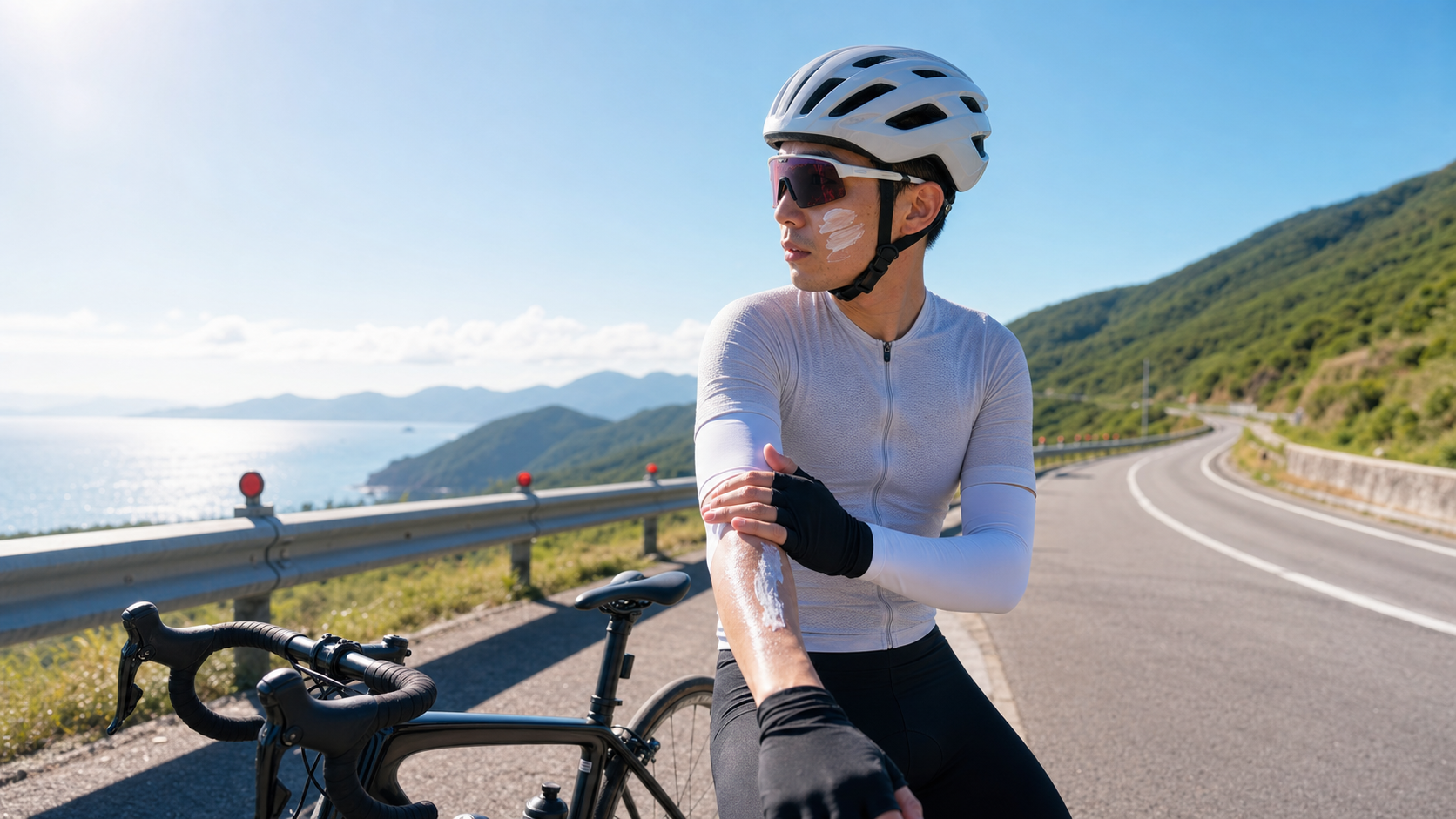
A 100 km one-day ride often takes 3–6 hours, with full exposure to the outdoor sun throughout. Taiwan is located in the subtropics, and in summer the UV Index frequently exceeds 10 (extreme), meaning that an unprotected fair-skinned person can start to sunburn in just 10–15 minutes. Most cyclists place great emphasis on physical training but overlook that skin health is equally important.
Types and Hazards of Ultraviolet Radiation
| UV Type | Wavelength | Penetration | Main Hazards |
|---|---|---|---|
| UVA | 320–400 nm | Can penetrate clouds and glass | Photoaging, skin cancer (deep layers) |
| UVB | 280–320 nm | Partially absorbed by clouds | Sunburn, skin cancer (epidermis) |
| UVC | 100–280 nm | Completely absorbed by the atmosphere | Almost nonexistent at ground level |
Special exposure risks for cyclists:
- Reflected radiation: UV reflected from the ground, roads, and water surfaces increases exposure by 10–15%
- High altitude: UV intensity increases by about 10% for every 1,000 meters ascended (Taiwan’s climbing routes can reach over 2,000m above sea level)
- Prolonged continuous exposure: Body parts receive long periods of uninterrupted exposure
- Sweat dilutes sunscreen effectiveness: Sweating accelerates the washing away of sunscreen
Typical Summer UV Exposure Estimates in Taiwan
Taking a 6-hour ride from 8 AM to 2 PM as an example (average UV Index of about 8):
- Minimum erythema dose (MED) without protection: about 15 minutes for fair skin, about 30 minutes for brown skin
- 6 hours of exposure is equivalent to 8–24 times the MED
- Long-term accumulation equals hundreds of standard daily sun exposure doses per year
Sunscreen Strategy: A Five-Layer Protection System
Layer 1: Timing
- In Taiwan from April to October, UV peaks between 10 AM and 2 PM
- It is recommended to complete the main mileage before 9 AM whenever possible, or set off at dawn
- On cloudy days, UV penetration is still 60–80%, so do not let your guard down
Layer 2: Sunscreen (Most Important)
- SPF selection: SPF 50+ (PA+++ or above) is recommended, providing protection against both UVA and UVB
- Apply sufficient amount: The face requires about 1/4 teaspoon (approximately 1.5 mL), and the whole body about 30 mL (most people apply only 1/4 of the recommended amount per use, greatly reducing actual protection)
- Apply 20–30 minutes before going out: Allow the sunscreen to fully form a film
- Reapplication timing: Reapply every 90–120 minutes, and reapply earlier after heavy sweating
- Sport sunscreens: Choose water-resistant, sweat-resistant formulas (look for the “Water Resistant 80 minutes” label)
Layer 3: Physical Protection
- Arm sleeves: Long-sleeve jerseys or arm sleeves protect the arms; fabrics with UPF (Ultraviolet Protection Factor) 50+ are most effective
- Cycling shorts: The legs cover the largest body surface area and should be protected first
- Gloves: The back of the hands has a small exposed area but is often overlooked
Layer 4: Eye and Face Protection
- UV-blocking sunglasses: Choose lenses that block 99–100% of UVA/UVB (CE/ANSI certified)
- Helmet visors: Some helmets feature extended visor designs that can shade part of the face
- Facial sunscreen: Pay special attention to the nose, tops of the ears, and the back of the neck (areas insufficiently covered by the helmet while riding)
Layer 5: Post-Ride Skin Care
- Wash the face and exposed skin immediately after riding to remove sunscreen residue
- Use soothing lotions containing aloe vera or vitamin E to repair mild post-sun redness and swelling
- In the evening, vitamin C serums or retinol products can help repair photoaging
Recognizing and Treating Sunburn
- First-degree sunburn: Skin redness and tenderness, peaking within 48 hours. Treatment: rinse with cold water, apply moisturizing lotion, avoid further exposure
- Second-degree sunburn: Blistering and severe pain. Treatment: do not pop the blisters; seek medical evaluation
- Heat exhaustion with sunburn: If dizziness, nausea, or high body temperature occur simultaneously, seek emergency medical care
Long-Term Skin Monitoring Recommendations
- Regularly self-examine your skin and observe moles using the ABCDE rule (Asymmetry, irregular Borders, uneven Color, Diameter >6mm, Evolution over time)
- Outdoor athletes are advised to receive a full skin examination by a dermatologist every 1–2 years
- Basal cell carcinoma and squamous cell carcinoma in Taiwan are closely linked to long-term UV exposure
Conclusion
When cycling in Taiwan, sun protection is not optional—it is protective gear as important as a helmet. Establishing the habit of “three things before heading out: put on your jersey, wear your helmet, apply sunscreen” is the simplest yet most effective way to protect your skin’s health. Don’t let the joy of every ride come at a long-term cost to your skin.
Related Reading
- The Protective Shield Under the Sun: A Complete UV Protection Guide for Outdoor Athletes
- Skin Protection for Cyclists: Sunscreen, Road Rash, and Skin Care
- Sunburn and Skin Protection for Cyclists: Sunscreen Recommendations for Long Summer Rides in Taiwan
- Sunscreen Strategies for Cyclists: Protective Measures Under Taiwan’s UV
靠單車減肥35公斤 心得分享與整理
7 年前
一日北高/長距離團騎 常見問題補充篇 / 組團或跟團的眉角 / 壯車友容易被瘦車友慢性拉爆 / 原來屁股痛可能是這個原因...? / 風場配速法 / 公路車 / CT Yeh
2 年前
碟煞公路車 銑面器 !? 原來銑完差這麼多! 降低蹭碟機率! | TIME 公路車 保養小記錄 | CT Yeh
3 年前
半日 小台灣 極限單車路線挑戰實錄
7 年前
單車 一日北高 ( 雙城 ) 肥宅雙人瘋狂行 紀錄片 REACTO
10 年前
#Canyon Aeroad 公路車 三年騎乘 #心得 | 出保方式 | 購買價格計算 | 同場加映累積三年大保養慘況
6 年前
一日北高常見問題大集合 | 攻略 | 路線 | 訓練 | 補給 | 自行車 單車 | 一日雙城 | 雙塔 | TWB北高360 | 屁股痛
6 年前
2025 自行車錶排行榜 兩萬車友大數據 / Garmin Bryton 排名會大洗牌嗎? / 全新的碼表前身分析 /公路車 / CT Yeh
1 年前