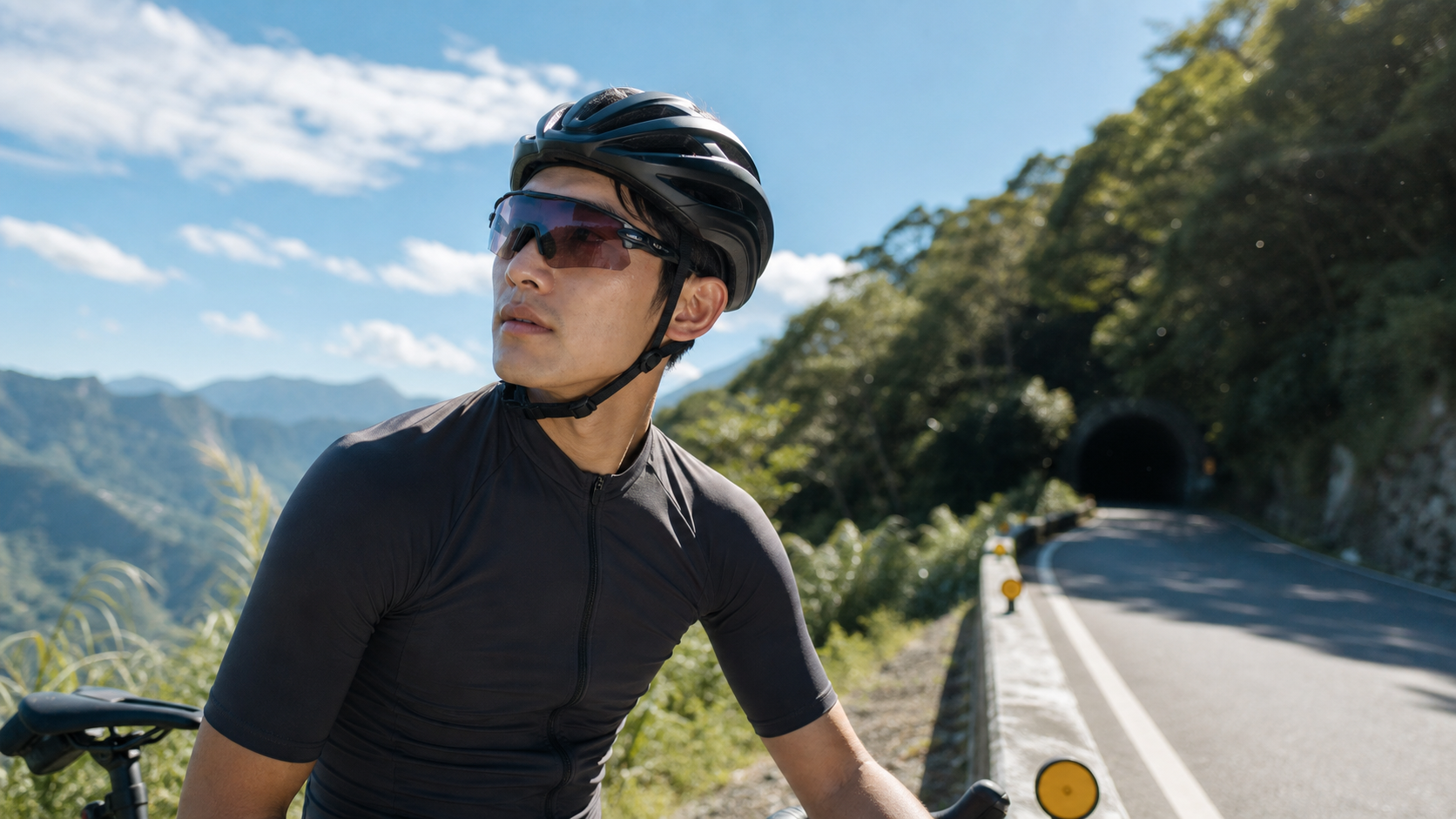
Introduction
When cycling, the eyes are among the most exposed sensory organs. During normal walking, the natural blink rate is about 15–20 times per minute, but while cycling, due to fast airflow and focused attention on the road ahead, the blink rate can drop to 7–10 times per minute, causing dry eyes. Combined with ultraviolet radiation, intense light, insects, and dust at high speeds, the environmental stress on the eyes is far greater than in everyday activities.
Main Threats to the Eyes While Cycling
| Threat Source | Impact | Protection Method |
|---|---|---|
| UVA/UVB ultraviolet radiation | Accelerated cataracts and macular degeneration | UV400 lenses |
| Intense sunlight | Eye fatigue, temporary blurred vision | Lenses with appropriate tint levels |
| Foreign objects (insects, grit) | Corneal abrasions, infections | Wraparound goggles |
| Strong wind and low humidity | Accelerated dry eye syndrome | Wraparound frames, artificial tears |
| Rapid light-to-dark changes | Accommodation fatigue (e.g., riding through tunnels) | Photochromic or light-adaptive lenses |
Choosing UV-Protective Lenses
UV Protection Standards
- UV400: Blocks all ultraviolet rays with wavelengths below 400nm; this is the basic requirement when purchasing
- CE European Certification: Classified into categories 0–4 (Category 0–4); the higher the category, the stronger the tint
- Category 1 (light tint): Suitable for cloudy days and indoor use
- Category 2–3 (medium tint): Suitable for general sunny outdoor conditions
- Category 4 (dark tint): For high mountains or intense sunlight; not suitable for cycling (too dark, compromising safety)
Lens Material Options
- Polycarbonate: Lightweight, impact-resistant; the standard material for sports lenses
- Trivex: Lighter than polycarbonate with better optical quality
- Glass: Best optical quality but heavy and not impact-resistant; unsuitable for cycling
Polarized Lenses
- Advantages: Reduces glare from water and road surface reflections
- Disadvantages: Some LCD displays (cycle computers, phones) may be unreadable at certain angles
- Recommendation: Polarized lenses suit fishing and water sports; their practicality for cycling is debatable
Photochromic Lenses
- Automatically adjust lens tint based on light intensity
- Advantages: Automatically lighten when entering tunnels/shaded sections and darken in bright light
- Disadvantages: Limited reaction speed (transition typically takes 30–60 seconds); less effective behind a car windshield
- Recommendation: Especially suitable for riders on mountainous routes (alternating tunnels and sunlight)
Frame Selection
- Wraparound design: Ensures foreign objects and side winds do not directly contact the eyes
- Anti-slip design: Prevents slipping when sweating; silicone nose pads and temple grips are key
- Interchangeable lens design: The same frame can accommodate different lenses for sunny, cloudy, and nighttime conditions
- Weight: Road cyclists count every gram; sports sunglasses typically weigh 25–35g
Preventing Eye Fatigue
Preventing Dry Eyes
- Use artificial tears before departure: Preservative-free single-dose artificial tears can be used preventively before a ride
- Consciously increase blink rate: Remind yourself to blink more on straight, relaxed sections
- Wraparound frames: Reduce direct wind exposure to the eyes
Improving Visual Fatigue
- Alternate near and far focus: During long rides, periodically shift your gaze distance (look at distant mountain views, then the road ahead) to reduce ciliary muscle fatigue
- Warm compresses on the eyes (after riding): Apply a warm towel over the eyes for 5–10 minutes to promote blood circulation around the eyes
- Eye massage: Gently press around the orbital bone; avoid pressing directly on the eyeball
Night Riding Vision Challenges
- Pupils dilate during nighttime riding, making blue light and glare more impactful on vision
- Choosing slightly yellow (Yellow/Amber) lenses increases contrast and improves nighttime visual clarity
- Glare from oncoming headlights: Develop the habit of briefly looking down or shifting your gaze
Prescription Issues
Riders with myopia or astigmatism have several options:
- Prescription sports eyewear: Customized sports sunglasses with prescription lenses; more expensive but offer the best visual quality
- Contact lenses + sunglasses: The most common approach; note that strong outdoor winds can easily dry out contact lenses
- Daily disposable contact lenses: More hygienic than extended-wear lenses; suitable for occasional rides
- Refractive surgery (LASIK): Consider for long-term needs; no need to worry about eyewear after cycling
Conclusion
Your eyes are the navigation system of cycling—protecting them means protecting your riding safety. Invest in a high-quality pair of sports sunglasses with UV400 protection, pair them with proper usage habits, and every ride will be clear and unobstructed, keeping your vision sharp for decades to come.
Related Reading
- Cycling Vision Protection: UV Rays, Windblown Sand, and Goggle Selection During Rides
- Eye Protection for Cyclists: Damage and Protection from UV Rays, Insects, and Airflow
- Vision Protection for Cyclists: A Guide to UV Rays, Flying Insects, and Goggle Selection
- Eye Protection for Cycling: Shielding Against UV Rays, Windblown Sand, and Insect Impacts
開箱) 近視車友 也可以很帥的 Envis Transform 太陽眼鏡開箱 翔鷹 配近視框超便宜秘訣
7 年前
再快都跟的上!? 單車跟隨攝影機之王 HOVERAir X1 PROMAX 全面實測 / 唯一!8K畫質&自行車專用模式和跟蹤信標&前後避障 / DJI Neo 可參考/ 公路車 / CT Yeh
1 年前
單車高張力拍攝神器 Antigravity A1 全景空拍機! / CT Yeh
1 個月前
再一組! 全碳幅條 碟煞/無內胎輪組 開箱! 到底好騎嗎? UNAAS X40 | 公路車 | CT Yeh
4 年前
一日北高/長距離團騎 常見問題補充篇 / 組團或跟團的眉角 / 壯車友容易被瘦車友慢性拉爆 / 原來屁股痛可能是這個原因...? / 風場配速法 / 公路車 / CT Yeh
2 年前
碟煞公路車 銑面器 !? 原來銑完差這麼多! 降低蹭碟機率! | TIME 公路車 保養小記錄 | CT Yeh
3 年前
公路車 | 塔塔加驚險員工旅遊 | 還好手腳快沒被抓交替!
5 年前
單車 一日北高 ( 雙城 ) 肥宅雙人瘋狂行 紀錄片 REACTO
10 年前