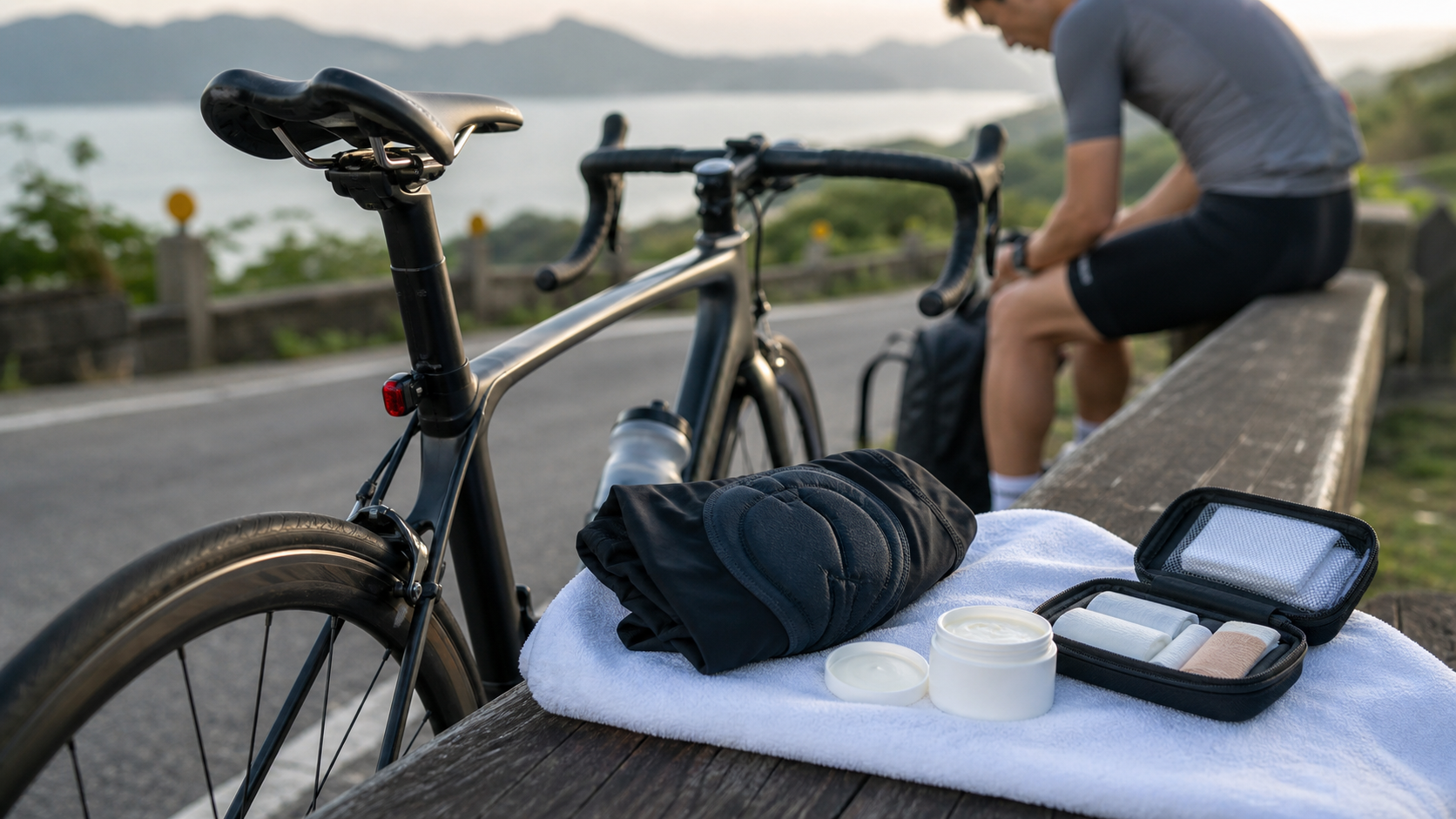
Introduction
The term “saddle sore” may sound mild, but for racers in the Tour de Taiwan or long-distance riders tackling Provincial Highway 3 or the East Rift Valley, it can be a severe challenge that leaves you completely unable to sit on your saddle one morning. Saddle sores are essentially skin damage caused by the triple factors of prolonged friction, heat and moisture, and pressure. Severity ranges widely, from mild redness to deep infection.
Types of Saddle Sores
| Type | Appearance | Pain Level | Infection Risk |
|---|---|---|---|
| Skin friction redness | Localized flushing, tenderness | Low–Medium | Low |
| Folliculitis | Red papules around hair follicles | Medium | Medium |
| Skin abrasion (chafing) | Loss of skin layers, exudate | Medium–High | Medium–High |
| Subcutaneous cyst | Hard lump, slow to resolve | Medium–High | Low–Medium |
| Deep infection (cellulitis) | Hot, red, swollen skin; possible fever | High | High (requires medical attention) |
Causes of Saddle Sores
The Vicious Cycle of Three Factors
- Mechanical friction: Skin repeatedly rubs against bib short seams and saddle edges
- Heat and moisture: Sweat plus stuffy bib shorts soften the skin’s keratin layer, making it more vulnerable
- Bacterial proliferation: Damaged skin + moist environment + natural skin flora → folliculitis or infection
Aggravating Factors
- Chamois pad too thin or degraded
- Wearing regular underwear under bib shorts (adding extra seam layers)
- Not changing out of bib shorts promptly after long rides
- Poor saddle setup (fore-aft position causing repeated forward sliding and friction)
- Sensitive skin or a predisposition to folliculitis
Using Chamois Cream
Chamois cream (also known as “banana cream” or “butt cream”) is an essential tool for long-distance riders. Its main functions:
- Reduce friction: Creates a lubricating barrier between skin and bib shorts
- Antibacterial protection: Some formulas contain antibacterial ingredients (such as tea tree oil) to inhibit bacterial growth
- Moisturizing and repair: Maintains the integrity of the skin barrier
How to Apply
- Amount: A thumb-sized amount, applied to the skin areas most exposed to the saddle (perineum, around the sit bones)
- Can also be applied to the chamois pad: Apply directly to the inside of the pad; both methods are equally effective
- Apply before departure: Don’t wait until you feel discomfort—preventive use works best
- When to reapply: For rides exceeding 4–5 hours, consider reapplying during rest stops
Choosing Ingredients
- Sensitive skin: Avoid formulas containing menthol or alcohol
- Antibacterial needs: Choose products with tea tree oil or broad-spectrum antibacterial ingredients
- All-natural preference: Shea butter or beeswax-based products are typically gentle and non-irritating
Caring for Different Types of Wounds
Mild Friction Redness (Most Common)
- Shower immediately after riding and clean the affected area
- After drying, apply a barrier cream containing zinc oxide or a moisturizing cream
- Wear loose, breathable underwear to let the skin breathe
- Decide whether to ride the next day based on recovery progress
Folliculitis
- Clean the affected area; avoid squeezing the papules
- May apply an acne cream containing 2.5–5% benzoyl peroxide topically
- If multiple folliculitis lesions, pus, or fever develop, seek medical attention for antibiotics
- Address the root cause (change bib shorts, adjust saddle)
Skin Abrasions
- Clean the wound with warm water to remove contaminants
- Apply medicated petroleum jelly or a wound care dressing (such as a hydrocolloid dressing)
- Use a waterproof dressing (such as Tegaderm) to protect the wound while riding
- Reassess whether to continue riding before the wound has healed
Warning Signs of Deep Infection
Seek medical attention immediately if any of the following occur:
- Localized skin redness, heat, and swelling (expanding area of cellulitis)
- Elevated body temperature (fever >38°C)
- Swollen lymph nodes
- Yellow-green discharge from the wound
Prevention Strategies
- Invest in high-quality bib shorts: Chamois pad design and materials vary enormously; good bib shorts are the most effective tool for preventing saddle sores
- Change out of bib shorts immediately after every ride: Don’t walk around in damp bib shorts
- Keep the perineal area dry: Change into dry bib shorts on long rides (bring a spare pair)
- Diet and immunity: Regular meals and adequate sleep help the skin resist infection
- Saddle adjustment: Reduce the sliding sensation of forward-backward movement to lower friction
Conclusion
Although saddle sores are a “classic problem” in cycling, they are not pain you simply have to endure. Using chamois cream correctly, choosing appropriate bib shorts, and maintaining good hygiene habits can keep you comfortable on long rides, ensuring your skin doesn’t become the bottleneck to achieving your goals.
Related Reading
- Preventing Saddle Pain on Long Rides: Riding Posture Adjustments and Rest Stop Moves
- The Complete Guide to Chamois Cream and Anti-Chafing Products: The Invisible Guardian of Long Rides
- Sore Butt from Long-Distance Cycling: Cause Analysis and Complete Solutions
- Perineal Pain and Skin Issues: Private Area Care for Cyclists
碟煞公路車 銑面器 !? 原來銑完差這麼多! 降低蹭碟機率! | TIME 公路車 保養小記錄 | CT Yeh
3 年前
摔車後補裝備: 好市多新款單車安全帽& Specialized Romin 北高整路屁股都不痛的坐墊 | 一千元居然有MIPS | CT Yeh | 公路車
4 年前
一日北高/長距離團騎 常見問題補充篇 / 組團或跟團的眉角 / 壯車友容易被瘦車友慢性拉爆 / 原來屁股痛可能是這個原因...? / 風場配速法 / 公路車 / CT Yeh
2 年前
#公路車 #Fitting 靠人工智慧APP 幫你調整單車
6 年前
3D 列印車褲墊 / 舒適改善? / 無痕 x 分區壓縮 / ATK & Decider系列 / JE22黑科技 / #公路車 #CTYEH
11 個月前
一日北高常見問題大集合 | 攻略 | 路線 | 訓練 | 補給 | 自行車 單車 | 一日雙城 | 雙塔 | TWB北高360 | 屁股痛
6 年前
碟煞公路車 優缺點?換車一年半實際經驗分享 / 公路車 / CT Yeh
2 年前
大家都在開箱的...單車用藍芽對講耳機真的有幫助嗎? SENA BiKom 20 長距離旅遊 & 海鷗繞圈賽 實際體驗心得 / 公路車 / CT Yeh
9 個月前