Running Light Buying Guide: Lumen Requirements and Battery Life for Night Running Headlamps
文章導覽
Introduction
A significant proportion of runners in Taiwan choose to train before 5 a.m. or late at night to avoid the daytime heat and traffic. A night running headlamp is one of the most important safety gear items for this group. However, choosing a headlamp involves multiple specifications such as lumens, beam angle, battery life, and weight. This article systematically helps you clarify the priorities.
Lumens: Brighter Isn’t Always Better
The lumen is the unit of luminous flux, representing total light output, but you shouldn’t base your purchase solely on the maximum lumen rating:
| Environment | Recommended Lumens | Notes |
|---|---|---|
| Taiwan urban streets (ample street lighting) | 50–100 lm | Primary function is “being seen by drivers,” not illumination |
| Taiwan urban streets (sparse street lighting) | 150–250 lm | Sufficient to light up the road 3–5 meters ahead |
| Mountain trails/off-road routes | 300–600 lm | Needs to illuminate complex terrain, 5–10 meters of visibility |
| Ultramarathon night trails | 600–1000+ lm | High-speed trail running requires a longer throw distance |
Urban night runners in Taiwan often buy high-lumen headlamps that exceed their actual needs, which only adds unnecessary weight and battery consumption.
Beam Patterns: Anti-Glare and Visibility
- Flood mode: Wide-angle illumination with a broad near-field view, suitable for jogging on trails
- Spot mode: Concentrated long-distance illumination for seeing road conditions far ahead, suitable for scenarios where you need to judge the path ahead
- Mixed mode: The default setting on most high-end headlamps, balancing wide-angle close-range vision with focused long-range visibility
- Red flashing mode: Power-saving and effective at drawing the attention of vehicles behind you; recommended for urban night running in Taiwan
Battery Types: Rechargeable vs. Disposable
| Battery Type | Advantages | Disadvantages | Recommended Use Cases |
|---|---|---|---|
| USB rechargeable (built-in lithium battery) | Saves money over long-term use, eco-friendly | Cannot be swapped out immediately when depleted | Regular urban training |
| Replaceable lithium battery (18650) | Spare batteries can be swapped instantly, remaining charge is predictable | Requires carrying spare batteries | Long-distance trail running, ultramarathons |
| AAA lithium batteries | Available for purchase almost anywhere, performs well in cold temperatures | Higher ongoing cost | Emergency backup, cold environments |
Recommendation for Taiwan urban runners: With USB rechargeable models, charge after every use; once this habit is established, you’ll rarely encounter low-battery issues.
Recommendation for ultramarathon runners: Choose models with replaceable 18650 lithium batteries; carrying one spare battery (about 40g) can immediately extend your runtime.
Headband Comfort and Stability
The vibration and movement of your head while running are far greater than when hiking, so the headlamp’s securing design requires extra attention:
- Dual elastic headbands: One across the front and one across the back, offering significantly better stability than a single headband
- Headband width: Wide headbands of 25mm or more distribute pressure and prevent discomfort during extended wear
- Adjustable tilt angle: Allows you to aim the beam downward to illuminate the ground directly ahead rather than far into the distance
- Total weight: Running headlamps should ideally weigh under 100g; heavier models will cause neck fatigue during prolonged use
Special Requirements for Taiwan’s Night Running Environment
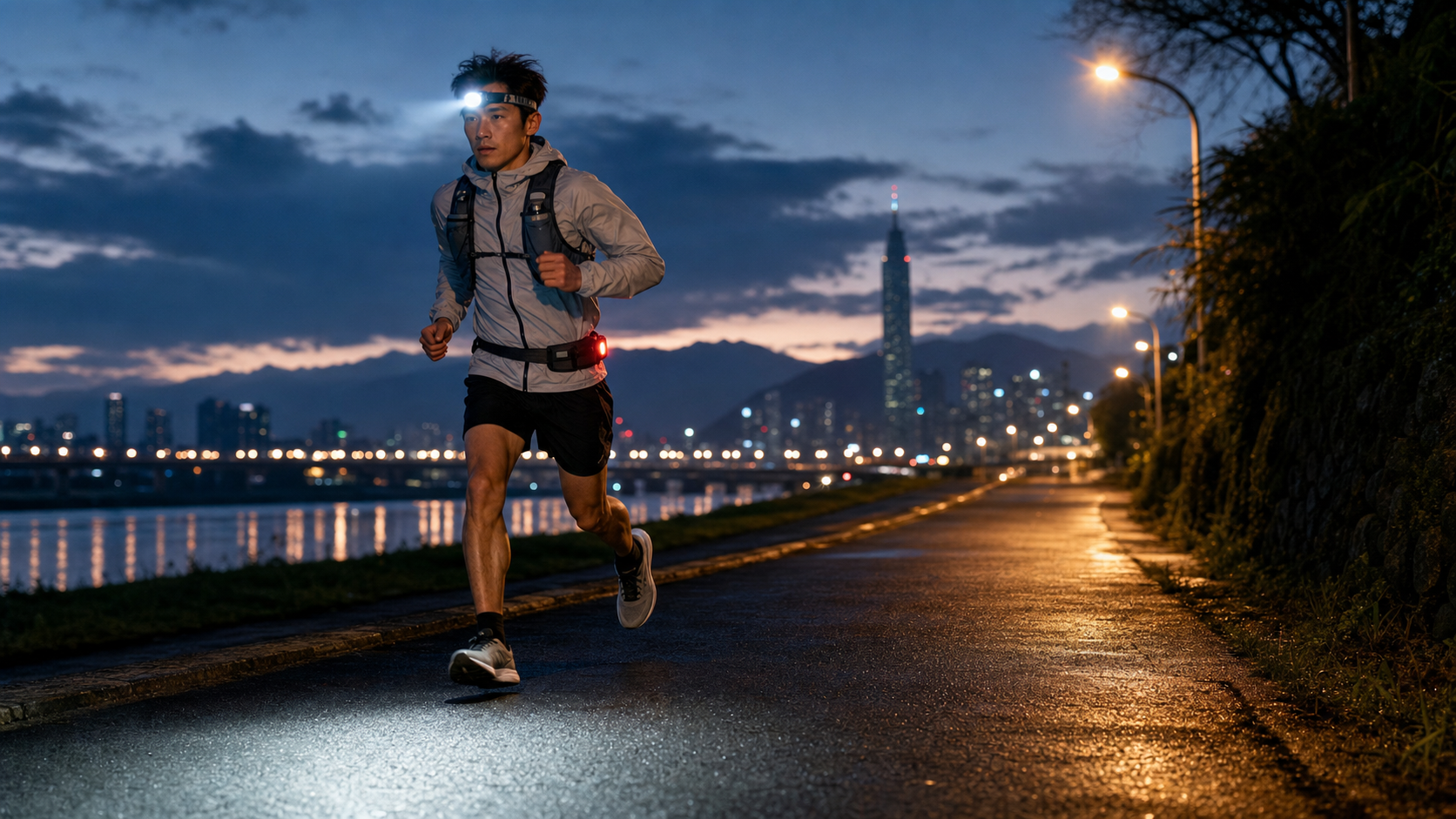
- Rear warning light: In addition to a headlamp, a red flashing light on your back greatly improves safety when vehicles approach from behind; it’s recommended to attach one to your pack or the back of your top
- Reflective gear pairing: Headlamp brightness is limited, so reflective vests, caps, or tops are an important complement to your headlamp
- Water resistance rating: IPX4 or higher (splash-proof) is sufficient for Taiwan’s rainy environment; there’s no need to pursue fully waterproof models
Recommended Major Brands
- Petzl: Actik Core / Nao RL, a French brand with consistent quality, available at Taiwan outdoor gear stores
- Black Diamond: Spot series, durable with even light distribution
- Ledlenser: German craftsmanship, high optical quality, excellent battery life
- Silva: Running-specific series with headbands optimized for running
Practical Advice
- For urban road running, there’s no need to buy a headlamp exceeding 300 lumens; the weight and battery drain aren’t worth it
- Pair your headlamp with a red flashing waist light on your back to create front-and-rear visibility, which is far more effective than a headlamp alone
- Check the battery level before every night run and develop the habit of charging immediately after training
- During warm-up runs in the early morning, lower the brightness to conserve battery, then switch to high brightness on truly dark sections
Conclusion
The key to choosing a night running headlamp lies in “visibility” rather than “brightness competition.” For urban runners in Taiwan, 150–250 lumens is more than sufficient; only trail and off-road runners need to consider models above 500 lumens. Combined with reflective gear to form a comprehensive safety system, that’s the complete strategy for night running safety.
Related Reading
- Choosing Running Lights: Headlamp Lumens, Battery Life, and Night Running Safety in Taiwan
- Road Running Headlamp Buying Guide: A Complete Comparison of Lumens and Battery Life for Night and Morning Runs
- Road Running Headlamp Selection: Lumens, Wide-Angle Beam Distribution, and Practical Recommendations for Night Running in Taiwan
- Night Running Safety Lighting Systems: A Complete Buying Guide from Headlamp Lumens to Reflective Gear