Introduction
Taiwan’s trail running landscape is diverse, ranging from the slippery grassy slopes of Yangmingshan in the north, the gravel forest trails of the central region, to the dry red clay of southern Taiwan’s mountain paths. Different terrains place significantly different demands on trail running shoes. A pair of trail shoes that excels on one type of terrain may completely fail in another environment. Understanding the characteristics of Taiwan’s major trail terrains is the first step in choosing the right shoes.
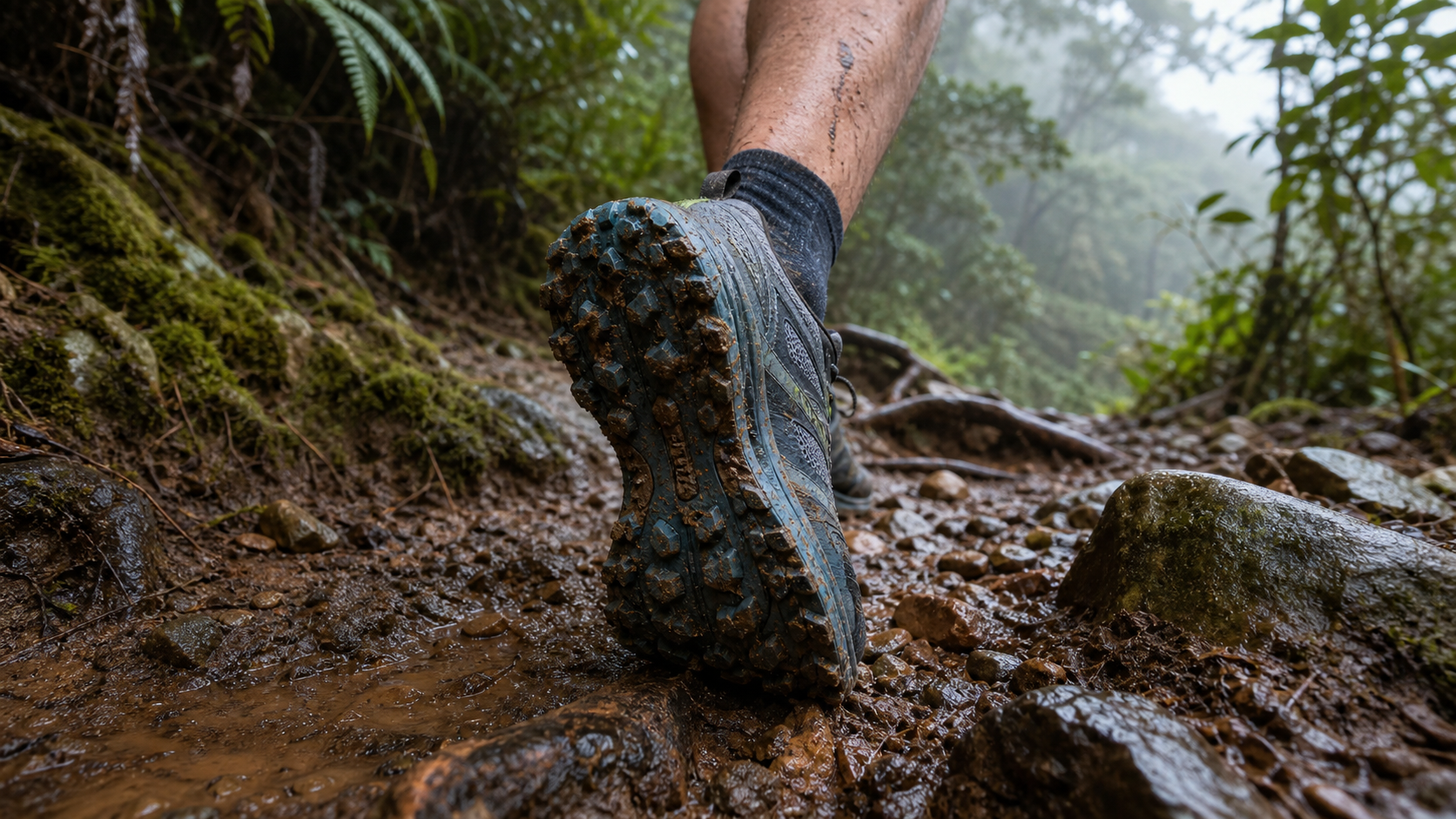
Outsole Lug Pattern: The Core of Traction
The depth and spacing of the rubber lugs on trail running shoe outsoles determine their grip on different terrains:
| Lug Characteristics | Suitable Terrain | Typical Scenarios |
|---|---|---|
| Deep lugs (5–8mm), wide spacing | Wet mud, deep mud | Mountain trail running, Taiwan’s forest trails after rain |
| Medium depth (3–5mm), multi-directional arrangement | Mixed terrain (rock and soil mix) | Taiwan’s mid-to-low elevation trail routes |
| Shallow lugs (2–3mm), dense arrangement | Dry hard-packed soil, gravel roads | Taiwan’s dry summer mountain trails |
| Climbing-rubber style (Vibram Megagrip) | Wet slate, granite | Taiwan’s creek valley routes |
Recommendation for Taiwanese runners: Choose a versatile trail lug pattern with medium depth and multi-directional arrangement to handle Taiwan’s varied terrain, avoiding extreme designs suited only to a single terrain type.
Waterproofing: GTX vs Non-Waterproof
The most common waterproofing needs in Taiwan’s trail running come from: morning dew on grassy slopes, creek crossings, and waterlogged sections after typhoons.
-
Gore-Tex (GTX) waterproof bootie:
- Pros: Fully waterproof, keeps feet dry in rain/shallow water crossings
- Cons: Breathability drops by approximately 30–50%, stuffy in Taiwan’s summer; water that gets in is slow to drain (effectively traps water inside)
- Best for: Autumn/winter mountain trails, routes with many creek crossings, runners who prefer dry feet
-
Non-waterproof breathable models:
- Pros: Better heat dissipation, water drains quickly after creek crossings in Taiwan’s summer (e.g., “drain port” designs), overall more comfortable
- Cons: Feet get wet immediately from puddles or dew-covered grassy slopes
- Best for: Taiwan’s May–September summer trail races, routes with frequent water crossings
Most mainstream trail races in Taiwan include water-crossing sections, making non-waterproof quick-drying models often more practical than GTX versions during races.
Protective Design: Ground Feel vs Protection
- Rock Plate: Located inside the midsole, prevents sharp rocks from piercing the sole; suitable for Taiwan’s gravel-heavy forest road routes; downside is adding approximately 30–50g to shoe weight
- Toe Bumper: A rigid outer shell protecting the toes; highly important on Taiwan’s mountain trails with dense root systems
- Midsole cushioning thickness: Trail running shoes generally have thinner cushioning than road shoes to enhance ground feel; for long-distance trail races (over 30km), models with thicker cushioning are recommended
Weight vs Durability Trade-offs
| Type | Weight (per shoe) | Durability | Suitable Distance |
|---|---|---|---|
| Racing lightweight trail shoes | 180–250g | Fair (approx. 400km) | Short trail runs to half-marathon trail races |
| All-round trail training shoes | 280–360g | Good (approx. 600km) | Training and racing across all distances |
| Long-endurance trail shoes | 330–420g | Excellent (approx. 800km) | Ultramarathons, multi-day events |
Key Brand Highlights
- Salomon: Speedcross series with ultra-deep lugs, the benchmark for wet mud grip; Sense Ride series balances speed and comfort
- Hoka: Speedgoat series with high cushioning for trail running, a top choice for long-distance ultramarathons; full distribution in Taiwan makes them easy to find
- Brooks: Cascadia series is durable and stable, highly visible at Taiwan’s trail race events
- Adidas Terrex: Agravic series offers lightweight racing options with good fit for Asian foot shapes
Special Considerations When Trying On Trail Running Shoes
- Trail running shoes typically have narrower toe boxes; Asian runners with wide feet are advised to try wide-fit versions half a size up
- Toes slide forward on descents, so more toe room is needed than in road shoes (at least one and a half finger-widths of space)
- Confirm ankle stability after lacing up tightly, as the risk of ankle sprains is high in trail running
Practical Advice
- For your first pair of trail shoes in Taiwan, choose an all-round training model rather than a racing or GTX version
- Prioritize quick-drying non-waterproof models for summer mountain trails; consider GTX versions for winter
- Complete at least 3 long training runs to break in new shoes before race day, confirming there are no hot spots that could cause blisters
- Clean mud off the outsoles after every use; keeping the lugs clean maintains traction
Conclusion
Choosing trail running shoes is more complex than selecting road shoes, because the diversity of terrain itself requires us to make trade-offs between grip, waterproofing, protection, and weight. After understanding the characteristics of Taiwan’s major trail terrains, starting with a versatile all-round model and then adjusting based on actual training feedback is the most efficient path to building your trail shoe rotation.
Related Reading
- Trail Running Shoe Buying Guide: A Comprehensive Comparison of Grip, Waterproofing, Protection, and Weight
- 2026 Trail Running Shoe Guide: The Trade-offs Between Grip, Rock Plates, and Waterproofing
- Trail Running Shoe Buying Guide: Grip and Protection for Mountain Terrain
- Trail Running Shoes vs Road Running Shoes: A Full Comparison of Grip, Protection, and Cushioning
單車 一日北高 ( 雙城 ) 肥宅雙人瘋狂行 紀錄片 REACTO
10 年前
CT 喇低賽) 武嶺牽車 才是王道 西進牽車四小時內秘訣 攝手位置 如何判斷 防抽筋小秘訣
7 年前
96聯賽 桃園市長盃 歷屆各路段大數據攻略 從菁英組到新手組的平均瓦數、均速、平均時間 x 賽前探路
5 年前
鉅齒紋輪組!? ControlTech MEG-T50 EVO 碳纖維幅條輪組/ 功率對比實驗 / 公路車 / CT Yeh
2 年前
Unaas X50 全碳纖幅條輪 數據實測對比PK | Lun Hyper 的高階版 | 板輪爬坡也可以很厲害? ! 武嶺2小時大師一起親測! CP值超高 | 公路車 | CT Yeh
4 年前
單車 梅山36灣 坡度介紹 路段介紹 空拍 (相關遊記影片,請參考說明或我的頻道喔,歡迎訂閱)
6 年前
再一組! 全碳幅條 碟煞/無內胎輪組 開箱! 到底好騎嗎? UNAAS X40 | 公路車 | CT Yeh
4 年前
3D 列印車褲墊 / 舒適改善? / 無痕 x 分區壓縮 / ATK & Decider系列 / JE22黑科技 / #公路車 #CTYEH
11 個月前