Running Gear Maintenance: The Right Way to Clean Running Shoes and Maintain Watch Water Resistance
Introduction
Runners often spend thousands to tens of thousands of NT$ on premium gear, only to drastically shorten its lifespan through improper maintenance. A well-maintained pair of running shoes can last an extra 100–200 km; a GPS watch that receives regular maintenance can retain its original factory water-resistance rating. This article systematically addresses the most common gear maintenance issues faced by Taiwanese runners.
Running Shoe Maintenance: Material Determines the Cleaning Method
Daily Cleaning Steps
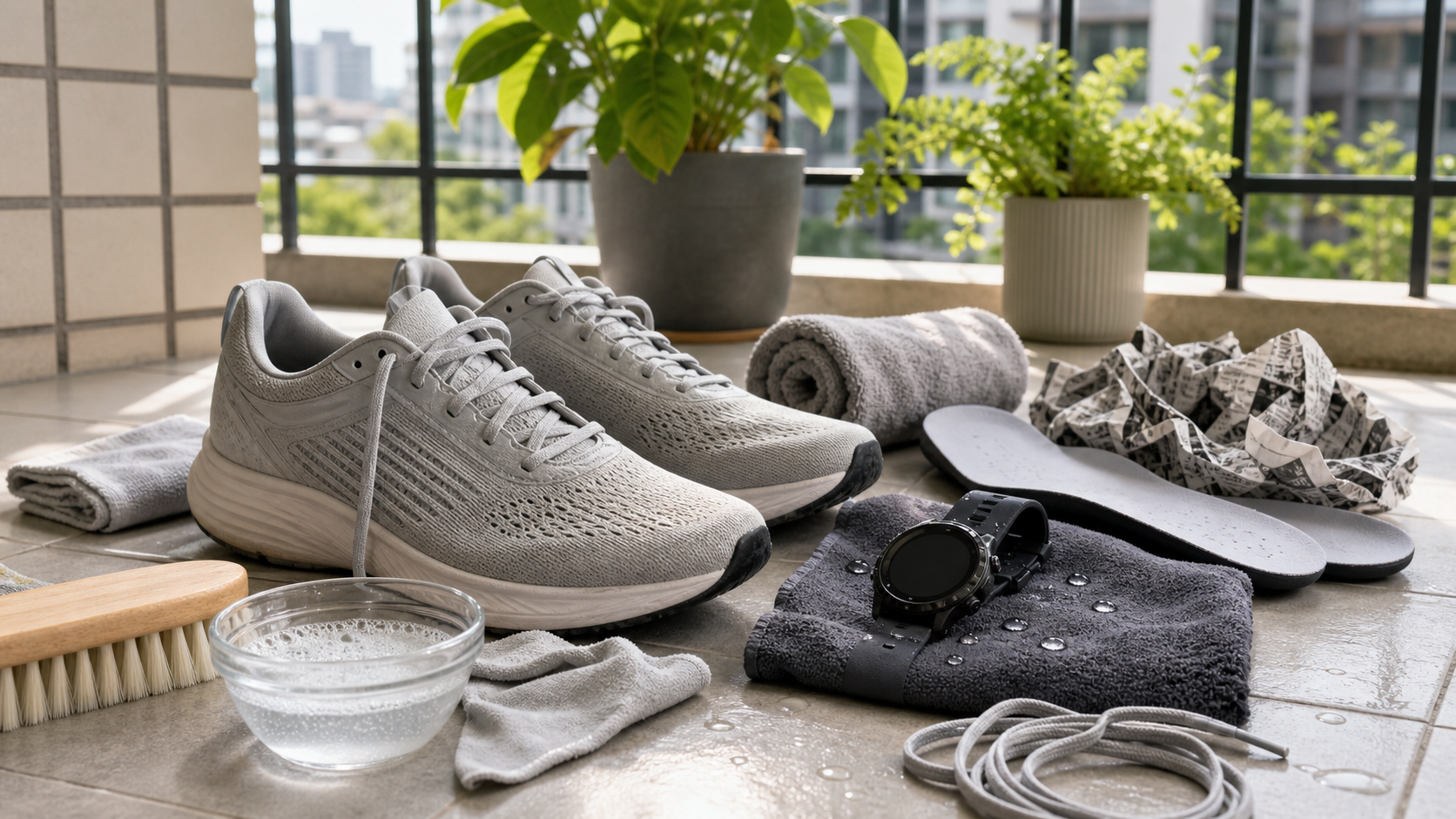
- Treat immediately after running: Use a soft-bristled brush (a toothbrush works fine) to remove mud and gravel from the tread grooves of the outsole, preventing dirt from hardening and becoming difficult to remove
- Upper cleaning: Wipe gently with a slightly damp cloth; for heavy dust, lightly scrub with clean water and mild dish soap (bleach-free)
- Remove the insoles: Take out the insoles after every run so both can air out separately, speeding up drying and reducing odor
- Stuff with newspaper: After cleaning wet shoes, stuff them with crumpled newspaper to help absorb moisture and maintain the shoe’s shape
The Right Way to Machine Wash (Conditionally Allowed)
| Step | Description |
|---|---|
| Before | Remove insoles and laces; hand-wash laces separately |
| Wash settings | Cold water (below 30°C), gentle/delicate cycle |
| Detergent | Mild liquid detergent; avoid bleach or fabric softener |
| Spin | Avoid high-speed spin; squeeze out excess water manually |
| Drying | Never use a dryer; air-dry naturally in a ventilated, shaded area |
Styles that should NOT be machine washed: Running shoes with carbon plates, certain leathers, or special mesh fabrics may have their internal structures damaged by machine washing and should be hand-washed only.
Fatal Shoe Maintenance Mistakes
- Direct sunlight: EVA foam cushioning materials degrade faster when exposed to direct high heat; Taiwan’s summer sun is especially dangerous
- Compressed storage: Shoes stacked and compressed in boxes are prone to deformation; use a shoe rack or stuff them to maintain shape
- Rapid drying (hair dryer/heater): Localized high heat can cause the bonded areas (where the upper meets the midsole) to delaminate prematurely
- Shared cleaning agents: Strong cleaners or acetone-based solvents can damage synthetic materials
Watch Maintenance: Preserving Water Resistance
Water Resistance Ratings Explained
- 3ATM (30m water resistance): Suitable only for use in rain, not for swimming
- 5ATM (50m): Suitable for swimming, but not for diving
- 10ATM (100m): Suitable for swimming and general water activities
- ISO 22810 (200m): Diving grade
Most running watches are rated 5ATM or above and can be used normally in rain or while swimming, but water resistance is not permanent.
Daily Maintenance of Water Resistance
- Rinse with fresh water after every contact with seawater: If Taiwanese runners train along coastal routes, residual salt will corrode the silicone gaskets at the case seams, accelerating aging
- Avoid hot water immersion: The high temperatures of saunas, hot springs, or baths cause silicone gaskets to expand and contract, gradually compromising water resistance over time
- Avoid spraying cleaners or sunscreen directly on the watch: Chemical ingredients may seep into the seams and damage internal components
- Have water-resistance testing done at the original manufacturer every 1–2 years (depending on usage intensity): The manufacturer can replace aged silicone gaskets to restore the original water-resistance rating
Strap Cleaning
| Strap Material | Cleaning Method | Cautions |
|---|---|---|
| Silicone strap | Clean with water and mild soap | Avoid strong solvents, or the silicone surface will become fuzzy |
| Rubber strap | Wipe with a soft cloth, rinse with water periodically | Avoid prolonged contact with oily substances |
| Nylon/fabric strap | Remove and hand-wash; reattach only after fully dried | Reattaching while damp can cause skin irritation |
| Leather strap | Wipe lightly with leather conditioner; avoid immersion in water | Best to switch to a silicone strap for workouts |
Heart Rate Strap Maintenance
- Rinse with fresh water after every use, especially the conductive electrode pads
- Avoid high-heat drying; air-dry naturally
- Store the elastic band flat to avoid prolonged curling that affects elasticity
- If the electrode pads show signs of corrosion, gently polish them with toothpaste to restore conductivity
Proper Washing of Athletic Apparel
- Cold water, gentle cycle: Polyester moisture-wicking fabrics can become permanently set with odors and have their surface moisture-wicking structure damaged by high heat
- Wash inside out: Reduces surface abrasion and protects reflective prints
- Avoid fabric softener: Softener molecules clog the pores of moisture-wicking fabrics, reducing their sweat-wicking performance
- Air-dry naturally: The high heat of a dryer damages Lycra/spandex elastic fibers, accelerating the loss of elasticity in garments
Gear Lifespan Management: When to Replace
- Running shoes: 300–600 km (carbon-plated race shoes around 400–500 km) is a general benchmark, but replace them as soon as cushioning noticeably declines—no need to wait for a specific mileage
- Compression socks: Replace immediately when elasticity noticeably loosens and compression feel disappears
- Heart rate straps: Replace electrode pads every 3–5 years; when electrode conductivity declines, heart rate signals become unstable
- Headlamp batteries: Rechargeable lithium batteries lose capacity after about 2–3 years; consider replacement when they can no longer sustain full runtime
Practical Tips
- Build a “5-minute post-run cleaning” habit: removing insoles, lightly brushing the outsole, and wiping down the watch are the most effective daily actions for extending gear lifespan
- Track cumulative shoe mileage monthly; start evaluating cushioning condition as you approach 400 km
- Taiwan’s summer sweat output is high, so athletic apparel should be washed more frequently than Western recommendations suggest; do not leave it “to wash the next day”
- GPS watch firmware updates often include sensor calibration; updating regularly maintains data accuracy
Conclusion
Gear maintenance doesn’t require spending extra money—just a few correct habits. Proper cleaning lets running shoes last an extra 100 km, and regular maintenance keeps watch water resistance intact for years. These are the most cost-effective returns on investment for runners. Taiwan’s hot, humid environment puts gear through harsher tests than in Europe or North America, so establishing maintenance habits suited to Taiwan’s climate lets every carefully chosen piece of equipment deliver its maximum lifespan.
Related Reading
- How to Extend Running Shoe Lifespan: The Complete Guide to Proper Running Gear Maintenance
- How Many Kilometers Before Replacing Running Shoes? Maintenance Tips to Extend Lifespan
- In-Depth Guide to Choosing Running Socks: A Comprehensive Comparison of Materials, Thickness, and Water Resistance
- Running Shoe Lifespan Fully Explained: When to Replace? 7 Signs of Wear and Scientific Mileage Management
洗單車神器 吹水機! 實際洗車用用看 暴力洗鍊條大法 | 公路車 | CT Yeh
4 年前
2025 自行車錶排行榜 兩萬車友大數據 / Garmin Bryton 排名會大洗牌嗎? / 全新的碼表前身分析 /公路車 / CT Yeh
1 年前
自助洗車場 洗單車 50元有找 清鍊條大法 居然還有小小兵
7 年前
Live) 備戰2019彰化經典百K 賽前攻略 (已完賽請看新影片
7 年前
單車 一日北高 ( 雙城 ) 肥宅雙人瘋狂行 紀錄片 REACTO
10 年前
一日北高前的高裝檢 | 北高 360 | 挑戰11小時的裝備 | 一日雙塔 | 補給
6 年前
2020 前十五名 台灣車友還在用的車錶? 同場加映武嶺四小時內的車友都用哪些車錶,以及車錶靈異經驗分享 北高居然騎了960公里!? | 車錶送修分享 | 公路車 | CT Yeh
5 年前
2026 車錶排行榜!誰是最多車友正在使用?練家子最愛哪款?🏆 (2萬名車友數據) / 公路車 / CT Yeh
5 個月前