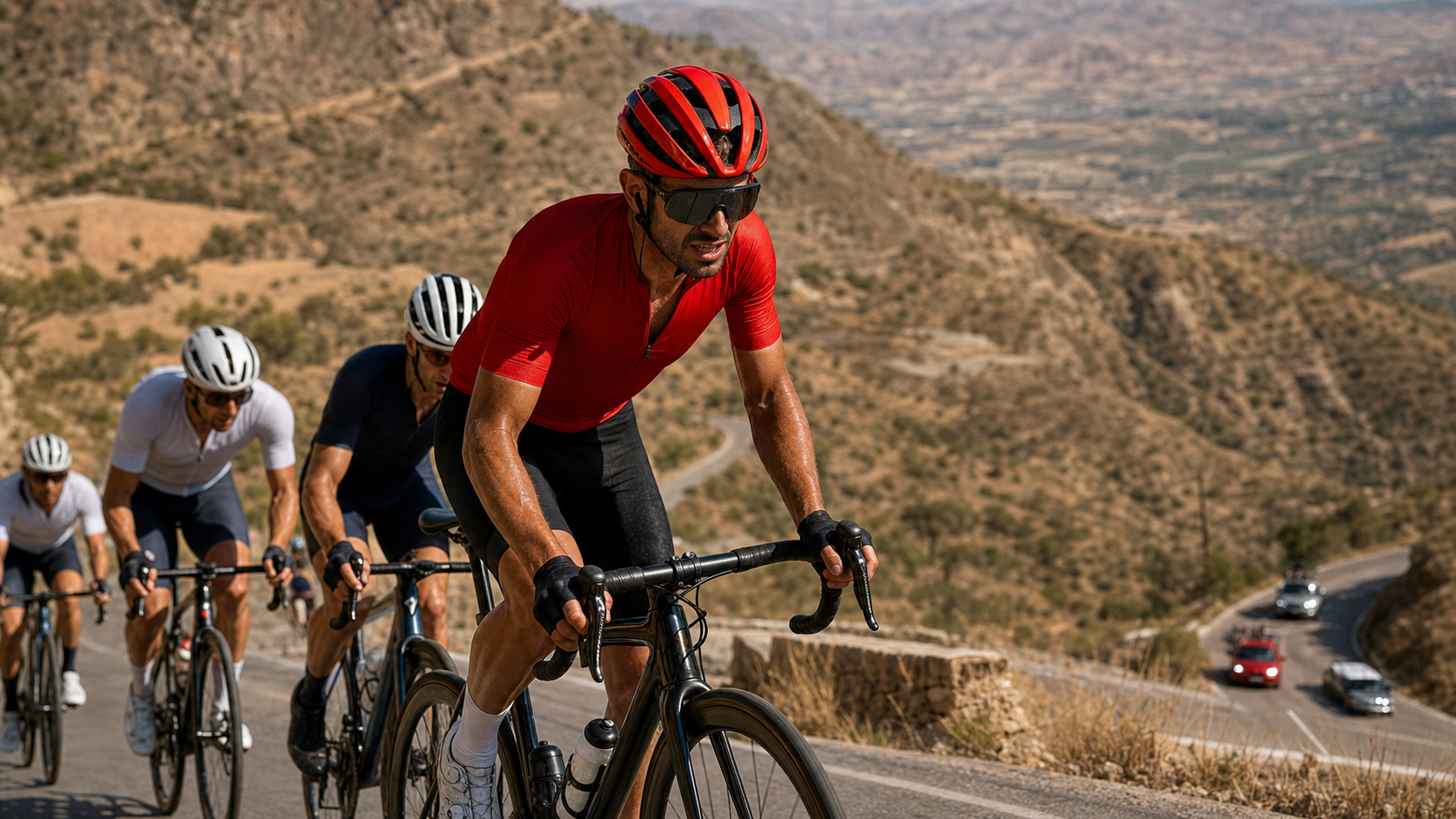
Vuelta a España: Climate, Route, and Unique Appeal of the Autumn Grand Tour
In late August, just as the glory of the Tour de France has faded, Europe’s top cycling season is far from over—the Vuelta a España is about to kick off under the scorching sun of the Iberian Peninsula. Affectionately nicknamed “La Vuelta” by fans, this race stands out among the three Grand Tours for its ever-changing route designs, sweltering conditions, and dramatic racing rhythm, making it the most unpredictable of them all.
Vuelta Race Basics
The Vuelta a España was founded in 1935, but it was the last of the three Grand Tours to establish its status at the very top of the sport. The modern Vuelta typically begins in the third week of August and ends in mid-September, also spanning three weeks with 21 stages.
| Race Attribute | Details |
|---|---|
| Dates | Late August to mid-September |
| Total Distance | Approximately 3,200–3,400 km |
| Main Terrain | Short steep climbs (Explosivo), dry plains, Andalusian hills |
| Overall Leader’s Jersey | Red Jersey (Maillot Rojo) |
| Mountains Classification Jersey | Polka Dot Jersey (Maillot de Lunares) |
| Points Classification Jersey | Green Jersey (Maillot Verde) |
Climate: A Test in the Furnace
Held in late summer on the Iberian Peninsula, the climate is one of the biggest challenges for riders. In Andalusia (a region the race frequently passes through), daytime temperatures in August can reach 38–42°C. Combined with 5–6 hours of high-intensity riding, dehydration and heat exhaustion are real risks.
How the climate affects the race:
- Rider hydration strategy: Team support cars frequently supply ice-cold water and ice vests, and staying alert on mountain descents is crucial
- Stage design favors short, steep climbs: Compared to the long grinding climbs of the Tour de France, the Vuelta leans toward summit finishes with short distances but extremely steep gradients (10–15%), making the racing more explosive
- Afternoon stage finishes: The hottest afternoon hours are usually reserved for flat sprint stages, while mountain stages are deliberately placed on higher-altitude routes where temperatures are slightly cooler
Vuelta Route Characteristics
The Vuelta’s route design is distinctly different from the Tour de France, with several defining features:
- High density of uphill finishes: Summit finishes appear at frequent intervals, quickly opening up gaps in the overall classification
- Short, explosive climbs: La Camperona and El Angliru (average gradient 9.8%, steepest section 23.6%) are legendary climbs where riders often need gear ratios of 34×32T or lower
- Routes traverse different regions of the peninsula: From Catalonia to Andalusia, from the Basque Country to Galicia, the route changes dramatically every year
The Time-Difference Advantage for Viewers
For Taiwanese fans, the Vuelta is the most viewer-friendly of the three Grand Tours in terms of time difference. Spain’s daylight saving time is CEST (UTC+2), a 6-hour difference from Taiwan (UTC+8). Stages typically finish between 8–11 PM Taiwan time, so there’s no need to stay up until dawn.
Viewing resources:
- GCN+: Full live coverage with technical commentary
- RTVE (Spanish national broadcaster): Official broadcast, with some free content on YouTube
- Eurosport: Mainstream European broadcasting platform with clear commentary
Primož Roglič and His Special Bond with the Vuelta
Roglič is one of the most successful riders in Vuelta history, having won the overall title three times (2019, 2020, 2021). His combination of time trial strength and uphill finishing ability makes him an iconic figure of the race. Even after multiple heartbreaks at the Tour de France, the Vuelta has always been the stage where he performs at his best.
Inspiration for Taiwanese Riders
The Vuelta’s short, steep climb design closely resembles Taiwan’s climbing terrain—Taiwan’s mountain routes (such as Wuling, Taipingshan, and Hehuanshan) feature steep gradients over short distances, perfectly matching the Vuelta’s “Explosivo” concept. Taiwanese cyclists can learn from watching the Vuelta about cadence control on short climbs, gear selection, and strategies for coping with heat.
Practical tips to observe:
- Watch riders’ cadence on 10% gradients (typically 70–80 rpm) to understand the trade-off between power pedaling and high cadence
- Pay attention to teams’ “domestique escort” strategies to learn how to save energy for the final climb
- Vuelta riders’ feeding intervals and fluid intake are an excellent reference for long summer rides in Taiwan
Conclusion
The Vuelta a España is the most “heated” of the three Grand Tours—both literally in terms of temperature and figuratively in the drama of its results. For Taiwanese fans, the Vuelta’s favorable time difference makes following the race easier, while its short, steep climbs bear a strong resemblance to Taiwan’s terrain. Every August and September, why not turn on the live stream after dinner and soak in the fiery passion of the Iberian Peninsula.
Related Reading
單車實況) 車測中心高速賽道 96 彰化讚 挑戰組一圈實錄 | ARTC
6 年前
2023桃園團體繞圈賽/環台賽等級拍攝/賽事精華/ 10人一隊缺一不可!50隊廝殺大場面 / 第三屆 海鷗繞圈賽 /公路車/CT Yeh
2 年前
西拉雅五庫單車挑戰 / 曾文水庫 & 南168 二寮 / 500元報名費居然這麼超值/ 公路車 / CT Yeh
10 個月前
一輪盃環湖挑戰賽 | TIME新車首航 | 一輪帶我飛 | 百萬流量都在場 | 4K畫質 | 公路車 | CT Yeh
3 年前
大武山後門26%歡樂陡坡!JJSC南台灣單車行Day2 / 被颱風追著跑 / 公路車 / CT Yeh
2 年前
2023自行車展!與環台賽選手一同表演賽 / 全自動AI Fitting?/ TIME新車發表/神秘充電桌等 精華分享 VLOG | CT Yeh | 公路車
3 年前
2023桃園團體繞圈賽 / 海鷗繞圈賽 | 全程空拍數據版 | 公路車 | CT Yeh
2 年前
嘉義大埔、阿婆灣挑戰賽,美到以為在日本!ft. 環騎5 Cool 西拉雅188 / 公路車 / CT Yeh
7 個月前