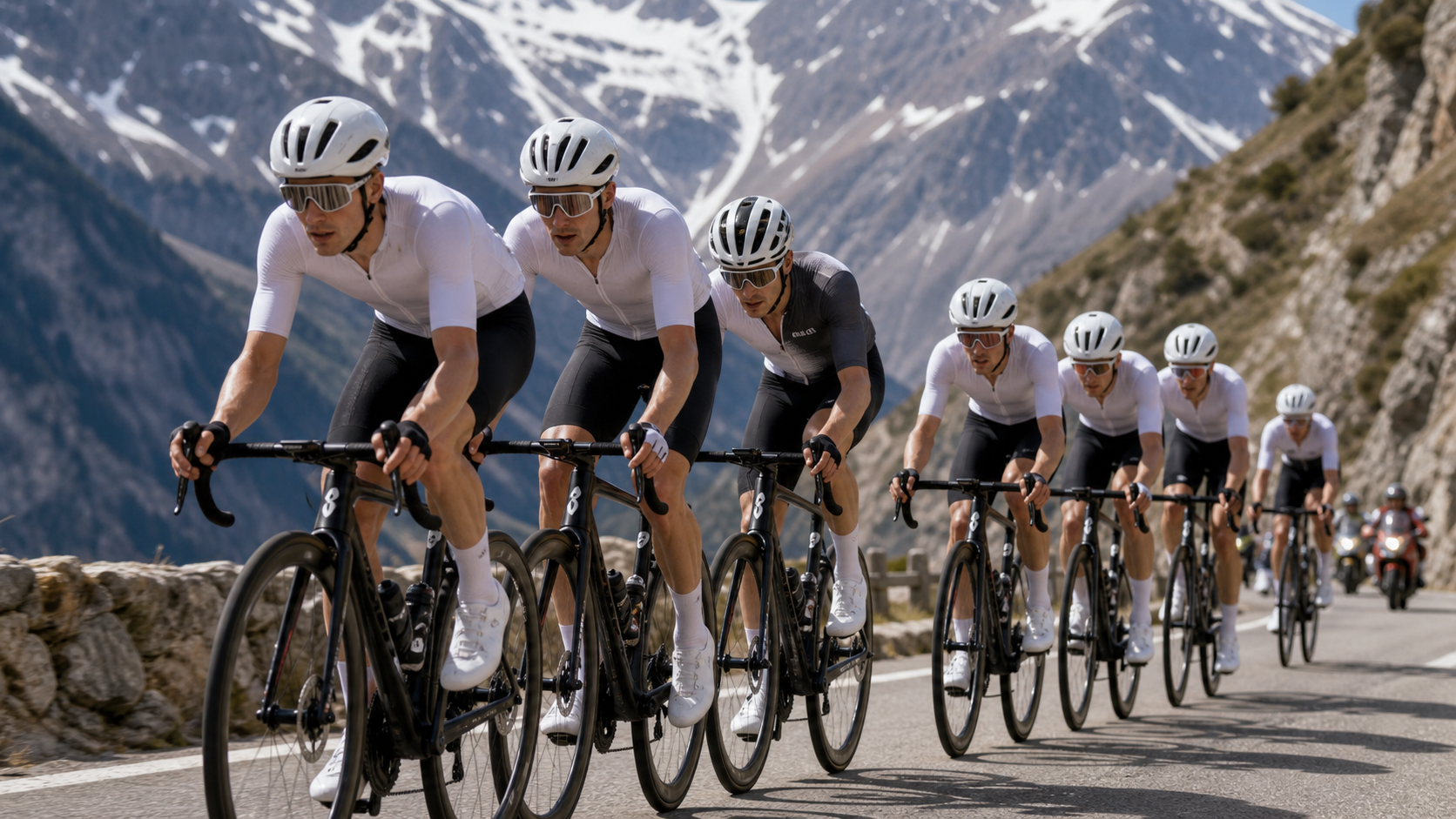
UAE Team Emirates Tactical Analysis: How to Build the Perfect Protective Shield Around Pogačar
In modern professional cycling, individual brilliance certainly matters, but what often decides the outcome is the collective intelligence and selfless dedication of an entire team. UAE Team Emirates’ success is a perfect example of individual talent combined with collective execution. This Emirati-sponsored team has built a precise and highly efficient race-day protection system around Tadej Pogačar, allowing “Pogi” to perform at his best in every decisive stage.
Team Structure and Role Division
UAE Team Emirates employs a clear division of roles, with each rider performing a specific function in different race scenarios:
| Rider | Role | Primary Function |
|---|---|---|
| Tadej Pogačar | Team Leader (GC Leader) | General classification battles, Grand Tour leader |
| Adam Yates | Deputy Leader / GC Support | Mountain escort, independent contender when needed |
| Marc Hirschi | Attacking Domestique | Breakaway stages, points accumulation |
| Brandon McNulty | Time Trial Support | Pace-setting in time trials, high-intensity support |
| Mikkel Bjerg | Time Trial Specialist / Flatland Escort | Individual time trials, organizing pace-chasing on flat stages |
| Juan Ayuso | Young GC Prospect | Grand Tour apprenticeship, leader in standalone races |
Three-Phase Mountain Protection Strategy
On high-mountain stages, UAE’s protection strategy unfolds in three phases, with precision comparable to a military operation:
Phase 1 (30–50 km from the summit): Collective Pace Control
- Team domestiques set the pace at the front of the peloton, keeping the team in the most advantageous position (top 10–15)
- Avoiding the danger of being caught in splits or exploited by rivals
- McNulty or Bjerg pulls at 450–500 W on 3–5% gradients, gradually shedding weaker riders from the back of the peloton
Phase 2 (10–20 km from the summit): Focused Escort
- Remaining domestiques (usually Yates or Hirschi) continue escorting Pogačar as the gradient steepens
- Ensuring Pogačar does not waste extra energy fighting crosswinds or following wheels before the attack
- If Pogačar is in exceptional form, the team may deliberately accelerate the pace to force rivals to show their cards early
Phase 3 (Final 3–5 km): Going It Alone
- Pogačar typically fights alone in the final 3–5 km
- His tactical options are extremely flexible: he may surge suddenly after a sharp corner, or wait until the steepest section to unleash
- The team continuously reports time gaps to rivals via race radio, helping Pogačar decide when to attack
Collective Execution in Sprint Stages
Even though Pogačar is known for his climbing, UAE also has a complete strategy for sprint stages:
- If the stage has little impact on the general classification, the team preserves Pogačar’s energy and lets other riders (such as Hirschi) sprint
- If there are points at stake (such as intermediate sprints), McNulty or Bjerg lead Pogačar out for sprint points
- On special stages like the Champs-Élysées, the entire team shifts to a pure lead-out train, ensuring Pogačar avoids crashing in the chaos
Team Radio and Data Command
Tactical execution in modern professional teams relies heavily on real-time data:
- Team Director (DS, Directeur Sportif): Sits in the follow car, directing on-road strategy via radio
- GPS Tracking: Each rider’s position, speed, and power are transmitted in real time to the support car behind
- Rival Monitoring: Analysts simultaneously track the roster attrition of rival teams such as Jumbo-Visma and Ineos
- Weather Forecasts: Real-time updates on summit temperatures and crosswinds determine whether extra warm clothing is needed on descents
The 2024 Challenge: Two Leaders Side by Side
As Juan Ayuso has grown into a GC rider capable of leading his own campaign, UAE has begun facing the challenge of a “dual-leader strategy.” At the 2024 Giro, Ayuso performed excellently as team leader, while Pogačar displayed overwhelming dominance at the Tour de France. This flexible “A-team / B-team” allocation allows UAE to compete for the highest honors across multiple races simultaneously, but it also tests the decision-making wisdom of team management.
A Perspective for Taiwanese Riders: Team-Building Logic from Amateur to Pro
While UAE’s collective tactics go beyond what amateur riders can directly apply, the core logic—clear role division, selfless support for the leader, and pace control as a priority—applies equally to amateur teams or climbing squads in Taiwan.
- In a group ride, taking turns at the front pulling wind is the most basic form of selflessness
- In mountain training, riders with strong pacing ability setting the tempo for others helps the whole group improve faster
- Knowing your role (am I a climber, sprinter, or rouleur?) makes training more targeted
Conclusion
UAE Team Emirates’ success tells us that world-class sports teams do not rely on a single genius alone, but on a precise system built around that genius. Pogačar is certainly the brightest star, but without the selfless contributions of every UAE rider, his brilliance would not shine so brightly. This is the most fascinating part of professional cycling—an individual race that conceals the most profound collective story.
Related Reading
- UAE Team Emirates’ Training Philosophy: How a Top Team Builds Champions
- All for One: How UAE Team Emirates XRG Builds Around Pogačar—A 2026 Season Case Study
- Tadej Pogačar Training Philosophy Analysis: The Slovenian Prodigy’s Aggressive Riding Style and Scientific Preparation
- How Are Pro Team Bikes Decided? A Look at the Three-Way Tug-of-War Behind Pogačar’s Sponsorship Deals
2025 海鷗團體繞圈賽 / 前八強賽事精華!/ 環台賽等級拍攝 / 國手菁英隊伍較勁 / CT Yeh #公路車
8 個月前
塔塔加 員工旅遊 加料 各路段大數據分析 | EP2 | 公路車 | CT Yeh
4 年前
新屋團體繞圈賽 | 眾多菁英好手賽道奔馳 | 千瓦女子軍團 | 無敵交管狂獲好評 明年你一定不能錯過 | #公路車
5 年前
Insta360/DJI做不到的!如何製作「騎士頭頂瓦數特效」單車影片?CycleDash 完整教學 / 超強批次影片數據疊加軟體
13 天前
單車元宇宙新霸主?TrainingPeaks Virtual 實測 / Zwift 完美平替? 還是超越?/ 有台灣國旗!前身 indieVelo / 公路車 / CT Yeh
1 年前
單車AI教練!全新 ChatGPT4o 幫你分析訓練成果!排武嶺課表,分析騎車姿勢! 太神了! / 公路車 / CT Yeh / feat. 緯緯
2 年前
如果Pogačar騎西進武嶺可以多快?會破2嗎?各種情況深度推估探討 / 公路車 / CT Yeh
2 年前
西進武嶺 免費訓練分析服務 Intervals | 練不夠還是練過頭?你哪一種類型選手?AI模型告訴你! | 備戰神器 | 公路車 訓練 | CT Yeh
4 年前