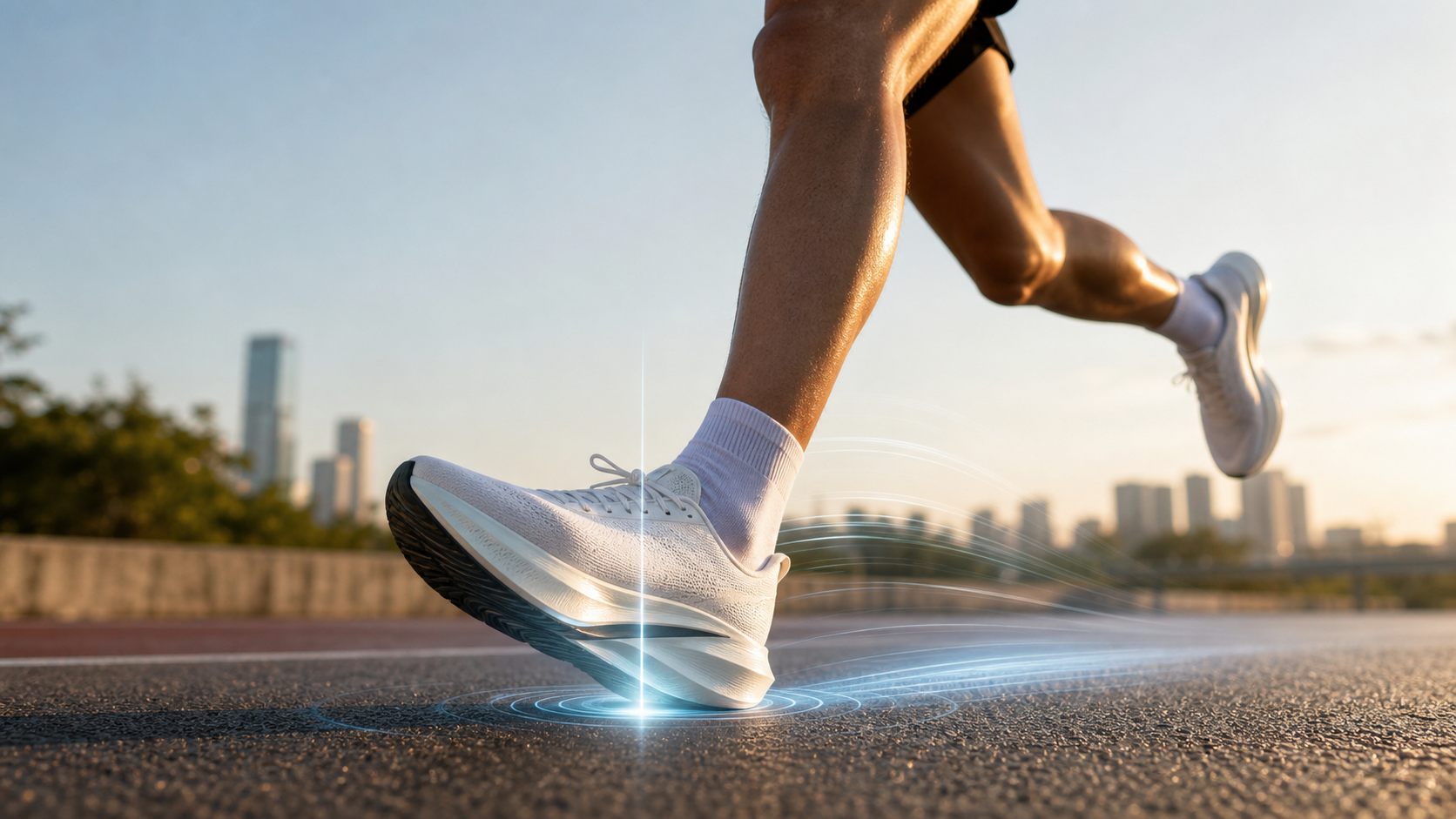
The Science of Ground Reaction Force and Energy Return in Carbon-Plated Shoes
Introduction
In 2017, Nike launched the Vaporfly series of carbon-plated running shoes, and elite marathon runners immediately showed a statistically anomalous collective improvement in performance. In 2019, Eliud Kipchoge, wearing carbon-plated shoes, completed the INEOS 1:59 Challenge in 1 hour 59 minutes 40 seconds, achieving the first sub-two-hour marathon in human history. The scientific community was stunned: could a pair of shoes really alter human biomechanics? The answer is yes, and the key lies in the efficiency of utilizing Ground Reaction Force (GRF).
Basic Concepts of Ground Reaction Force
According to Newton’s Third Law, when the foot pushes against the ground, the ground pushes back on the body with an equal and opposite force—this is the Ground Reaction Force (GRF). The essence of running propulsion is precisely the directional control and utilization of this reaction force:
- Vertical GRF: The largest component, approximately 2–3 times body weight, responsible for supporting body weight and generating the vertical component of propulsion.
- Anterior-Posterior GRF: Acts as a braking force (backward) during the early stance phase and as a propulsive force (forward) during the late push-off phase.
- Medial-Lateral GRF: Controls lateral stability and is typically the smallest component.
Engineering Design of Carbon-Plated Shoes
The performance of modern carbon-plated running shoes comes from three synergistic engineering elements:
| Element | Description | Effect |
|---|---|---|
| Carbon Plate | A rigid carbon fiber plate embedded in the full foot or forefoot | Stores and releases bending elastic energy, creating a seesaw effect |
| Super-thick PEBA Foam | High-rebound materials such as Nike ZoomX, Adidas Lightstrike Pro | Efficiently rebounds after each compression (energy return rate 85%+ vs. 65% for traditional EVA) |
| Rocker Geometry | Curved design with an upward-swept toe | Accelerates forward shift of the center of mass, shortening ground contact time |
Scientific Data on Energy Return
In 2017, Hoogkamer et al. published a quantitative study on the Vaporfly in Sports Medicine: compared with traditional racing shoes, runners wearing the Vaporfly improved running economy by 4.2%. This figure is remarkable in running science—a typical runner would need years of training to improve running economy by 2–3%.
In 2021, additional comparative studies on carbon-plated shoes showed:
- Ground contact time shortened by approximately 10–15ms (from 250ms down to 235–240ms)
- Increased work at the ankle joint, with relatively reduced work at the knee and hip (more efficient energy transfer)
- Increased forefoot metatarsal bending stiffness, reducing toe flexor fatigue
The “Metatarsal Rocker Effect” of the Carbon Plate
The traditional view holds that the carbon plate primarily “springs back” energy, but a more precise explanation is that the carbon plate increases the stiffness of the metatarsal joints, preventing energy leakage caused by the toes bending downward during the late push-off phase. This effect is called the “Metatarsal Rocker Effect”:
- Upon landing, the forefoot contacts the ground and the carbon plate begins to bend, storing energy
- The rigidity of the carbon plate prevents excessive downward pressing of the toes, preserving elastic potential energy
- During the late push-off phase, the carbon plate springs back, releasing stored energy to assist forward propulsion
- The rocker geometry simultaneously accelerates the forward shift of the center of mass, shortening ground contact time
Applicability for Everyday Runners
Carbon-plated shoes offer the greatest benefit to elite runners, but do they still benefit everyday runners? Research provides a cautiously optimistic answer:
- The faster the runner (pace of 3–4 minutes per kilometer), the more significant the benefit
- Runners at a pace of 5 minutes per kilometer or slower see a running economy improvement of about 2–3% (still helpful but smaller)
- Heel strikers benefit relatively less (carbon-plated designs are optimized for midfoot/forefoot strike patterns)
- Runners with insufficient calf strength may experience calf soreness after initial use (a side effect of increased ankle joint work)
Potential Risks of Carbon-Plated Shoes
- Metatarsal stress fractures: With increased forefoot stiffness, stress concentrates on the metatarsals; caution is needed with prolonged high-volume training.
- Achilles tendon overuse: Increased ankle joint work may place greater load on the Achilles tendon.
- Muscle strength dependence: Long-term use may reduce proprioceptive training of the calf muscles and foot arch.
Recommendation: Use carbon-plated shoes for races and speed training, and reserve everyday easy runs for regular training shoes.
Conclusion
The energy return science of carbon-plated running shoes is not merely a commercial gimmick—it is an engineering breakthrough supported by solid physics and biomechanical research. However, the best shoes are ultimately just tools—the runner’s fitness, running form, and pacing strategy are what fundamentally determine performance. For road running enthusiasts in Taiwan, wearing a high-quality pair of carbon-plated shoes on race day is indeed an investment backed by scientific evidence, but understanding how they work can also help you choose and use shoes more wisely, and build a solid foundation in your daily training.
Related Reading
- The Science of Carbon-Plated Running Shoes: In-Depth Analysis of Rebound Energy Feedback and Running Economy
- Biomechanics of Carbon-Plated Shoes: A Scientific Explanation of Elastic Rebound and Running Efficiency
- Biomechanical Analysis of Road Running: How Ground Reaction Force Determines Your Running Efficiency
- Sports Science of Carbon-Plated Running Shoes: An Analysis of the Nike Vaporfly Propulsion Mechanism
全台首發神車錶! iGPSPORT iGS630 兩趟一日北高的續航! 超強導航、功率訓練、超人性APP! Garmin & Bryton 有對手了嗎? | 公路車 |CT Yeh
3 年前
單車高張力拍攝神器 Antigravity A1 全景空拍機! / CT Yeh
30 天前
iPhone內建一秒變長腿🤣 車友必備#cycling
2 年前
再快都跟的上!? 單車跟隨攝影機之王 HOVERAir X1 PROMAX 全面實測 / 唯一!8K畫質&自行車專用模式和跟蹤信標&前後避障 / DJI Neo 可參考/ 公路車 / CT Yeh
1 年前
Nepest NOVA 碳條輪組:輕量、空力、舒適一次滿足!/ 公路車 / CT Yeh
7 個月前
#公路車 #Fitting 靠人工智慧APP 幫你調整單車
6 年前
全台首發!邁金P715踏板功率計!市場價格撼動者再出招 / 功率對比實測 / FAVERO ASSIOMA 可參考! / 公路車 / CT Yeh
1 年前
Insta360 X3 單車YT界的拍攝神器! 首發實測 | 超強AI後製! 超強夜拍實測! 帥氣騎車錄影自己來! | 公路車 |CT Yeh
3 年前