The Fatigue Mechanisms in Swimming: Central Fatigue vs. Peripheral Fatigue in Long-Distance Swimming
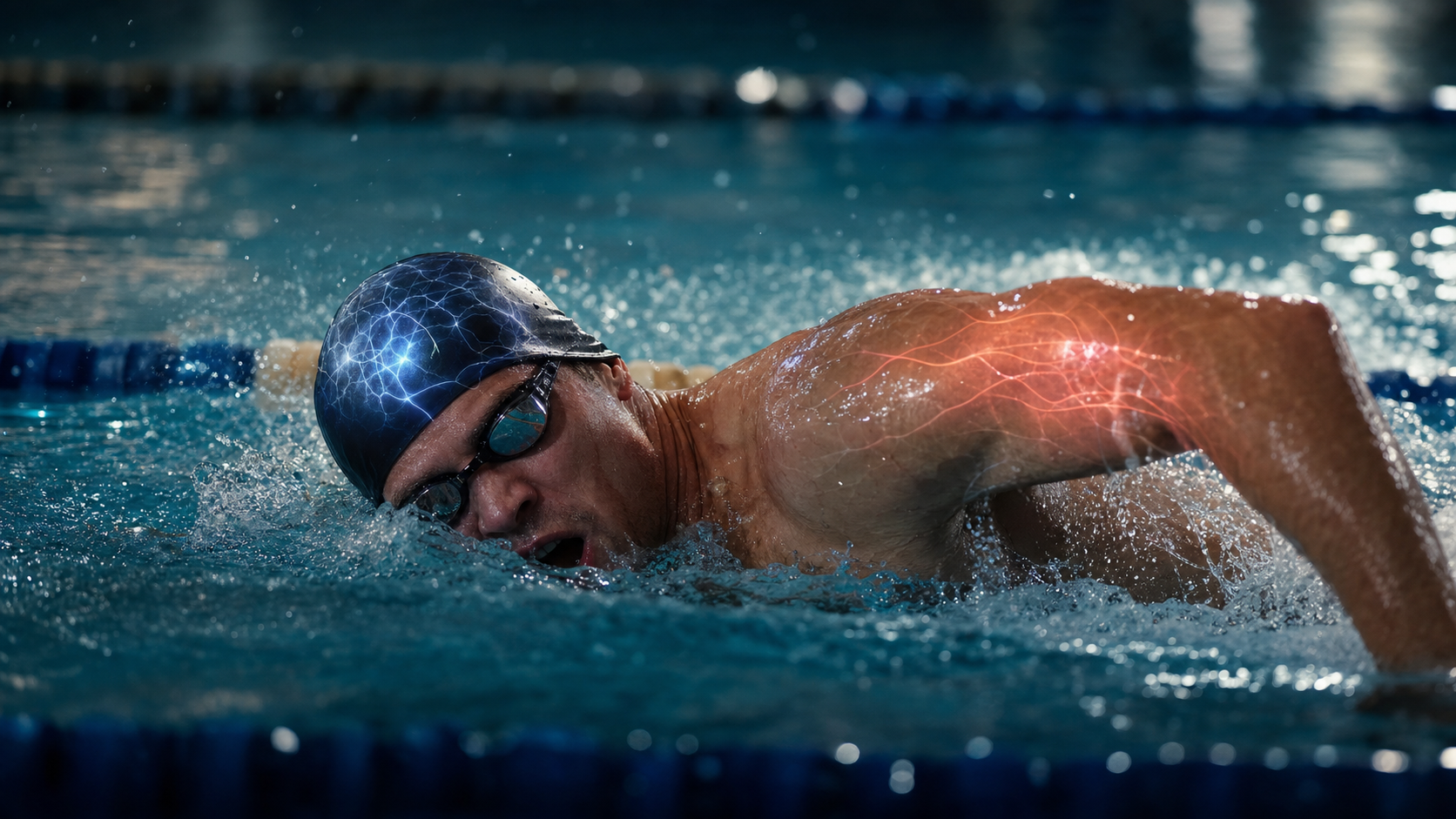
Fatigue: The Ultimate Challenge to Swimming Performance
“Why is it that I just can’t hold my speed in the final few hundred meters?” Every swimmer knows this feeling. Fatigue is the ultimate limiting factor in swimming performance, but “fatigue” is not a single phenomenon—modern sports science divides it into central fatigue and peripheral fatigue, and their relative contributions differ markedly across different swimming distances. Understanding this distinction has important implications for pacing strategies and training design.
Definitions of Central Fatigue and Peripheral Fatigue
| Fatigue Type | Location | Primary Mechanism | Detection Method |
|---|---|---|---|
| Central Fatigue | Brain, spinal cord, motor neurons | Inhibition of neural transmission, reduced motivation, altered neurotransmitters | Transcranial magnetic stimulation (TMS), neural activity markers |
| Peripheral Fatigue | Muscles, neuromuscular junctions | ATP depletion, lactate/H⁺ accumulation, impaired calcium regulation | Electromyography (EMG), muscle biopsy |
Molecular Mechanisms of Peripheral Fatigue
In long-distance swimming, peripheral fatigue is one of the first limiting factors to appear, and its primary molecular mechanisms include:
1. ATP and Phosphocreatine (PCr) Depletion
During high-intensity swimming (e.g., 200–400m races), PCr in the muscles is largely consumed within the first 30 seconds, limiting the rapid resynthesis of ATP and reducing muscle contractile force.
2. Lactate and Hydrogen Ion (H⁺) Accumulation
- Anaerobic glycolysis produces lactate while also releasing H⁺ (protons)
- H⁺ accumulation lowers muscle pH (from a normal 7.1 down to 6.7–6.9)
- Low pH inhibits phosphofructokinase (PFK), further hindering the glycolytic pathway
- Important clarification: Lactate itself is not the direct cause of fatigue; rather, it is the accumulation of H⁺. Lactate actually serves as a rapid energy source
3. Impaired Calcium Regulation
- Repeated muscle contractions lead to reduced calcium ion (Ca²⁺) release from the sarcoplasmic reticulum
- Actin-myosin cross-bridge formation is affected, reducing muscle contractile force
- This is one of the primary causes of the “muscle weakness” sensation in the later stages of long-distance swimming
4. Inorganic Phosphate (Pi) Accumulation
- PCr breakdown produces large amounts of inorganic phosphate
- Pi directly interferes with the cross-bridge cycle in muscle fibers, reducing the force generated by each cross-bridge
Neurophysiological Mechanisms of Central Fatigue
Central fatigue is a relatively new and still actively researched area that plays an increasingly important role in long-distance swimming (e.g., 1500m, open-water 10km).
1. Afferent Inhibition
Fatigued muscles produce metabolic byproducts (lactate, adenosine, ATP), which activate type III and type IV afferent nerves in the muscle, sending “inhibitory signals” to the brain. The brain then reduces the firing rate of motor neurons, actively protecting the body.
Central Governor Theory:
South African sports scientist Tim Noakes proposed that the brain (particularly the anterior cingulate cortex) continuously assesses the danger of exercise and “commands” the muscles to reduce output when necessary. In other words, “not being able to swim on” is sometimes not because the muscles are truly exhausted, but rather an active protective mechanism of the brain.
2. Neurotransmitter Changes
Prolonged exercise alters the balance of neurotransmitters in the brain:
- Increased serotonin (5-HT): Associated with feelings of fatigue, drowsiness, and reduced motivation
- Relatively decreased dopamine (DA): Reduced motivation and arousal
- Increased tryptophan/branched-chain amino acid ratio in the brain: Promotes greater serotonin synthesis
This is the neurochemical basis for the psychological feeling of “just wanting to stop” in the later stages of long-distance swimming.
Dominant Fatigue Factors by Swimming Distance
| Swimming Distance | Peripheral Fatigue Proportion | Central Fatigue Proportion | Primary Limiting Factor |
|---|---|---|---|
| 50m | 60–70% | 30–40% | PCr depletion, neural conduction velocity |
| 100m | 55–65% | 35–45% | H⁺ accumulation, calcium regulation |
| 400m | 45–55% | 45–55% | Aerobic capacity ceiling |
| 1500m | 35–45% | 55–65% | Central fatigue dominant |
| Open-water 10km | 20–35% | 65–80% | Central inhibition, glycogen depletion |
Swimming’s Unique Fatigue Patterns
Compared with running or cycling, swimming has several distinctive fatigue characteristics:
- Technical deterioration accelerates fatigue: Swimming technique relies heavily on neuromuscular coordination; once central fatigue causes technical breakdown (e.g., head lifting, kicking too deep), drag increases sharply, and fatigue follows a positive feedback loop of accelerating deterioration
- Breathing constraints exacerbate central fatigue: Swimmers cannot breathe freely at will, so CO₂ accumulates faster than in land-based sports, accelerating central inhibitory signals
- Cold water slows peripheral fatigue but does not affect central fatigue: Cold water can temporarily lower muscle metabolic rate and reduce peripheral fatigue accumulation, but its protective effect on central fatigue is limited
Evidence-Based Strategies to Delay Fatigue
Delaying Peripheral Fatigue
- Lactate threshold training (CSS training): Raises lactate threshold speed, reducing lactate and H⁺ accumulation at race pace
- Sodium bicarbonate supplementation: Take 0.2–0.3 g/kg 60–90 minutes before racing to increase blood buffering capacity and delay pH decline (gastrointestinal response should be tested in advance)
- Intermittent carbohydrate intake: In ultra-long open-water swimming, regularly replenish energy to prevent muscle glycogen depletion
Delaying Central Fatigue
- Pacing training: Train the brain to adapt to the sensation of “propulsion,” learn to ignore early central inhibitory signals, and build tolerance to fatigue
- Carbohydrate mouth rinsing: Research shows that even without swallowing, rinsing the mouth with a carbohydrate solution can activate the brain’s reward circuitry and delay central fatigue (may have application potential for long-distance swimming)
- Positive mental imagery: Visualize successful pacing before a race to train the anterior cingulate cortex’s inhibitory regulation capacity
- Music (when surfacing to breathe): Research shows that music can lower subjective ratings of perceived exertion (RPE) and help delay central fatigue
Practical Pacing Recommendations
With an understanding of fatigue mechanisms, the optimal pacing strategy for long-distance freestyle swimming should be:
- First 20%: Restrain the instinctive urge to surge; start at 95–97% of target pace
- Middle 60%: Maintain a steady pace, avoid excessive H⁺ accumulation, and “bank” central reserve
- Final 20%: If the early portion was properly restrained, central reserve remains at this point, allowing a gradual acceleration to 102–105% of target pace
Conclusion
Fatigue in swimming is not simply “muscles running out of strength,” but rather a complex result of the interaction between the central nervous system and muscle metabolism. The longer the swimming distance, the greater the proportion of central fatigue in the later stages. Recognizing this scientific fact can help swimmers build fatigue tolerance more purposefully in training, manage pacing more intelligently in competition, and make the right physical choices at the moment of greatest mental exhaustion.
Related Reading
- The Fatigue Mechanisms in Swimming: The Interaction Between Central Fatigue and Peripheral Muscle Fatigue
- Neuromuscular Fatigue in Swimming: The Physiological Mechanisms of Technical Breakdown
- The Science of Running Fatigue: How Central and Peripheral Fatigue Jointly Determine Your Limits
- Central Fatigue and Peripheral Fatigue: Decoding the Dual Mechanisms of Exercise Exhaustion
西進武嶺 免費訓練分析服務 Intervals | 練不夠還是練過頭?你哪一種類型選手?AI模型告訴你! | 備戰神器 | 公路車 訓練 | CT Yeh
4 年前
一日北高/長距離團騎 常見問題補充篇 / 組團或跟團的眉角 / 壯車友容易被瘦車友慢性拉爆 / 原來屁股痛可能是這個原因...? / 風場配速法 / 公路車 / CT Yeh
2 年前
西進武嶺 自製新版AI配速表產生器 x 賽前攻略 抱佛腳! 沒有功率計也可以產生配速表嗎?有什麼其他眉角賽前要注意的呢? | 西進武嶺 / 東進武嶺 KOM 攻略 | 公路車 | CT Yeh
4 年前
一起升級!海鷗盃LSD團練...JJSC Zone2招待 騎到手抖 / 公路車 / CT Yeh
1 天前
一日北高前的西濱集訓 | 跟著11小時軍團 | 300W踩不動的大逆風 | 輪車破風差幾瓦?
6 年前
2026 輪霸西濱200K 挑戰VLOG / 第一集團 / 首次參加..經驗不足、膀胱不足 /死守6H內 / AI戰鬥力顯示系統 / 公路車 / CT Yeh
4 個月前
FTL 與 SYB 車隊專訪 西進武嶺 實用攻略分享! 2小時 如何練?!你不知道的眉角!新手準備武嶺必看 EP1 | 實力派女車友 | 精華版 | 公路車 | CTYeh
4 年前
一日北高常見問題大集合 | 攻略 | 路線 | 訓練 | 補給 | 自行車 單車 | 一日雙城 | 雙塔 | TWB北高360 | 屁股痛
6 年前