Introduction
Many Taiwanese cyclists diligently ride the Beiyi Highway and climb Wuling every week, only to find their climbing performance plateauing. This is often not a cardiorespiratory issue, but rather insufficient strength in a specific link of the “power transmission chain.” Climbing demands highly coordinated, sustained output from the quadriceps, glutes, core, and hip flexors—a weakness in any one link drags down overall efficiency. This article provides a strength training program tailored for climbing, centered on single-leg movements to precisely strengthen the muscles required for climbing.
Anatomy of Climbing Muscles
The pedaling motion can be divided into four phases, each dominated by different muscle groups:
| Pedaling Phase | Primary Muscles | Common Weakness Manifestations |
|---|---|---|
| Downstroke (12→6 o’clock) | Quadriceps, Glutes | Knee valgus or varus when climbing |
| Backstroke (6→9 o’clock) | Hamstrings, Calves | Obvious dead spot, power loss |
| Upstroke (9→12 o’clock) | Hip Flexors, Iliopsoas | Anterior thigh fatigue in the latter part of climbs |
| Forward push (after 12 o’clock) | Gluteus Medius, Abductors | Pelvic instability, side-to-side rocking |
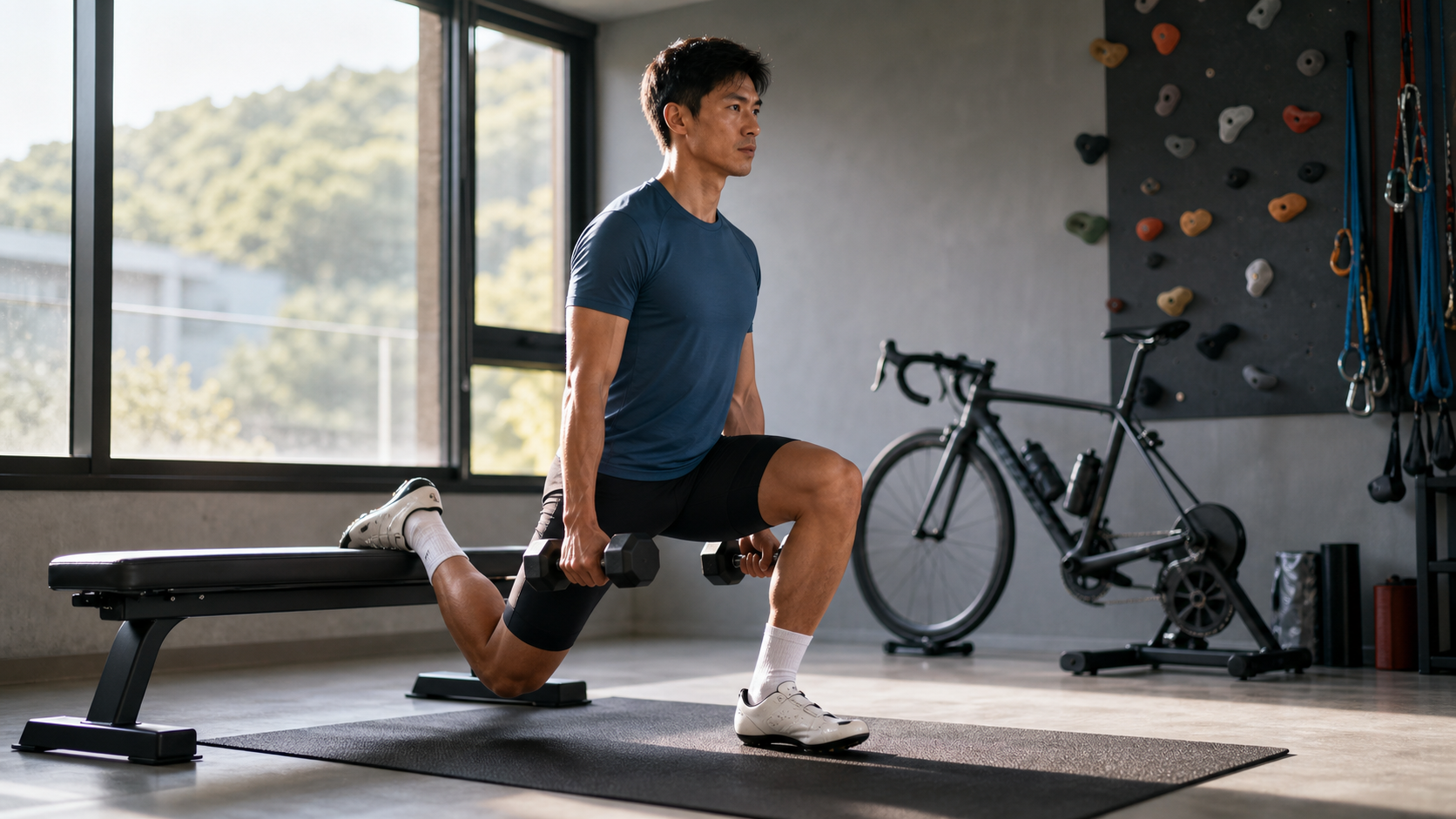
Core Exercise One: Bulgarian Split Squat
The Bulgarian split squat is the strength exercise that most closely mimics the pedaling motion, simultaneously strengthening the quadriceps, glutes, and hip stabilizers.
Instructions:
- Stand about 60 cm in front of a bench, resting the instep of your rear foot on the bench
- Squat down with your front knee aligned with your second toe
- Lower until your thigh is parallel to the floor, without letting your front knee travel too far past your toes
- Drive upward through the floor, feeling the contraction in your glutes and quadriceps
Program Recommendations:
- Beginner: 3 sets × 8 reps per leg, bodyweight or with light dumbbells
- Intermediate: 4 sets × 10 reps per leg, with moderate dumbbells
- Advanced: 4 sets × 6–8 reps per leg, with heavy dumbbells or a barbell
- Rest: 90–120 seconds between sets
Core Exercise Two: Hip Flexor Strengthening
The hip flexors (especially the iliopsoas) are responsible for generating force during the upstroke phase of pedaling and are a common source of fatigue in the latter part of climbs.
Exercise One: Standing Knee Drive
- Stand tall with your core engaged
- Balance on one leg while driving the other knee up to hip height
- Hold at the top for 2 seconds, feeling the hip flexor contract
- 3 sets × 12 reps per leg
Exercise Two: Supine Scissor Kicks
- Lie on your back with your lower back pressed into the floor, legs raised 15–30 cm
- Alternately kick your legs up and down, mimicking the pedaling motion
- 3 sets × 20 seconds, maintaining continuous tension in the lower abs and hip flexors
Core Exercise Three: Single-Leg Glute Bridge
The glutes are the most important power-producing muscles when climbing, yet many cyclists have insufficient glute activation, leading to over-reliance on the quadriceps.
Instructions:
- Lie on your back with one knee bent and foot on the floor, the other leg extended and raised
- Drive through the foot on the floor to lift your pelvis until your body forms a straight line
- Hold at the top for 2–3 seconds, feeling the contraction in the working-side glute
- 3 sets × 10–12 reps per leg
4-Week Climbing Strength Program
Below is a 4-week program framework designed to complement your riding training:
| Week | Strength Training Frequency | Key Exercises | Load Settings |
|---|---|---|---|
| Week 1 | 2 sessions per week | Bulgarian Split Squat + Single-Leg Glute Bridge | Light load, focus on mastering form |
| Week 2 | 2 sessions per week | Same as above + Hip Flexor Training | Increase load by 10–15% |
| Week 3 | 3 sessions per week | Full routine | Peak load week |
| Week 4 | 1 session per week | Light maintenance | Deload, integrate with riding |
Practical Tips
- Schedule strength training after riding sessions or on separate non-riding days to avoid fatigue compromising ride quality
- Add 10 dynamic Bulgarian split squats to your warm-up before climbing to pre-activate the glutes
- If you experience knee pain while climbing, first check saddle height and quadriceps flexibility rather than immediately increasing training volume
- Reassess your strength levels every 6–8 weeks and adjust training intensity accordingly
Conclusion
Climbing is not just a test of cardiorespiratory fitness—it is the integrated expression of your entire muscular chain. Through consistent training with Bulgarian split squats, hip flexor exercises, and single-leg glute bridges, you will build a stronger, more efficient pedaling power system. The next time you feel power in every pedal stroke on the long climbs of Hehuan Mountain, you’ll be grateful for the foundation you built in the gym.
Related Reading
- Climbing-Specific Strength Training: Glute and Core Strengthening Program
- Hip Flexor Strengthening for Runners: Climbing Ability and Stride Extension Training Plan
- Climbing-Specific Strength: How to Build Legs That Won’t Slow Down on Long Climbs in the Gym
- Beginner’s Guide to Weight Training for Cyclists: Proper Form for Squats, Deadlifts, and Single-Leg Exercises
一日北高/長距離團騎 常見問題補充篇 / 組團或跟團的眉角 / 壯車友容易被瘦車友慢性拉爆 / 原來屁股痛可能是這個原因...? / 風場配速法 / 公路車 / CT Yeh
2 年前
一日北高常見問題大集合 | 攻略 | 路線 | 訓練 | 補給 | 自行車 單車 | 一日雙城 | 雙塔 | TWB北高360 | 屁股痛
6 年前
單車 一日北高 ( 雙城 ) 肥宅雙人瘋狂行 紀錄片 REACTO
10 年前
#北橫 + #北進武嶺 最硬的員工旅遊 EP1 | #公路車 #拉拉山 | 明池 | 武嶺 | 武陵農場 | 雲海 | Taiwan Cycling Route Wulin
6 年前
2019 柯P 超越北高 第一集團實錄 (11小時實錄請參考另一部影片) 一日雙城 一日北高 NeverStop Taiwan Long Distance Cycling Challenge
7 年前
大禹嶺 到 武嶺牌樓 全程前後實況錄影 | 北進武嶺 | 東進武嶺 | KOM | 訓練台 | 坡度分析 | Taiwan KOM Last 10 km HARD | 公路車
6 年前
西進武嶺 免費訓練分析服務 Intervals | 練不夠還是練過頭?你哪一種類型選手?AI模型告訴你! | 備戰神器 | 公路車 訓練 | CT Yeh
4 年前
ThinkRider 智騎 XXPRO 訓練台,高階機種功能 只要 1/3價格!? 實測功率對比、噪音實測 / 公路車 / CT Yeh
1 年前