Introduction
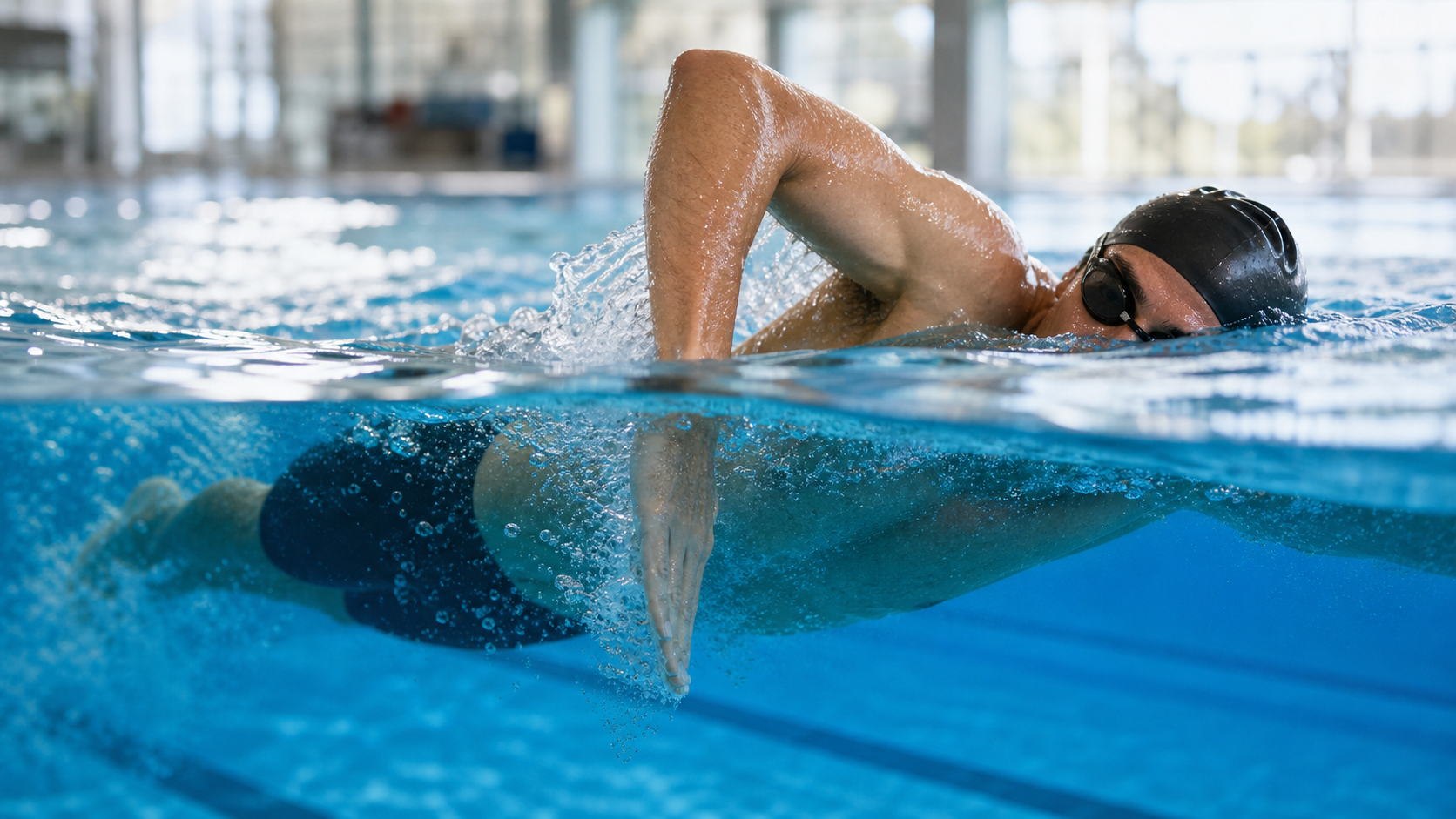
If high-elbow entry is the ticket to freestyle technique, then the Early Vertical Forearm (EVF) is the core code to advanced swimming efficiency. This technical concept, popularized by legendary coach Bob Bowman (Michael Phelps’ coach) and others, has gradually gained attention in swimming training circles across Taiwan in recent years. Simply put, EVF means getting the forearm into a vertical position as early as possible during the catch phase, so that the palm and forearm form a “large paddle surface” that applies maximum backward force to the water.
The Technical Principles of EVF
Traditional stroke instruction often focuses on “palm pulling,” while EVF technique emphasizes using the entire forearm (from elbow to fingertips) as a single propulsive surface.
Why is EVF more efficient?
When the forearm is perpendicular to the water surface, the propulsive area is 2–3 times greater than pulling with just the palm. According to fluid dynamics, propulsive force is proportional to contact area, so EVF generates greater propulsion with the same muscular effort.
The Key Role of the Elbow
The core of EVF technique lies in the high elbow catch: after the hand enters and extends, the elbow bends slightly outward and downward, the wrist presses down, and the forearm quickly rotates to a vertical position. This movement requires coordinated activation of the serratus anterior and the rotator cuff muscles, making it the most difficult technical element for many recreational swimmers to master.
EVF Phase-by-Phase Technical Breakdown
| Phase | Key Action Points | Common Errors | Correction Methods |
|---|---|---|---|
| Entry & Extension | Arm extended, elbow slightly higher than wrist | Hand touches water first on entry (low elbow) | High-elbow entry drills |
| Catch Initiation | Wrist presses down, elbow abducts outward | Elbow sinks first (shoulder pull) | Slow-motion single-arm stroke |
| Vertical Forearm | Forearm perpendicular to water, elbow under shoulder | Forearm angle too steep (shallow catch) | Catch awareness training |
| Pull Completion | Forearm pushes back to beside the thigh | Incomplete pull, early exit | Full pull awareness drills |
EVF Training Plan for Taiwanese Swimming Enthusiasts
Phase 1: Awareness Training (Recommended 2 weeks)
Sculling
This is the foundational EVF drill. Hold a pull buoy between your feet and scull your arms in a figure-8 pattern in front of your chest, feeling the water pressure on your palms and forearms. Many advanced swimming classes in Taiwan incorporate this drill; it is recommended to do 100–200 meters of sculling as a warm-up before each session.
Finger Paddles
Wear small finger paddles (smaller than regular paddles) to amplify the sensation of water on your palms. Be careful not to use oversized paddles, as they can lead to compensatory movement patterns.
Phase 2: Movement Building (Recommended 3–4 weeks)
Single-Arm Stroke with Kickboard
Hold a kickboard with one hand while performing a full freestyle stroke with the other, slowing down to 60% of normal speed, focusing on the feeling of the forearm “hanging” on the water.
Catch-Up Drill
The lead arm extends and waits for the trailing arm to enter the water before beginning its pull, forcing every stroke to fully execute a high-elbow catch. During open lane swim times at Taipei Municipal Swimming Pool or Kaohsiung Jhongjheng Swimming Pool, you can claim a lane for slow, focused practice.
Wall Push Simulation (Dry Land)
Push against a wall with both hands, simulating the EVF catch motion, and feel the activation sequence of the serratus anterior and latissimus dorsi.
Phase 3: Integration & Application (From Week 5 onward)
- Ratio Training: In every 200 meters, swim the first 50 meters at a slow technical pace (focusing on EVF), then the remaining 150 meters at normal speed, attempting to maintain the technique
- Visual Feedback: At Qingshui Swimming Pool (Taichung Qingshui Public Swimming Pool) or school outdoor pools with higher water clarity, have someone film an underwater side-view video to confirm your catch angle
Common EVF Myths Debunked
- “EVF requires a lot of strength”: False. EVF emphasizes efficiency—applying force in the right direction, not more force.
- “Only competitive athletes need EVF”: Anyone looking to improve swimming efficiency can benefit, especially triathletes, for whom EVF can significantly conserve energy in long-distance swimming.
- “EVF hurts the shoulders”: When performed correctly, EVF actually protects the shoulders; shoulder injuries are usually caused by improper technique (bending the elbow too early to pull).
Practical Tips
- Do 5 minutes of dry-land shoulder mobility warm-up before entering the water, including shoulder circles and external rotation exercises
- Record your technical sensations after each session and keep an improvement log
- Race footage of Taiwanese swimmers such as Huang Mei-Chien and Chang Ya-Ting can be found on YouTube; carefully observing their catch mechanics is excellent learning material
- Schedule underwater video recording every 2–4 weeks and compare progress against previous footage
Conclusion
Learning EVF technique is a gradual process—from awareness training to movement building, then to integration and application—requiring patience and sustained deliberate practice. Although Taiwan’s swimming environment is dominated by indoor pools, as long as you make purposeful use of every swim session for technical practice, mastering EVF is not out of reach. Remember, every correctly executed EVF stroke is an investment in efficiency.
Related Reading
- Early Vertical Forearm (EVF) Catch Technique: The Key to Freestyle Pull Trajectory
- Freestyle High-Elbow Catch (EVF) Fully Explained: How Early Vertical Forearm Lets You Advance 15% Further Per Stroke
- Freestyle High-Elbow Catch Fully Broken Down: The Mechanics Secrets from Entry to Push
- Freestyle High-Elbow Catch Technique: Muscle Activation Sequence and Common Error Analysis
CT 喇低賽) 武嶺牽車 才是王道 西進牽車四小時內秘訣 攝手位置 如何判斷 防抽筋小秘訣
7 年前
西進武嶺 自製新版AI配速表產生器 x 賽前攻略 抱佛腳! 沒有功率計也可以產生配速表嗎?有什麼其他眉角賽前要注意的呢? | 西進武嶺 / 東進武嶺 KOM 攻略 | 公路車 | CT Yeh
4 年前
FTL 與 SYB 車隊專訪 西進武嶺 實用攻略分享! 2小時 如何練?!你不知道的眉角!新手準備武嶺必看 EP1 | 實力派女車友 | 精華版 | 公路車 | CTYeh
4 年前
西進武嶺 免費訓練分析服務 Intervals | 練不夠還是練過頭?你哪一種類型選手?AI模型告訴你! | 備戰神器 | 公路車 訓練 | CT Yeh
4 年前
戰略) Zwift Race 如何咬在第一集團 如何評估自己要開多少推力 (請開1.5倍速看)
7 年前
風櫃嘴 衝刺慢動作回放!
8 年前
[教學] Premiere 影片 手震 修正 教學 防抖 單眼 影像 GoPro 穩定 Video Stabilization
8 年前
CT趣訪 西進武嶺 2小時組 EP2 全村的希望 蔣緯緯! 訓練菜單&技巧公開 |公路車 |CT Yeh
4 年前