The Wave Motion of Butterfly Dolphin Kick: Coordinated Training from the Lumbar Spine to the Ankles
Introduction
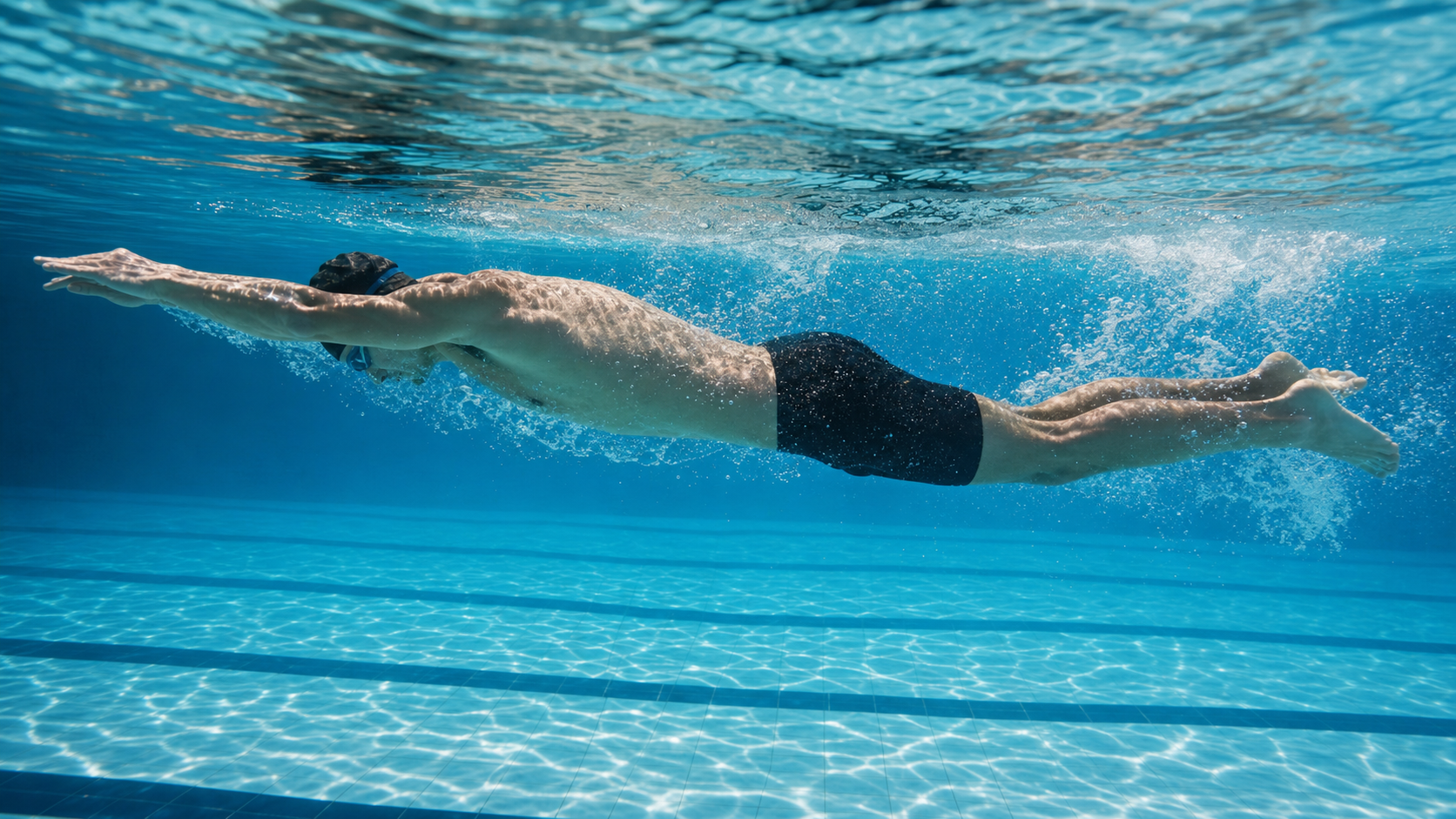
The Butterfly Stroke is the most difficult of the four competitive swimming strokes, and the Dolphin Kick is its defining movement. Many swimming enthusiasts, when first trying the butterfly, tend to think of the dolphin kick as “slapping the legs hard,” only to find themselves exhausted after a few meters—and slow. The true dolphin kick is not about brute force, but about a wave-like linkage from the lumbar spine to the ankles, transmitting energy from the upper body to the ankles, where it is ultimately converted into propulsion.
The Wave Mechanics of the Dolphin Kick
The propulsion principle of the dolphin kick resembles fish swimming, and its efficiency is far higher than that of a flapping motion driven solely by leg strength. The wave action is transmitted sequentially through the following nodes:
Lumbar Spine → Hip Joint → Knee Joint → Ankle Joint → Sole of the Foot
The energy transmission path runs from top to bottom, with each joint flexing and extending at the right moment to amplify the force from the previous node. This is like cracking a whip—a small motion at the wrist can generate tremendous speed at the tip.
Movement Requirements for Each Node
| Body Part | Movement Requirement | Flexibility Demand | Common Issues |
|---|---|---|---|
| Lumbar Spine | Starting point of the wave, moderate flexion and extension | Moderate | Stiff lower back, interrupted wave |
| Hip Joint | Vertical range of approximately 30–40 cm | Moderate | Insufficient range, weak propulsion |
| Knee Joint | Flexion no greater than 90° | Low (mainly control) | Excessive flexion, increased drag |
| Ankle Joint | Plantarflexion and relaxation to maximize sole area | High | Stiff ankle, unable to extend the sole |
| Sole of the Foot | Relaxed, toes pointing backward | High | Tight ankle, sole pointing upward |
The Importance of Lumbar Spine Flexibility
The dolphin kick wave begins at the lumbar spine, and lumbar flexibility directly determines the quality of the wave. If the lower back is stiff, the wave motion is “interrupted” at the lumbar spine, energy cannot reach the lower limbs, and the kick can only be sustained by leg strength—extremely inefficient and prone to fatigue.
Training to improve lumbar spine flexibility:
- Cat-Cow: Start on all fours, alternately arching and dipping the back, 15 reps per set, 2 sets daily
- Cobra Pose: Lie prone, press the hands into the floor to lift the upper body, feeling the lumbar extension, hold for 20–30 seconds
- Prone Dolphin Extension: Lie prone with feet crossed, perform small-amplitude wave simulation movements, feeling the lumbar spine engage
The Learning Progression of the Dolphin Kick
Step 1: Underwater Dolphin Kick
After pushing off the wall, keep your hands together over your ears, maintain a streamlined body position, and perform the dolphin kick underwater, trying to cover as much distance as possible on one breath. The underwater environment removes the distraction of breathing, allowing the learner to focus on the wave rhythm. It is recommended to start with 5 meters per attempt and gradually increase to 12–15 meters.
In swimming pools across Taiwan’s cities and counties, there are usually training lanes with depths of 1.5–1.8 meters, which are well suited for underwater dolphin kick practice.
Step 2: Side-Lying Dolphin Kick
Lie on your side and perform the dolphin kick, with one arm extended forward and the other resting against your thigh, feeling how the wave is transmitted when observed from the side. Many coaches believe that side-lying practice makes it easier to establish the “head-to-toe” wave sensation, because your eyes can observe the undulation of your waist.
Step 3: Coordinating with the Butterfly Arm Pull
First practice the butterfly arm pull independently (on land or with a kickboard), and once the arm pull rhythm is confirmed, try combining it with the dolphin kick. The kick rhythm is “one kick as the hands enter the water, one kick as the hands push through the pull,” meaning two kicks per complete arm pull cycle (a two-beat kick).
Ankle Relaxation Is the Hidden Key to the Dolphin Kick
Many swimmers have a weak dolphin kick not because of insufficient leg strength, but because the ankle is too tight and the sole cannot naturally extend at the end of the kick. The more relaxed the ankle, the larger the surface area of the sole pressing against the water, and the stronger the propulsion.
Daily ankle relaxation habits:
- After getting up in the morning, sit on the edge of the bed and do ankle circles 30 times (half clockwise, half counterclockwise)
- While watching TV, point the toes downward in a pointed-foot stretch, holding for 30 seconds each time
- Include a kneeling ankle stretch in your pre-swim warm-up (30 seconds per side)
Practical Advice
- Rhythm in the dolphin kick matters more than strength; do not rush to increase kick speed—first make the wave smooth
- If your lower back feels especially fatigued during butterfly practice, it indicates insufficient lumbar flexibility, and lumbar training should be prioritized
- Summer snorkeling at Taiwan’s beaches is an excellent venue for dolphin kick practice; fins can help establish the correct kicking sensation
- The butterfly has a steep learning curve; it is recommended to start with short distances (25 meters), ensuring the quality of each lap rather than chasing distance
- Schedule 1–2 dedicated butterfly training sessions per week, and add 2–4 laps of 25-meter butterfly on other training days to maintain the feel
Conclusion
The essence of the butterfly dolphin kick lies in the wave-like undulation of the entire body, not in kicking with brute force. From cultivating lumbar flexibility, to learning the linkage of each joint, to relaxing the ankles, every element is an important component of improving dolphin kick efficiency. Mastering this fluid wave motion not only makes the butterfly easier, but also turns swimming itself into an enjoyment of full-body rhythmic movement.
Related Reading
- Coordination Training for the Butterfly Dolphin Kick and Body Wave
- The Butterfly Dolphin Wave: An Introductory Breakdown of Spinal Rhythm and Core Transmission
- Lumbar Pressure in Swimming: Lower Back Protection Strategies for Butterfly and Backstroke
- Perfect Butterfly Wave Transmission: The Energy Chain from Fingertips to Hips
海豚島滑沙
11 年前
一起升級!海鷗盃LSD團練...JJSC Zone2招待 騎到手抖 / 公路車 / CT Yeh
2 天前
抖肩舞 台灣x日本交流版 (台灣 vs 前橋) 赤城山登山賽 coincidance
8 年前
風櫃嘴 衝刺慢動作回放!
8 年前
備戰 戀戀197 賽前關門點分析 西濱團練 #公路車 4K高畫質
6 年前
Nepest NOVA 碳條輪組:輕量、空力、舒適一次滿足!/ 公路車 / CT Yeh
7 個月前
西進武嶺 免費訓練分析服務 Intervals | 練不夠還是練過頭?你哪一種類型選手?AI模型告訴你! | 備戰神器 | 公路車 訓練 | CT Yeh
4 年前
單車 梅山36灣 坡度介紹 路段介紹 空拍 (相關遊記影片,請參考說明或我的頻道喔,歡迎訂閱)
6 年前