Inducing Flow State: 5 Conditions for Entering a State of Effortless Absorption in Road Running
文章導覽
- Introduction
- What Is Flow in Road Running?
- The 5 Trigger Conditions for Flow
- Condition 1: Perfect Balance Between Skill and Challenge
- Condition 2: Clear Immediate Goals
- Condition 3: Immediate and Clear Feedback
- Condition 4: Eliminate Distractions and Establish Rituals
- Condition 5: The Right Mental Posture—Let Go of Outcomes
Introduction
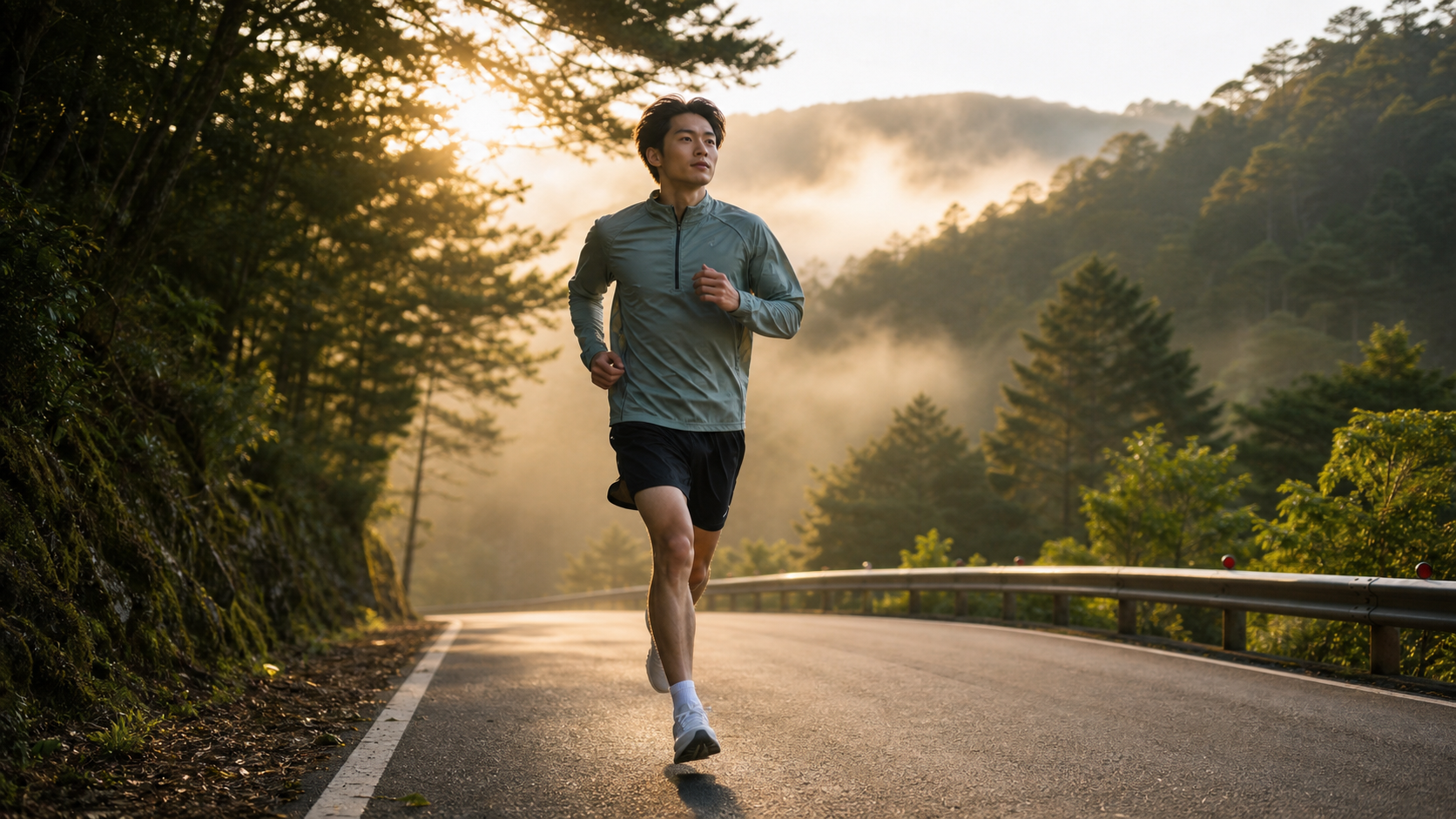
Taiwanese runners often describe how, during a morning run on the trails of Basianshan or Hehuanshan, they suddenly enter a state of “not thinking about anything, just running”—feet light, breathing smooth, mind clear yet relaxed, completely immersed in the movement of the present moment. Ninety minutes pass, yet it feels like only thirty. This experience has a scientific name: Flow.
Psychologist Mihaly Csikszentmihalyi, after studying artists, musicians, chess players, and athletes, proposed the theory of flow: when a person’s skill level perfectly matches the challenge of a task, they may enter a flow state. It is not merely a subjective sense of “feeling good”—EEG studies show that brain activity patterns do undergo measurable changes during flow.
What Is Flow in Road Running?
Flow in road running has six identifiable characteristics:
- Merging of action and awareness: “I’m not thinking about running; I am running”
- Complete concentration: Distracting thoughts vanish; only the present steps, breath, and ground remain
- Loss of self-consciousness: No worry about “how I look,” no concern for the gaze of passersby
- Distorted sense of time: Time feels like it passes faster (or occasionally slower) than it actually does
- Intrinsic motivation: Running itself is the reward; no external justification is needed
- Sense of control: Feeling perfect command over every step, yet without effort
The 5 Trigger Conditions for Flow
Flow does not appear randomly; research shows it can be systematically induced:
Condition 1: Perfect Balance Between Skill and Challenge
This is the most fundamental condition of flow. If running intensity is too low (such as strolling through the city), the brain becomes bored and flow cannot occur. If intensity is too high (such as high-intensity intervals beyond your fitness), anxiety blocks flow.
| State | Skill vs Challenge | Mental State |
|---|---|---|
| Boredom | Skill >> Challenge | Distracted, mind wandering |
| Anxiety | Challenge >> Skill | Worry, excessive effort |
| Flow | Skill ≈ Challenge (slightly challenging) | Focused, light, selfless |
Practical application: Choose a pace that is “somewhat challenging but not enough to leave you breathless,” typically around lactate threshold speed (able to talk but slightly strained).
Condition 2: Clear Immediate Goals
Flow requires a focal point for attention, and vague goals (“just run casually today”) cannot provide one. But goals that are too ambitious (“I’m going to become a world champion”) only breed anxiety.
Specific method: Set a “micro-goal” for each run—“Today I’ll focus on my foot strike, landing midfoot with every step.” This immediate goal anchors attention to bodily sensations and serves as an excellent guide for inducing flow.
Condition 3: Immediate and Clear Feedback
In a flow state, you need to clearly sense whether each of your movements is “correct.” For road runners, this feedback comes from:
- Whether breathing rhythm is smooth
- Whether cadence is regular (most flow states occur at 175–185 steps per minute)
- Whether foot strikes are light
- Real-time feedback from a pace watch
Suggestion: On routes where flow tends to occur, turn off the music to become more attuned to the body’s natural feedback.
Condition 4: Eliminate Distractions and Establish Rituals
External distractions (frequent phone vibrations, complex traffic environments, unfamiliar routes) interrupt the formation of flow. Research shows that flow typically emerges 15–20 minutes after starting a run, and any strong external stimulus can disrupt it.
Establish a “flow route”: Choose a route you know well with few distractions, such as Taipei’s Daan Forest Park, the Kaohsiung Love River, or a familiar riverside levee track. A familiar environment means the brain doesn’t need to divert attention to processing new information, making it easier for the prefrontal cortex to “switch off” and enter flow.
Condition 5: The Right Mental Posture—Let Go of Outcomes
This is the hardest condition, and the most critical. The essence of flow is “process orientation”; the moment you pull your attention back to “what time do I need to run today,” flow disappears.
Practical method: During a “flow run,” deliberately avoid looking at your watch’s pace (or flip the watch over), letting your body run purely by feel. Afterwards, you’ll often be surprised to find that the “selfless” run produced unexpectedly great results.
Specific Methods for Training Your Flow Capacity
- At least one “goal-free run” per week: Run entirely by feel, with no distance or pace targets, stopping only when your body naturally wants to
- Meditation training: The neural mechanisms of flow and mindfulness meditation overlap heavily; 10 minutes of daily meditation can enhance your flow capacity
- Pre-run preparation routine: Establish a fixed warm-up sequence to get your body and brain into “running mode,” shortening the time needed to enter flow
- Record your flow experiences during training: Under what conditions did it occur? What interrupted it? Build your personal flow map
Practical Advice
If you want to induce flow in a race, the most important thing is to “not try to force flow to appear.” The more deliberately you chase it, the harder it is to achieve. The best strategy is: set up the five conditions of flow (appropriate pace, clear immediate goals, familiar environment, eliminated distractions, letting go of performance anxiety), and then let it happen naturally.
Conclusion
Flow is the purest gift running gives us—it needs no recognition from results, no applause from others; it only needs that complete connection between you and the road, you and the present moment. When you’re in Daan Forest Park on some early morning and suddenly realize you’ve already run 12 kilometers without feeling tired at all, that is flow whispering to you: this is why you run.
Related Reading
- The Flow Experience in Road Running: How to Enter a State of Effortless Optimal Performance
- Flow State in Running: How to Enter the “Selfless” Zone of Peak Performance
- Flow Experience and Running: How to Achieve the Optimal Mental State of Selfless Running
- Flow State in Road Running: How to Create the Best Running Experience