Introduction
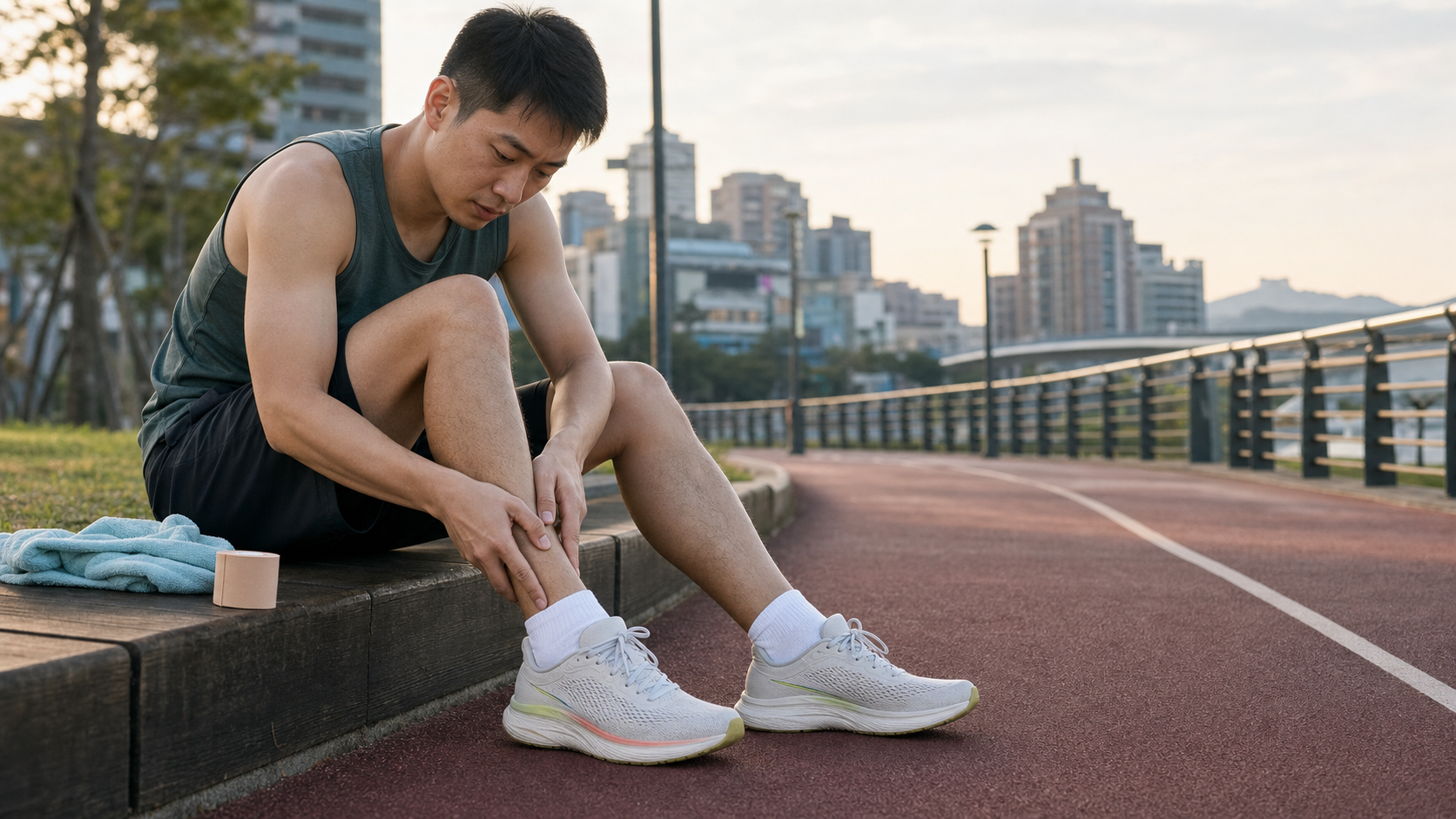
“Pain in the front of the lower leg” is the most common question asked by Taiwanese road-running beginners in running group communities. The English term “shin splint” is actually a vague medical catch-all that covers several different pathologies around the tibia. If not correctly classified, the treatment approach can be completely wrong—in severe cases, a stress fracture may even be overlooked.
This article will help Taiwanese runners understand the different types of tibial pain and provide classification-based recovery strategies.
Classification of Tibial Pain
Type 1: Medial Tibial Stress Syndrome (MTSS)
Medial Tibial Stress Syndrome (MTSS) is the most common type, accounting for 70–80% of tibial pain.
Characteristics:
- Pain distributed along the lower 1/3 of the medial tibia, with diffuse tenderness spanning more than 5 cm
- Most painful at the start of a run, slightly relieved after warming up, and worsening again after finishing
- Usually able to walk normally the next day after rest
Type 2: Chronic Exertional Compartment Syndrome
A “tight, swollen sensation” appears on the anterolateral lower leg after exercise and subsides within minutes of stopping. This type requires ruling out complications; severe cases may require surgical decompression.
Type 3: Tibial Stress Fracture
⚠️ A serious condition that must be ruled out. The pain point of a stress fracture is more localized and more precise—you can find a distinct “point tenderness” with two fingers, and resting pain at night may also occur.
Type Comparison Table
| Feature | MTSS | Stress Fracture |
|---|---|---|
| Tenderness area | Diffuse (> 5 cm) | Localized point |
| Night pain at rest | Rare | Possible |
| Relief after warm-up | Yes | No |
| Imaging confirmation | X-ray often negative | MRI/bone scan |
| Time to return to running | 2–6 weeks | 6–12 weeks |
Causes of MTSS and High-Risk Groups
Biomechanical Factors
- Excessive pronation: Excessive inward rotation of the foot upon landing increases tibial torque
- Low cadence: When cadence is below 160 steps/min, impact force per step is greater
- Limited ankle dorsiflexion: Tight calf muscles lead to compensatory stress
Training Factors
- Highest risk in the first 4 weeks for beginners (body not yet adapted to running impact)
- Transitioning from a track to harder surfaces such as asphalt
- Increasing weekly running time by more than 30 minutes
Staged Recovery Strategy
Acute Phase (Weeks 1–2)
- Stop running; switch to swimming or deep-water running to maintain cardiovascular fitness
- Ice therapy: 2–3 times per day, 15–20 minutes each time; wrap the ice pack in a towel to prevent frostbite
- Ready-to-use ice packs are available 24/7 at Taiwanese convenience stores (7-Eleven, FamilyMart), convenient in an emergency
- Apply compression wrapping with elastic bandage (use in the morning after waking up and before running)
Subacute Phase (Weeks 3–4)
- Begin low-impact aerobic exercise: cycling or swimming, 30–45 minutes/day each
- Calf stretching: gastrocnemius and soleus, 30 seconds × 3 sets each, 2 times per day
- Intrinsic foot muscle strengthening: short foot exercise, toe towel curls
Return-to-Running Phase (From Week 5–6)
Begin returning to running using the run-walk method:
- Day 1: Walk 20 minutes, completely pain-free
- Day 3: Walk 10 minutes + run 5 minutes + walk 10 minutes
- Day 5: Walk 5 minutes + run 15 minutes + walk 5 minutes
- Thereafter, increase running time by 10% each session
If pain occurs at any stage, immediately step back to the previous phase.
Keys to Preventing Long-Term Recurrence
- Strengthen calf eccentric strength: Rise onto toes, then lower slowly on one leg, 3 times per week × 3 sets × 15 reps
- Increase cadence: Target 170–180 steps/min (use the metronome feature on running music apps)
- Replace running shoes: MTSS patients are advised to choose running shoes with better cushioning and to have a running gait analysis done at specialty running shoe stores in Taipei, Taichung, and Kaohsiung
Practical Advice
- If pain persists for more than 2 weeks or localized point tenderness appears, be sure to see a doctor for an X-ray or MRI
- Orthopedics or sports medicine departments at major medical centers across Taiwan can arrange imaging studies
- Do not rely on painkillers to “keep running”—a stress fracture that is not properly rested may progress to a complete fracture
Conclusion
The key to successfully treating tibial pain lies in correct classification and patiently following a staged plan. Taiwanese runners should make good use of local medical resources and seek immediate medical attention when localized point tenderness appears, to avoid letting a minor injury become a major one. Through systematic strengthening training, most runners can safely return to running within 4–6 weeks.
Related Reading
- Shin Splints: Cause Analysis, Type Classification, and a Scientific Recovery Timeline
- Shin Splints: The Most Common Overtraining Injury Among Runners
- Tibial Pain (Shin Splints): The Most Common Lower Leg Complaint Among Runners and Complete Solutions
- Shin Splints: The Price of Increasing Mileage Too Quickly
一日北高/長距離團騎 常見問題補充篇 / 組團或跟團的眉角 / 壯車友容易被瘦車友慢性拉爆 / 原來屁股痛可能是這個原因...? / 風場配速法 / 公路車 / CT Yeh
2 年前
一日北高常見問題大集合 | 攻略 | 路線 | 訓練 | 補給 | 自行車 單車 | 一日雙城 | 雙塔 | TWB北高360 | 屁股痛
6 年前
Never Stop 西進武嶺 前後雙機 完整全程錄影 訓練台 實境
8 年前
近視雷射三個月後悔嗎?單車族/工程師必看,Smart TransPRK 術後血淚史與後遺症全公開 / CT Yeh
4 個月前
西進武嶺 免費訓練分析服務 Intervals | 練不夠還是練過頭?你哪一種類型選手?AI模型告訴你! | 備戰神器 | 公路車 訓練 | CT Yeh
4 年前
滑雪新手們慘摔學習全紀錄(請開字幕),滑雪好好玩 | Snowboard + Ski | 岩原 スキー場 | 滑雪APP使用 | GoPro Max
6 年前
CT 喇低賽) 武嶺牽車 才是王道 西進牽車四小時內秘訣 攝手位置 如何判斷 防抽筋小秘訣
7 年前
白沙屯媽祖進香在家走!UREVO 坡度自調走步機 / 可連接訓練遊戲APP MyWhoosh / 邊看直播邊走起來 / CT Yeh
11 個月前