Achilles Tendinitis Mileage Management: How to Promote Healing Without Completely Stopping Running
Introduction
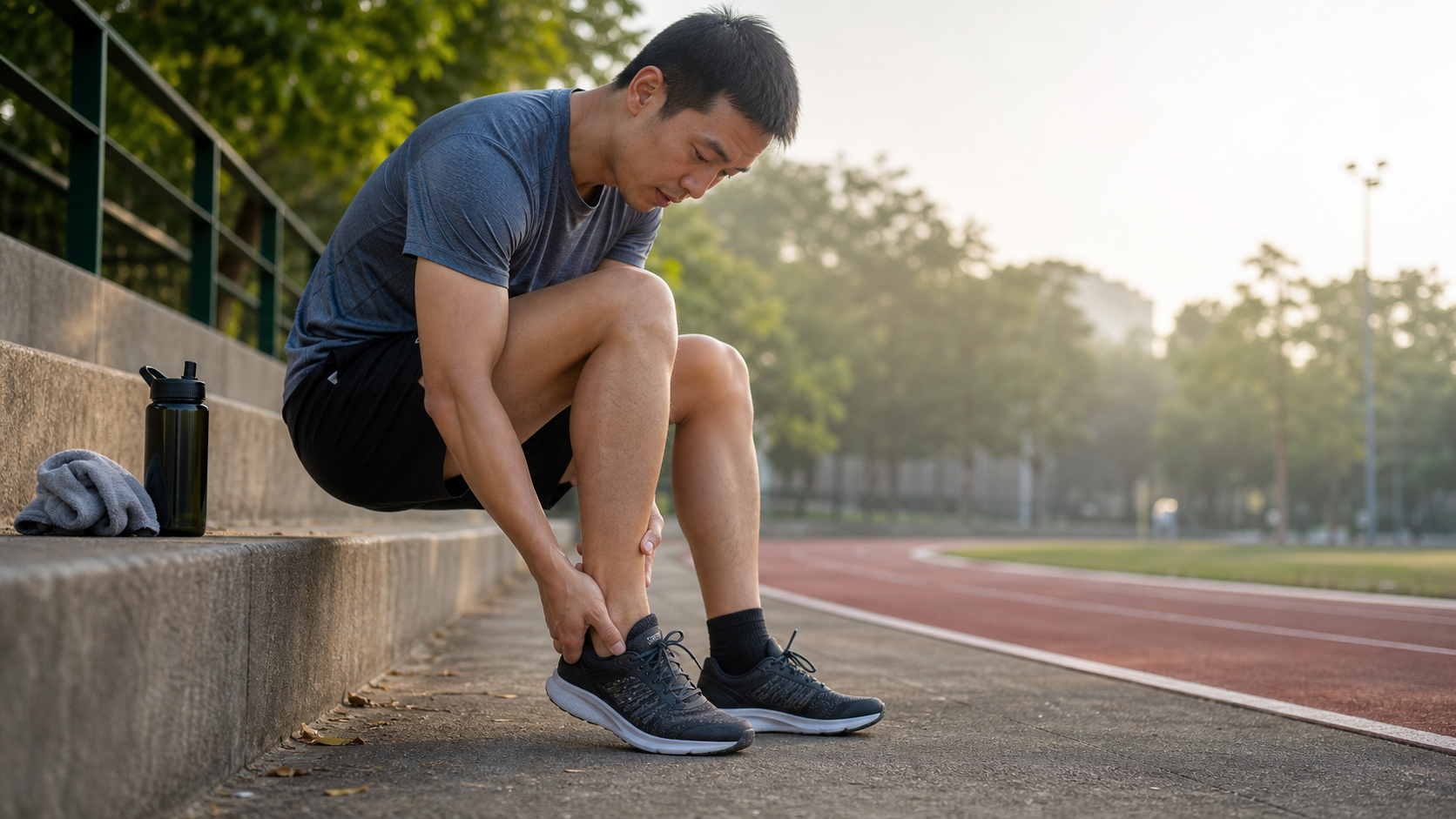
Achilles tendinopathy is a troublesome chronic injury among long-distance runners, with an incidence rate of approximately 8–11% among marathon runners in Taiwan. Unlike acute sprains, Achilles tendinopathy is a cumulative degenerative process—the collagen tissue in the Achilles tendon becomes disorganized, accompanied by neovascularization and proliferation of pain nerve endings.
The most important breakthrough in modern sports medicine is this: appropriate mechanical loading is a necessary condition for Achilles tendon recovery, not an obstacle. Complete rest may actually weaken the tendon further and make re-injury more likely. This article will teach you how to scientifically manage your mileage and promote Achilles tendon healing without completely stopping running.
Two Main Types of Achilles Tendinopathy
Midportion Achilles Tendinopathy
Pain is located approximately 2–6 cm above the heel bone, and this is the most common type (accounting for 55–65% of cases). A distinct tender point can be identified by pinching with two fingers.
Insertional Achilles Tendinopathy
Pain is located where the Achilles tendon attaches to the heel bone, and it is particularly painful when the back of the heel hits the shoe counter while walking. The treatment strategy differs slightly from the midportion type, and stretching methods require caution.
Assessing Severity (VISA-A Score)
| Score | Severity | Running Recommendation |
|---|---|---|
| 80–100 | Mild | Can train normally, add strengthening |
| 60–79 | Moderate | Reduce volume by 30–50%, add strengthening |
| 40–59 | Moderate to Severe | Reduce volume by > 50%, substitute with cycling |
| < 40 | Severe | Stop running, seek medical evaluation |
Core Therapy: Eccentric and Isometric Training
Why Is Eccentric Training Effective?
The 2002 study by Alfredson laid the foundation: contracting the Achilles tendon while it is being lengthened (eccentric contraction) promotes collagen remodeling and remains the most scientifically supported therapy for Achilles tendinopathy.
Alfredson Eccentric Training Protocol
Standard protocol for midportion Achilles tendinopathy (twice daily):
- Stand on the edge of a step with your heels hanging off
- Rise up on your healthy leg, then slowly lower down on the affected leg (3-second lowering phase)
- Straight-knee version: trains the gastrocnemius
- Slightly bent-knee version (30 degrees): trains the soleus
- Perform 3 sets × 15 repetitions each time; continue even with mild pain (pain ≤ 4/10)
- Note: The heel-hanging version is not suitable for insertional Achilles tendinopathy; use flat-ground calf raises instead
Isometric Training (Acute Pain Phase)
When pain exceeds 5/10 and eccentric training cannot be performed, use isometric training first:
- Stand and slowly rise onto your toes, holding the highest position for 45 seconds
- Perform 5 sets daily; provides immediate pain relief (via cortical inhibition mechanisms)
Practical Principles for Mileage Management
The “Traffic Light” System
- Green Light (can run): Morning stiffness ≤ 10 minutes, pain during running ≤ 2/10, post-run pain subsides by the next day
- Yellow Light (reduce volume by 50%): Morning stiffness 10–30 minutes, pain during running 3–4/10, mild pain still present the next day
- Red Light (stop running): Morning stiffness > 30 minutes, pain during running ≥ 5/10, pain persists for more than 24 hours
Mileage Substitution Options
When mileage needs to be reduced, the following low-impact methods can maintain cardiovascular fitness:
- Cycling: Produces no vertical impact on the Achilles tendon; the safest first choice
- Aqua jogging: Requires a swimming pool (all counties and cities in Taiwan have public pools, with monthly passes around NT$1,000–2,000)
- Elliptical trainer: Gym equipment; movement closely resembles running but with extremely low impact
Adjunct Tools and Resources Available in Taiwan
- Kinesio Taping for the Achilles tendon: Applied by physical therapists, costing approximately NT$300–500 per session
- Extracorporeal Shock Wave Therapy (ESWT): Effective for chronic Achilles tendinopathy; may be covered by National Health Insurance in certain cases, requiring a rehabilitation medicine diagnosis
- Heel Lifts: Short-term use can reduce Achilles tendon tension; available at Watsons or pharmacies
- Custom orthotics: For those with excessively high or low arches, custom insoles are recommended
Criteria for Returning to Running
Only attempt to resume full mileage after meeting the following conditions:
- Morning stiffness has resolved or is < 5 minutes
- Single-leg calf raises × 25 performed pain-free
- “Morning assessment” shows green light for 3 consecutive days
- No discomfort after an easy 5 km run
Conclusion
The modern treatment logic for Achilles tendinopathy is “manage the load, not eliminate the load.” By strengthening the Achilles tendon through eccentric training combined with scientific mileage management, most runners can return to normal training within 8–12 weeks. Taiwan has abundant rehabilitation medical resources; if conservative treatment shows no improvement after 3 months, you should actively seek medical attention to consider further interventions (such as PRP injections or extracorporeal shock wave therapy).
Related Reading
- Achilles Tendon Pathology: Why Eccentric Training Is the Gold Standard for Rehabilitation
- Conservative Treatment and Return-to-Running Criteria for Achilles Tendinitis
- The Golden Treatment Protocol for Achilles Tendinitis: The Scientific Basis and Complete Execution Guide for Eccentric Training
- Achilles Tendon Pathology: Eccentric Solutions for Morning Stiffness and Start-of-Run Tightness
西進武嶺 免費訓練分析服務 Intervals | 練不夠還是練過頭?你哪一種類型選手?AI模型告訴你! | 備戰神器 | 公路車 訓練 | CT Yeh
4 年前
Never Stop 西進武嶺 前後雙機 完整全程錄影 訓練台 實境
8 年前
CT 喇低賽) 武嶺牽車 才是王道 西進牽車四小時內秘訣 攝手位置 如何判斷 防抽筋小秘訣
7 年前
一日北高/長距離團騎 常見問題補充篇 / 組團或跟團的眉角 / 壯車友容易被瘦車友慢性拉爆 / 原來屁股痛可能是這個原因...? / 風場配速法 / 公路車 / CT Yeh
2 年前
摔車後補裝備: 好市多新款單車安全帽& Specialized Romin 北高整路屁股都不痛的坐墊 | 一千元居然有MIPS | CT Yeh | 公路車
4 年前
CT趣訪 西進武嶺 2小時組 EP2 全村的希望 蔣緯緯! 訓練菜單&技巧公開 |公路車 |CT Yeh
4 年前
FTL 與 SYB 車隊專訪 西進武嶺 實用攻略分享! 2小時 如何練?!你不知道的眉角!新手準備武嶺必看 EP1 | 實力派女車友 | 精華版 | 公路車 | CTYeh
4 年前
西進武嶺 自製新版AI配速表產生器 x 賽前攻略 抱佛腳! 沒有功率計也可以產生配速表嗎?有什麼其他眉角賽前要注意的呢? | 西進武嶺 / 東進武嶺 KOM 攻略 | 公路車 | CT Yeh
4 年前