The Science of Contrast Water Therapy: A Low-Cost Recovery Method You Can Do in a Taiwanese Bathroom
Introduction
Search YouTube for “marathon runner recovery methods” and nearly every video mentions ice baths or contrast water therapy. This is no coincidence—Contrast Water Therapy (CWT) has solid support in sports science research, and Taiwanese runners can perform it in an ordinary home bathroom at virtually zero cost.
However, many people don’t understand the mechanisms behind it or the correct way to do it. This article will break down contrast water therapy from a physiological perspective and provide a complete guide that can be implemented in a Taiwanese home environment.
The Physiological Mechanisms of Contrast Water Therapy
Effects of Cold Water
When the body is exposed to cold water (8–15°C):
- Vasoconstriction: Peripheral blood vessels constrict, reducing local congestion and swelling
- Reduced nerve conduction velocity: Decreases acute inflammatory pain signals
- Lowered metabolic rate: Reduces oxygen demand, helping damaged cells “stop the bleeding”
Effects of Hot Water
When the body is exposed to hot water (36–40°C):
- Vasodilation: Promotes blood circulation and accelerates the removal of metabolic waste (such as lactate)
- Increased tissue oxygen supply: Aids muscle repair
- Muscle relaxation: Reduces muscle tension and spasms
The “Pumping Effect” of Alternating
The repeated vasoconstriction–vasodilation produced by alternating cold and hot water creates a “muscle pump”-like effect, accelerating the removal of metabolic waste and the delivery of fresh blood—more effective than cold or hot baths alone.
What Does the Scientific Research Say?
Summary of Research Findings
| Research Focus | Effect | Level of Evidence |
|---|---|---|
| Reduction of delayed-onset muscle soreness (DOMS) | Moderate effect | Strong |
| Speed of muscle function recovery | Faster than control group | Moderate |
| Decrease in post-exercise inflammatory markers | Effective | Moderate |
| Reduction in subjective fatigue | Significant | Strong |
| Full strength recovery | Similar to cold bath alone | Moderate |
A 2013 systematic review (Cochrane) noted that contrast water therapy is more effective than rest alone for reducing DOMS, but its advantage over cold water baths alone is not significant. For Taiwanese runners, the biggest benefit is that it can be done at home without needing ice.
A Guide for Taiwanese Bathrooms
Preparation
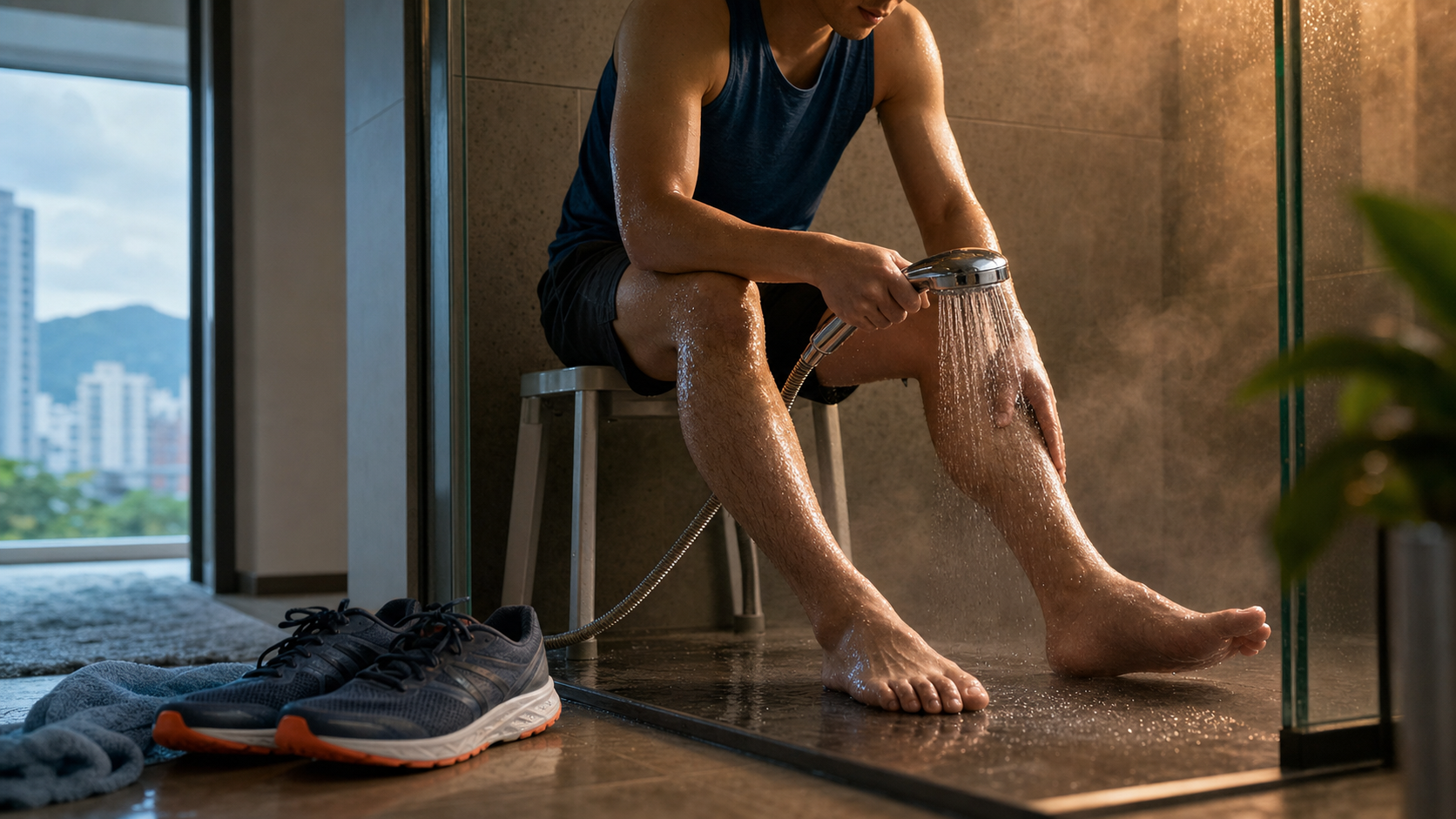
Taiwanese households typically have water heaters and shower facilities, so a contrast shower version is entirely feasible (no bathtub needed).
Equipment needed:
- A shower with hot water supply (standard in Taiwanese homes)
- A timer (a phone works fine)
- A non-slip bath mat (your feet may feel numb during cold water, so slip resistance is essential)
Standard Operating Procedure
It is recommended to perform this within 1–2 hours after running, and no later than 4 hours:
- Hot water (38–40°C): 2–3 minutes
- Cold water (15–20°C; Taiwanese tap water works in winter, but ice may be needed in summer): 1 minute
- Repeat steps 1–2 for a total of 3–4 cycles
- Finish with hot water (to promote vasodilation and avoid excessive body temperature drop)
Total time: 12–20 minutes
What If the Cold Water Isn’t Cold Enough in Summer?
In Taiwan’s summer, tap water is around 25–28°C, which may not be cold enough. Solutions:
- Fill a bucket with water and add bagged ice purchased from a convenience store
- Buy a small detachable foot bath bucket (about NT$300–500) for localized contrast therapy (calves and feet)
- Use ice packs for localized application
Precautions and Contraindications for Contrast Water Therapy
Best Times to Use
- After intense training (long runs, speed workouts, races)
- For recovery between consecutive training days
- When muscles feel particularly fatigued
When It Is Not Recommended
- Acute injury phase (first 24–48 hours): For acute sprains or strains, apply ice only; do not alternate
- History of heart disease: Rapid vasoconstriction and dilation places stress on the heart; consult a physician first
- Peripheral vascular disease: Such as Raynaud’s syndrome
- Skin wounds: Open wounds are not suitable for hydrotherapy
Comparison with Other Recovery Methods
- vs. cold water bath alone: Similar effects, but better tolerability (no need to endure the discomfort of pure cold water)
- vs. hot bath alone: Better recovery outcomes (hot baths used alone may prolong inflammation)
- vs. complete rest: Research shows active recovery (including hydrotherapy) is superior to passive rest
Practical Recommendations
- On long-run days (21 km or more), perform a full contrast water therapy session that evening
- Combine contrast water therapy with a protein drink as a “recovery ritual” to help build the habit
- If you have a hot tub at home, consider a sitting bath (closer to the “immersion” conditions in research, with better results)
- First-timers should start with a shorter cold water duration (30 seconds) and gradually extend it
Conclusion
Contrast water therapy is one of the easiest and lowest-cost scientific recovery methods available to Taiwanese runners. Spending 15–20 minutes after each long run can significantly reduce delayed-onset muscle soreness, accelerate functional recovery, and leave you in better shape for your next workout. Hydrotherapy is not exclusive to elite athletes—every runner should learn to make good use of the bathroom at home.
Related Reading
- The Science of Contrast Water Therapy for Running Recovery: Optimizing Ice Bath Temperature and Duration
- Contrast Therapy: Applications of Ice Baths and Hot Baths in Sports Recovery
- Cold Shower vs. Ice Bath: Key Differences in Temperature and Duration
- Hot and Cold Therapy After Swimming: Comparing the Recovery Benefits of Ice Baths and Hot Baths
CT暗黑廚房) 車友必備 宇宙無敵鮮蚵湯 幫助訓練恢復 天然食補 好市多 超肥鮮蚵 破PR
7 年前
[防寒衣體驗] 鐵人魂 三鐵 防寒衣試穿會 於松運 深水游泳池 鯨魚池
8 年前
抖肩舞 台灣x日本交流版 (台灣 vs 前橋) 赤城山登山賽 coincidance
8 年前
秘境雪場 日本 八甲田 冰樹探險與滑雪體驗 ft. Q老師 & 運動生活
7 年前
2016/05/13 單車 冷水坑下滑
10 年前
實景訓練台) 彰化經典百K 高強度喵團 90分鐘 跟著一起練功 2019 Indoor workout Changhua Classic 100 Taiwan
7 年前
西進武嶺 免費訓練分析服務 Intervals | 練不夠還是練過頭?你哪一種類型選手?AI模型告訴你! | 備戰神器 | 公路車 訓練 | CT Yeh
4 年前
台灣旅行團參加 第7回まえばし赤城山ヒルクライム大会 雙視點
8 年前