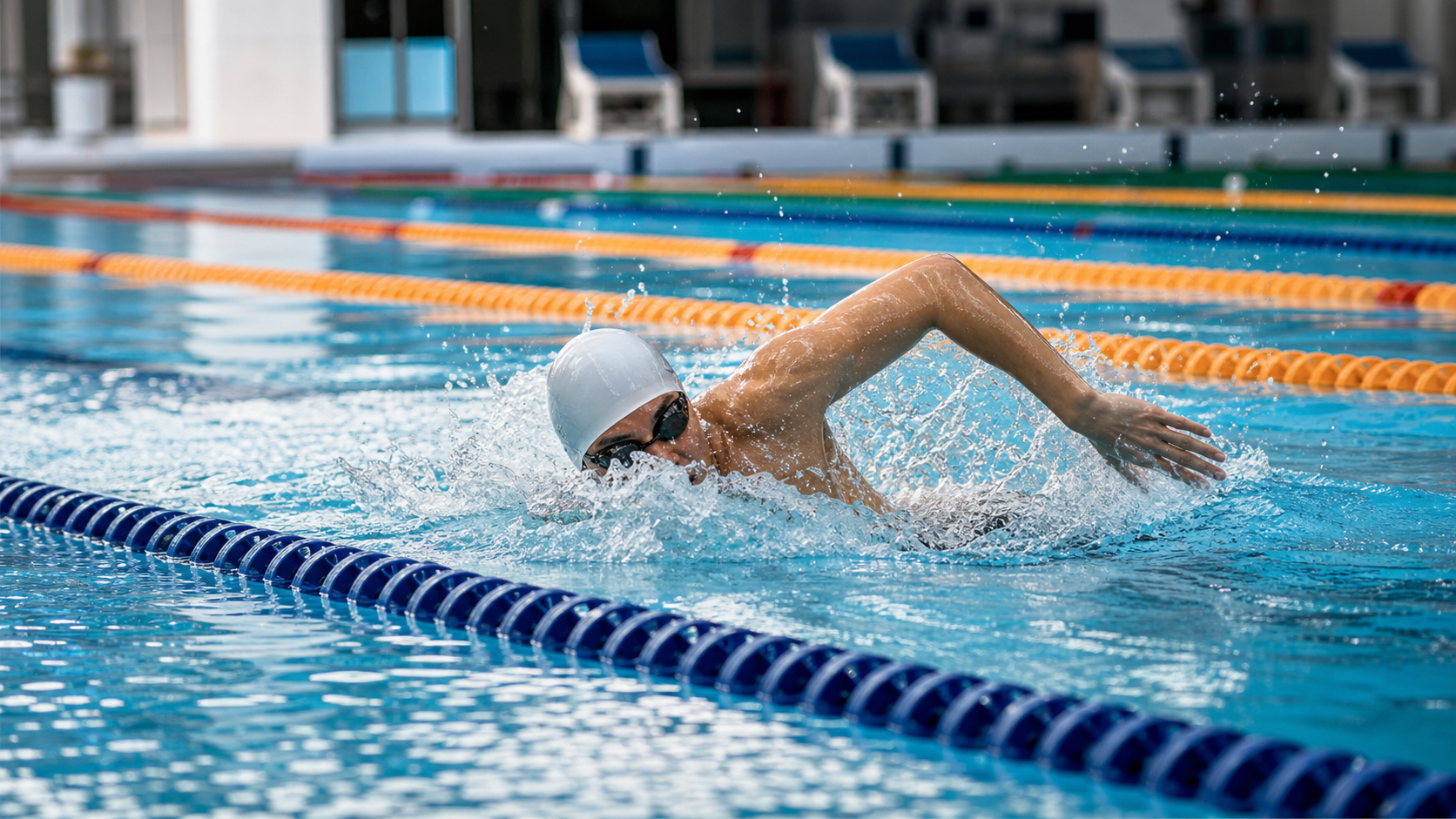
Introduction
Pacing is one of the core factors determining performance in swim races. Whether at the Taiwan National Swimming Championships, county/city meets, or the swim leg of a triathlon, athletes who push too hard in the early stages will inevitably collapse later; those who are overly conservative waste usable energy reserves. Understanding the “Split Ratio” for different distances is fundamental homework every competitive swimmer must master.
Pacing Principles by Distance
50m Sprint Distance
The 50m freestyle is almost a purely anaerobic, explosive-power contest. The vast majority of elite athletes show an extremely small front/back half difference, with some even swimming the second half slightly faster. The reason is that after the underwater dolphin kick phase following the start, swimmers enter their stroke rhythm and experience a surge of speed.
- The first half (0–25m) typically includes the start acceleration phase, taking slightly longer
- The second half (25–50m) reaches a speed close to or slightly faster than the first half due to momentum conversion
- Recommended front/back half ratio: approximately 1.00–1.02 (first half slightly faster or even)
100m Mid-Sprint Distance
The 100m is a distance where mixed aerobic and anaerobic energy systems carry equal weight, making front/back half pacing control the most critical factor. Too many athletes make the mistake of “sprinting too fast in the first 50m and fading in the second 50m.”
- World-class athletes show a front/back half gap of about 1–2 seconds (front faster, back slower by 0.5–1%)
- Amateur athletes commonly show gaps of 4–6 seconds, indicating depleted anaerobic reserves
- Recommended front/back half ratio: approximately 1.01–1.03
200m Long-Sprint Distance
The 200m tests the complete transition between aerobic and anaerobic energy systems. A steady rhythm in the first half is crucial to avoid premature lactate accumulation.
- Manage it in four 50m segments: start, maintain, challenge, sprint
- The third segment (at the 150m mark) is the critical point where athletes most easily lose speed
- Recommended front/back half ratio: approximately 1.02–1.05
400m Long Distance
The 400m is primarily an aerobic race, where the consistency of each 50m segment determines the final result. Pushing too hard early will cause a noticeable collapse at the 250–300m mark.
- The best strategy is a “Negative Split,” with the second half slightly faster
- A common issue among Taiwanese swimmers: pushing too hard in the first 100m, caught up in the venue atmosphere
- Recommended front/back half ratio: approximately 1.02–1.06 (attempting a slightly faster second half is even possible)
Pacing Ratio Comparison Table by Distance
| Distance | Recommended Front/Back Half Ratio | Energy System Distribution | Common Mistakes |
|---|---|---|---|
| 50m | 1.00–1.02 | Anaerobic 95% | Over-accelerating early leads to technical breakdown in the latter half |
| 100m | 1.01–1.03 | Anaerobic 70% / Aerobic 30% | First 50m too fast, lactate accumulation in the latter half |
| 200m | 1.02–1.05 | Anaerobic 40% / Aerobic 60% | Speed drop in the third 50m segment |
| 400m | 1.02–1.06 | Anaerobic 20% / Aerobic 80% | Following the pack in the first 100m leads to excessive speed |
Real-World Scenarios in Taiwanese Competitions
In the preliminary heats of county/city meets, athletes often over-push in the early stages due to nerves, draining too much energy before the finals. The following strategies are recommended:
- Preliminary heats: Swim at 98% of your target time to conserve energy
- Semifinals (if applicable): Use as a pacing practice, observing opponents’ rhythms
- Finals: Execute the planned front/back half ratio without following opponents’ pacing
Practical Recommendations
- Record your own race footage to analyze split times for each 50m segment and identify habitual speed-drop points
- Deliberately practice negative splits in training, e.g., swimming the second half of a 200m 1–2 seconds faster than the first half
- Build a personal “race pacing chart” based on recent training times to set target times for each segment
- Simulate the start segment before races to train your body to remember the feeling of “not pushing too hard”
- Use heart rate monitoring (e.g., wearable devices) during practice to verify how different pacing affects recovery speed
Conclusion
Pacing is not a shackle that limits performance, but the wisdom of releasing energy at the moments it is needed most. If Taiwanese swimmers can establish clear segment awareness in training and integrate pacing strategies into every simulated race, they can demonstrate more stable and efficient competitive form at national championships or triathlon events. Remember: swim smart, and you will swim faster.
Related Reading
- 100m Freestyle Pacing Analysis: Optimal Front/Back Half Distribution Ratios and Performance Impact
- 100m Freestyle Pacing: The Science of Time Distribution Between First and Second Halves
- Race Pacing Strategies: Segment Time Analysis for 100m, 200m, and 400m Events
- Front/Back Half Pacing in the 100m Freestyle: World Record Segment Analysis
崇越盃武嶺冠軍高手 賽前JJSC 群峰會精華!對應大數據分析,會有落差嗎?/ feat. JJSC中部公路車約騎 /公路車 / CT Yeh
2 年前
西進武嶺 自製新版AI配速表產生器 x 賽前攻略 抱佛腳! 沒有功率計也可以產生配速表嗎?有什麼其他眉角賽前要注意的呢? | 西進武嶺 / 東進武嶺 KOM 攻略 | 公路車 | CT Yeh
4 年前
Live) 備戰2019彰化經典百K 賽前攻略 (已完賽請看新影片
7 年前
西進武嶺 免費訓練分析服務 Intervals | 練不夠還是練過頭?你哪一種類型選手?AI模型告訴你! | 備戰神器 | 公路車 訓練 | CT Yeh
4 年前
西進武嶺各路段 前8000名 大數據分析 配速攻略/功率/心律/推力比/維持率/踏頻/踏瓦比/牽車率 大公開 | 建大盃 NeverStop 可參考 | 公路車 | CT Yeh
5 年前
#公路車 #西進武嶺 配速配瓦實驗 坡度分析 四小時內攻略 建大盃 NeverStop #西進武嶺攻略
6 年前
武嶺配速表最佳使用方式 #bike
1 年前
戀戀197 競賽組 | 50頁投影片心得報告 | 賽後檢討 攻略 #公路車
6 年前