Introduction
Many Taiwanese swimmers tend to underestimate the systematic design of pre-race warm-ups in their competition-day preparation. A good warm-up routine is not just about “getting the body warm”—it must precisely activate the neuromuscular system, adjust cardiorespiratory function to race intensity, and establish the correct technical feel. This article provides a complete 45-minute pre-race warm-up protocol suitable for formal competitive settings such as county/city games and national swimming championships.
Phase 1: Dry-Land Preparation (45–25 minutes before entering the water)
Dynamic Warm-Up (10 minutes)
The purpose of dry-land dynamic warm-up is to raise core body temperature, increase joint mobility, and awaken the major muscle groups. Avoid static stretching before a race, as it can reduce muscular explosive power.
Recommended exercise sequence:
- Neck circles: 8–10 reps in each direction to relax the cervical spine
- Shoulder circles: 15 reps forward and backward to thoroughly activate the rotator cuff muscles
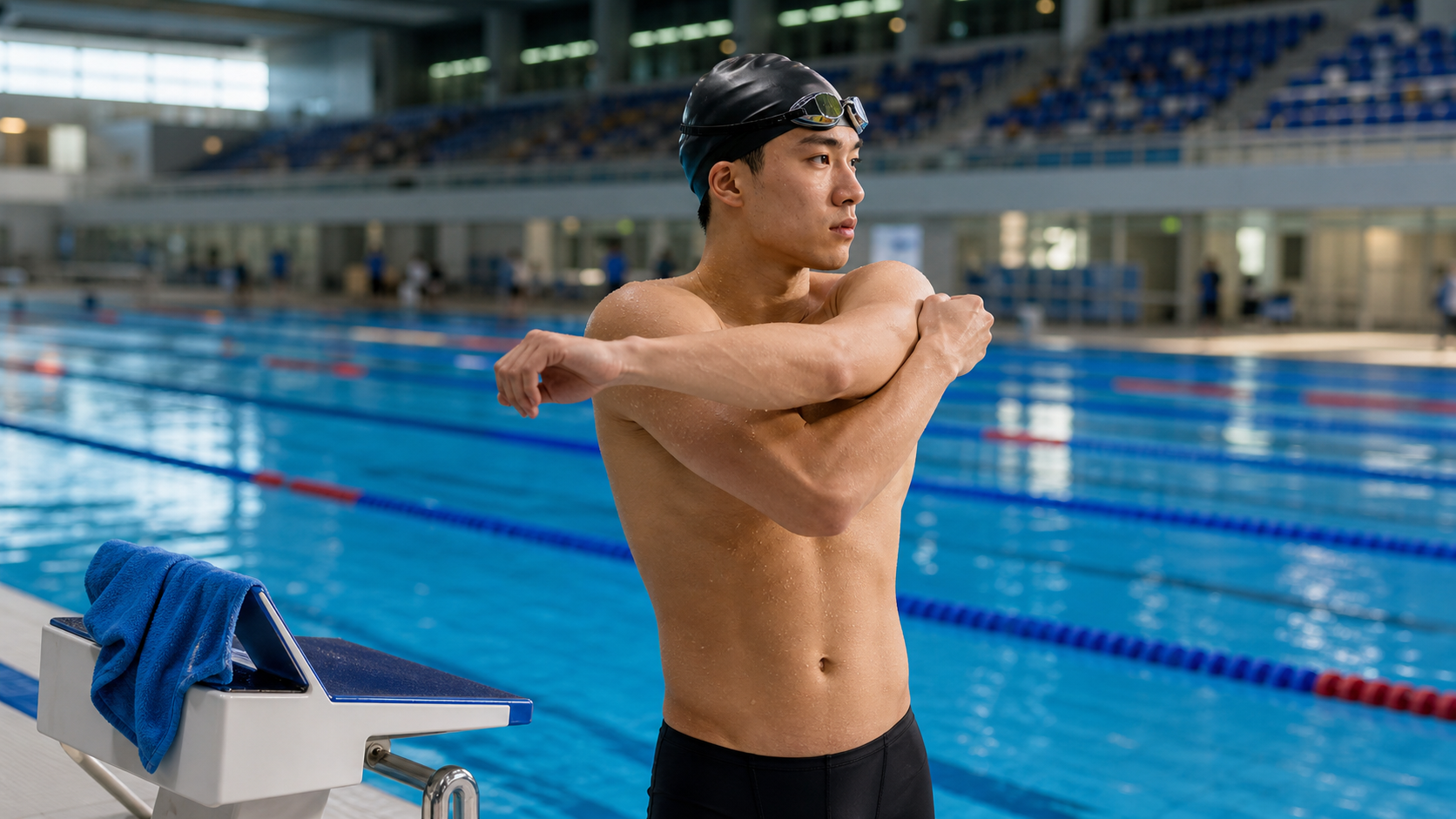
- Arm cross swings: 20 reps of alternating arm swings while standing, mimicking the pulling motion
- Hip circles: 10 reps in each direction to activate the torso-rotation muscles
- Dynamic lunges: 10 steps forward and backward to activate the leg muscles
- Ankle rotations and calf raises: 15 reps each to activate the kicking muscles
Neural Activation (10 minutes)
Simulate starting movements on dry land to help the nervous system reach a heightened state of alertness:
- Starting block crouch simulation: perform 3–5 false starts (without entering the water)
- Resistance band pull simulation: perform 20–30 reps mimicking the pulling motion of each stroke
- Quick high-knee sprints: 10 seconds of high-knee running in place × 3 sets
Phase 2: In-Water Warm-Up (25–5 minutes before entering the water)
Progressive Distance Warm-Up (15 minutes)
The in-water warm-up should be designed on the principle of progressing from low to high intensity. Avoid starting high-intensity swimming immediately upon entering the water.
| Distance | Intensity | Focus |
|---|---|---|
| 400m easy swim | 50–60% | Feel the water, refine technique |
| 4×50m descending swim | 60–80% | Gradually increase intensity every 50m |
| 2×25m all-out sprint | 95% | Activate the anaerobic system, adapt to race pace |
| 200m easy swim | 40% | Recover heart rate, keep muscles warm |
Technique Confirmation Segment (5 minutes)
Based on the day’s race event, perform 2–3 “technique confirmation swims”:
- Underwater dolphin kick after the start: Feel today’s water sensation and dolphin kick rhythm
- Turn practice (for events 100m and above): Confirm the rhythm of touching the wall and pushing off
- Finish simulation: Confirm the final 5m finishing motion
Phase 3: Race Waiting (5–0 minutes after leaving the water)
From the end of the warm-up until the official start, you need to maintain the body’s activated state:
- Put on the competition swimsuit, cap, and goggles
- Continue light arm swings and stepping in the waiting area
- Take 3–5 deep breaths to adjust your mental state
- Mentally rehearse your pacing plan and build a race image
Warm-Up Considerations for Taiwanese Competitions
Many swimming events in Taiwan have limited warm-up pool resources, especially at county/city games where multiple events often run simultaneously. Here are practical recommendations:
- Confirm warm-up slots in advance: Check with the officials’ team for each event’s warm-up time window
- When the warm-up pool is crowded: Shorten the in-water warm-up distance and increase dry-land neural activation time
- When there is no warm-up pool: Complete a full dry-land warm-up, then perform 5–10 jumps before the start to raise body temperature
Practical Recommendations
- Practice this warm-up routine during training so your body feels a sense of familiarity at the actual competition
- Record your optimal warm-up duration—each swimmer’s ideal activation time differs; some need a longer in-water warm-up
- Avoid over-warming up—the warm-up volume should not exceed 20–25% of your capacity, or you will be fatigued by race time
- Do not try new warm-up exercises—on race day, only perform warm-up routines you have already tested
- Prepare a warm-up backup plan—if the warm-up pool is suddenly closed, you need a complete dry-land alternative
Conclusion
The pre-race warm-up is the final piece of the competition preparation puzzle, and it is also the most easily overlooked aspect for many swimmers. A systematic 45-minute warm-up routine allows you to enter the race with optimal neuromuscular readiness the moment the gun goes off. Whether at the national championships pool in Taipei or a local venue for county/city games, this routine can help you fully deliver the results of your training.
Related Reading
- Pre-Swim Warm-Up Design: A 45-Minute Scientific Activation Session Before Races
- Swimmer Warm-Up and Cool-Down: Pre- and Post-Procedures to Maximize Training Effects
- The Science of Pre-Race Warm-Ups for Swimmers: Best Strategies for Water Temperature Adaptation and Neural Activation
- Swimming Warm-Up Protocol: A Complete Dry-Land Dynamic Warm-Up + 800m In-Pool Warm-Up Routine
實景訓練台) 彰化經典百K 高強度喵團 90分鐘 跟著一起練功 2019 Indoor workout Changhua Classic 100 Taiwan
7 年前
FTL 與 SYB 車隊專訪 西進武嶺 實用攻略分享! 2小時 如何練?!你不知道的眉角!新手準備武嶺必看 EP1 | 實力派女車友 | 精華版 | 公路車 | CTYeh
4 年前
Live) 備戰2019彰化經典百K 賽前攻略 (已完賽請看新影片
7 年前
一起升級!海鷗盃LSD團練...JJSC Zone2招待 騎到手抖 / 公路車 / CT Yeh
2 天前
西進武嶺 自製新版AI配速表產生器 x 賽前攻略 抱佛腳! 沒有功率計也可以產生配速表嗎?有什麼其他眉角賽前要注意的呢? | 西進武嶺 / 東進武嶺 KOM 攻略 | 公路車 | CT Yeh
4 年前
備戰 戀戀197 賽前關門點分析 西濱團練 #公路車 4K高畫質
6 年前
西進武嶺 免費訓練分析服務 Intervals | 練不夠還是練過頭?你哪一種類型選手?AI模型告訴你! | 備戰神器 | 公路車 訓練 | CT Yeh
4 年前
2023桃園團體繞圈賽 / 海鷗繞圈賽 | 全程空拍數據版 | 公路車 | CT Yeh
2 年前