Introduction
In competitive swimming, the starting block takeoff technique may only affect the first few seconds of a race, but in reality, it can impact 50m race results by 0.2–0.5 seconds, and 100m races by 0.1–0.3 seconds. For Taiwanese swimmers competing in county and city games and the National Swimming Championships, optimizing starting technique can often provide a crucial edge over strong opponents. This article systematically compares the two major starting techniques currently in use, helping athletes make the best choice for themselves.
Basic Introduction to the Two Starting Techniques
Grab Start
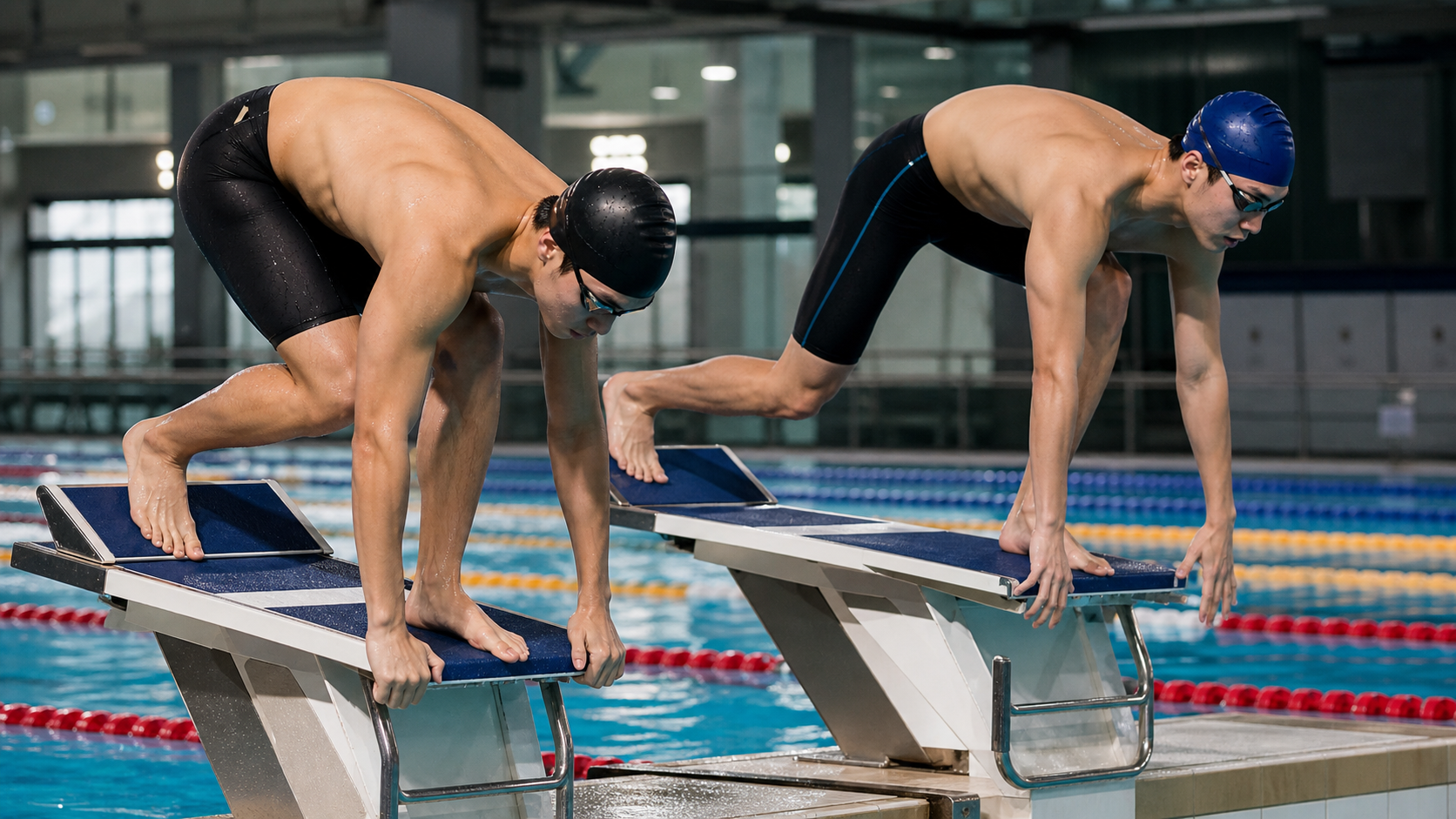
The Grab Start is a traditional technique where the swimmer stands on the front edge of the starting block with feet approximately shoulder-width apart, grips the edge of the block with both hands, and leans forward into a low crouch.
Movement Characteristics:
- Low center of gravity, ample power storage
- More advantageous for power-oriented athletes
- Relatively flatter entry angle, suitable for strategies involving longer underwater dolphin kicks
Track Start
The Track Start is currently the mainstream international technique, where the swimmer places one foot on the front edge of the block and the other foot back behind, forming a staggered “athletics-style” starting stance.
Movement Characteristics:
- The rear foot provides push-off force, resulting in faster reaction
- The center of gravity can shift forward more quickly when the starting signal sounds
- Better suited to the competitive demands of modern competition rules
Scientific Comparison of Reaction Time
Reaction Time is the duration from the starting signal to the swimmer’s feet leaving the block. Research shows:
| Technique Type | Average Reaction Time | Fastest Elite Record | Suitable Athlete Profile |
|---|---|---|---|
| Grab Start | 0.68–0.72 seconds | 0.60 seconds | Power-oriented, strong back muscles |
| Track Start | 0.62–0.67 seconds | 0.55 seconds | Speed-oriented, strong leg explosive power |
The Track Start’s reaction time is on average 0.05–0.08 seconds faster, because the rear foot’s push-off mechanism allows the body to leave the starting block more quickly.
Entry Angle and Underwater Efficiency
Beyond reaction time, the entry angle is also a key factor:
Ideal Entry Angle
- The optimal entry angle for elite swimmers is 30–35 degrees (relative to the horizontal plane)
- Angle too large (over 40 degrees): increased body drag, rapid decay of underwater speed
- Angle too small (under 25 degrees): unfavorable body position for underwater dolphin kick after entry
Entry Differences Between the Two Techniques
- Grab Start: Overall lower flight trajectory, entry angle approximately 28–32 degrees, shallower underwater depth, quicker dolphin kick initiation
- Track Start: Slightly higher flight trajectory, entry angle approximately 33–38 degrees, slightly greater underwater depth, requiring more dolphin kick adjustment
Common Issues Among Taiwanese Swimmers
After observing starting movements at Taiwan’s county and city games and the National Championships, the following common technical issues are frequently seen:
- Head raised too early: Affects streamlining, increases water resistance (an issue in both techniques)
- Arms not fully extended forward: Bent arms at entry disrupt streamlining
- Unstable rear foot position in Track Start: Rear foot slips under race pressure, affecting push-off power
- Center of gravity too high in Grab Start: Fails to fully utilize the power-storing mechanism, resulting in insufficient takeoff force
How to Choose the Starting Technique That Suits You
The following evaluation criteria can help athletes make their choice:
- Leg explosive power test: If vertical jump height exceeds 55cm, the Track Start advantage is more pronounced
- Training experience: Beginners are advised to first become familiar with the Grab Start before transitioning to the Track Start
- Race distance: For short distances of 50m and 100m, the Track Start is recommended; for 200m and above, the difference narrows
- Body proportions: Athletes with proportionally longer legs have an advantage with the Track Start
Practical Recommendations
- Start every practice session with the start: Incorporate the full start (including 15m underwater dolphin kick) into daily training, rather than only practicing it during competitions
- Video-analyze the entry moment: Use a phone or action camera to film the entry angle from the side and identify problem areas
- Use a timer to measure reaction time: Use training apps to record reaction times across multiple starts and track progress
- Do not switch techniques right before a competition: If you decide to change your starting technique, allow at least 4–6 weeks of adaptation training
- Confirm a secure grip on the starting block: Test the starting block used on race day before competing, and assess the anti-slip conditions of the platform surface
Conclusion
Although the starting technique occupies only a tiny fraction of race time, in competitive swimming, every 0.01 second can be the difference between a medal and no medal. Taiwanese swimmers should systematically select and refine their starting technique based on their physical attributes and training background. In the high-pressure environment of the National Swimming Championships, a stable and efficient start is a source of confidence and the foundation of performance.
Related Reading
- Starting Technique: Comparing Track Start, Track Start, and Water Start
- Swimming Start Technique: Speed Differences Between Track Start and Rear-Step Start
- Swimming Takeoff Technique: Complete Analysis of Starting Block Stance, Crouch, and Entry Angle
- Starting Block Dive vs. Water Start: Technical Choices and Competition Rules Explained
Live) 備戰2019彰化經典百K 賽前攻略 (已完賽請看新影片
7 年前
CT 喇低賽) 武嶺牽車 才是王道 西進牽車四小時內秘訣 攝手位置 如何判斷 防抽筋小秘訣
7 年前
戰略) Zwift Race 如何咬在第一集團 如何評估自己要開多少推力 (請開1.5倍速看)
7 年前
2024 彰化經典百K 參賽直播 / 黃亭茵集團 / 公路車 / CT Yeh
2 年前
Zwift跨國線上追逐賽 第二站 台灣 TTR vs. 日本 JETT 第二場 (台灣追日本) | 數百位國內外公路車高手,同場較勁 | 多視角賽事直播
4 年前
滑雪新手們慘摔學習全紀錄(請開字幕),滑雪好好玩 | Snowboard + Ski | 岩原 スキー場 | 滑雪APP使用 | GoPro Max
6 年前
#PUSHBIKE 原來這麼好玩! 小朋友 滑步車 初體驗 超可愛
6 年前
實景訓練台) 彰化經典百K 高強度喵團 90分鐘 跟著一起練功 2019 Indoor workout Changhua Classic 100 Taiwan
7 年前