Analyzing Competitive Swimming Opponents: How to Study Their Breathing Rhythm to Find Overtaking Opportunities
Introduction
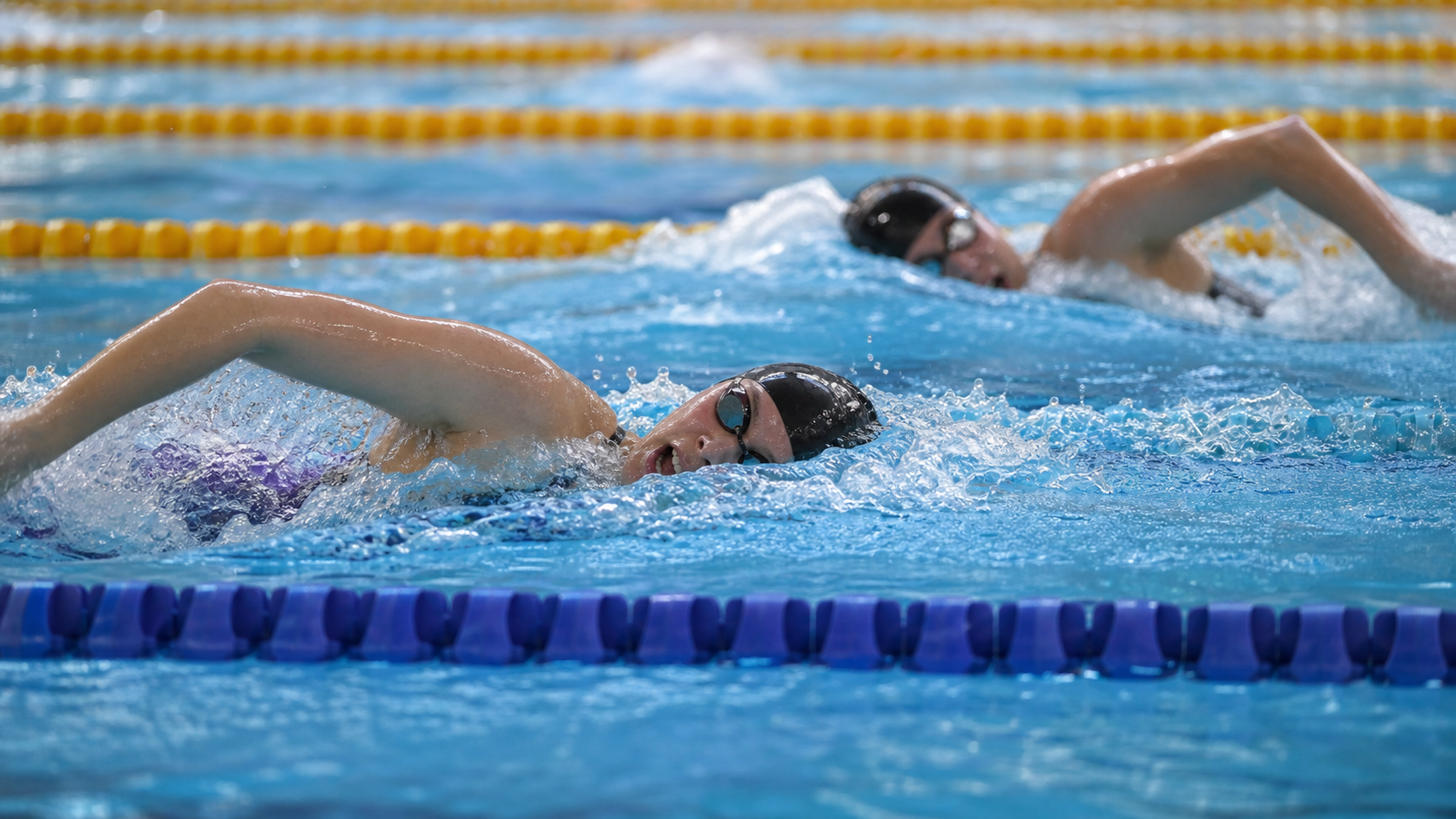
Competitive swimming may appear to be a purely individual sport against the clock, but on the final’s lanes, sharp tactical awareness can often provide a decisive edge. Especially in the final pool of Taiwan’s National Swimming Championships, an opponent’s breathing pattern, pacing rhythm, and energy distribution are all tactical information you can exploit. This article teaches you how to systematically study your opponents and find the opportunity to overtake at the most critical moment.
The Tactical Implications of Breathing Rhythm
Why Is Breathing Rhythm an Important Indicator?
In freestyle swimming, the breathing motion causes the following effects:
- Slight decrease in speed: Turning the head to the side during breathing disrupts the streamlined position, reducing speed by an average of 3–5%
- Opportunity to break rhythm: A powerful stroke can create a sense of “overtaking” when the opponent is breathing, with a significant psychological effect
- Fitness indicator: An excessively high breathing frequency (e.g., breathing every stroke) usually indicates the swimmer has reached or exceeded their lactate threshold—a prime time to sprint
Common Breathing Rhythm Patterns
| Breathing Pattern | Breaths Every X Strokes | Significance |
|---|---|---|
| Continuous breathing | Every 1 stroke | Approaching the limit; may collapse in the latter stages |
| Short cycle | Every 2 strokes | Swimming at high intensity; rapid lactate accumulation |
| Standard cycle | Every 3 strokes | Normal race pace; aerobic-dominant |
| Long cycle | Every 4–5 strokes | Conservative pace; may still have reserves |
| Bilateral breathing | Every 3 or 5 strokes, alternating sides | Good technical control; steady pacing |
How to Observe an Opponent’s Breathing Rhythm During a Race
Observing an opponent’s breathing during a race requires skill, because turning your head directly is inefficient and compromises your own technique. Here are smarter ways to observe:
- Underwater perspective: Use your peripheral vision through your goggles to observe the head and arm rhythm of the swimmer in the adjacent lane
- Side glance while breathing: Each time you breathe, take 0.3 seconds to quickly scan the situation in the lane beside you
- Judging by bubble sounds: Experienced swimmers can gauge the stroke rate of the swimmer beside them by listening to the sound of bubbles in the water
- Noticing positional changes: If you notice the adjacent swimmer’s head starting to appear at your shoulder level (previously at your legs), it means the gap is closing
Preliminary Heat Observation: Intelligence Gathering Before the Race
The preliminary heats (qualifying rounds) before the race are the best opportunity for intelligence gathering:
Key observation points:
- Is the opponent’s split between the first and second half stable, or clearly fast-first-slow-second?
- At which stroke does the opponent begin to increase breathing frequency? (The point where breathing becomes more frequent is usually when lactate starts accumulating rapidly)
- Is the underwater dolphin kick distance after turns maintained, or does it clearly shorten in the latter stages?
- Is the final 10m sprint acceleration noticeable?
Recording tools:
- Phone video (if the venue permits): can be analyzed later in slow motion
- Notebook for quick notes: each competitor’s split times and observed physical condition
Developing an Overtaking Strategy
Based on the opponent’s breathing rhythm and pacing pattern, the following overtaking strategies can be developed:
Scenario A: Opponent leads early but breathing becomes more frequent
Assessment: Opponent is going out too fast and will collapse in the latter stages
Strategy: Maintain your own steady pace, apply pressure at the 70–75m mark, and overtake after the opponent naturally slows down
Scenario B: Opponent is level with you, with a stable breathing rhythm
Assessment: An evenly matched competitor
Strategy: Deliberately increase your stroke rate during the final 20–25m sprint, using the difference in energy reserves to decide the outcome
Scenario C: You are trailing the opponent, and their breathing pattern changes (from 3 strokes to 2 strokes)
Assessment: The opponent is feeling the pressure and their breathing is becoming disordered
Strategy: Immediately increase your stroke rate to apply psychological pressure; the opponent may further collapse upon seeing you close in
Managing Your Own Breathing Rhythm
While studying your opponents, you must also manage your own breathing:
- Set a breathing plan in advance: For example, in the 100m freestyle, adopt a fixed strategy of “breathe every 3 strokes for the first 50m, every 2 strokes for the last 50m”
- Don’t be carried away by the opponent’s pace: If the swimmer beside you suddenly accelerates, maintain your own predetermined rhythm and do not blindly follow
- Maintain a streamlined position while breathing: Ensure the breathing motion does not disrupt your stroke rhythm; this requires extensive technical training
Practical Advice
- Build an opponent database: For long-term competitors, record their breathing patterns and split times across different competitions
- Conduct self-comparative analysis: Study your own race footage to identify the point where your breathing becomes more frequent, and correlate it with the same observations you make of opponents
- Work with your coach to develop tactics: Coaches have a more comprehensive view from the poolside than swimmers do in the water; post-race analysis together is the fastest path to improvement
- Simulate competitive training: Conduct mock races with teammates to practice maintaining your own rhythm under competitive conditions
- Don’t focus all your attention on the opponent: Tactical awareness is important, but over-focusing on the opponent will compromise your own technical execution
Conclusion
The wisdom of competitive swimming lies not only in the water, but also in pre-race research and in-race decision-making. By systematically analyzing opponents’ breathing rhythms and pacing patterns, Taiwanese swimmers can make smarter tactical choices on the final’s lanes of the National Swimming Championships. Remember: the one who ultimately wins is not necessarily the fastest, but the one who knows best when to unleash their power.
Related Reading
- Studying Swimming Race Opponents: How to Analyze Competitors’ Technical Characteristics
- Research on Breathing Deceleration: Speed Differences Between Breathing and Non-Breathing, and Training Countermeasures
- Breathing Training Transfer in Swimming: The Impact of Swimming Breathing on Running Respiratory Rhythm
- Race Strategy Analysis for Swimmers: How to Study Opponents and Develop a Plan
西進武嶺 免費訓練分析服務 Intervals | 練不夠還是練過頭?你哪一種類型選手?AI模型告訴你! | 備戰神器 | 公路車 訓練 | CT Yeh
4 年前
live) 超越北高 之一日北高12小時 策略
7 年前
戰略) Zwift Race 如何咬在第一集團 如何評估自己要開多少推力 (請開1.5倍速看)
7 年前
西進武嶺 自製新版AI配速表產生器 x 賽前攻略 抱佛腳! 沒有功率計也可以產生配速表嗎?有什麼其他眉角賽前要注意的呢? | 西進武嶺 / 東進武嶺 KOM 攻略 | 公路車 | CT Yeh
4 年前
#公路車 #Vo2Max #最大攝氧量 測驗 體驗 | 心肺測試
6 年前
2025 海鷗團體繞圈賽 網路直播 超激烈裁判長視角 / EIPC 李廷威、Waypoint 等眾多高手競爭 / feat. 卡密兒主持 / 海鷗繞圈賽
9 個月前
備戰 戀戀197 賽前關門點分析 西濱團練 #公路車 4K高畫質
6 年前
Zwift跨國線上追逐賽 第二站 台灣 TTR vs. 日本 JETT 第二場 (台灣追日本) | 數百位國內外公路車高手,同場較勁 | 多視角賽事直播
4 年前