Post-Race Performance Analysis in Swimming: A Systematic Approach to Identifying Technical Errors Through Video Review
Introduction
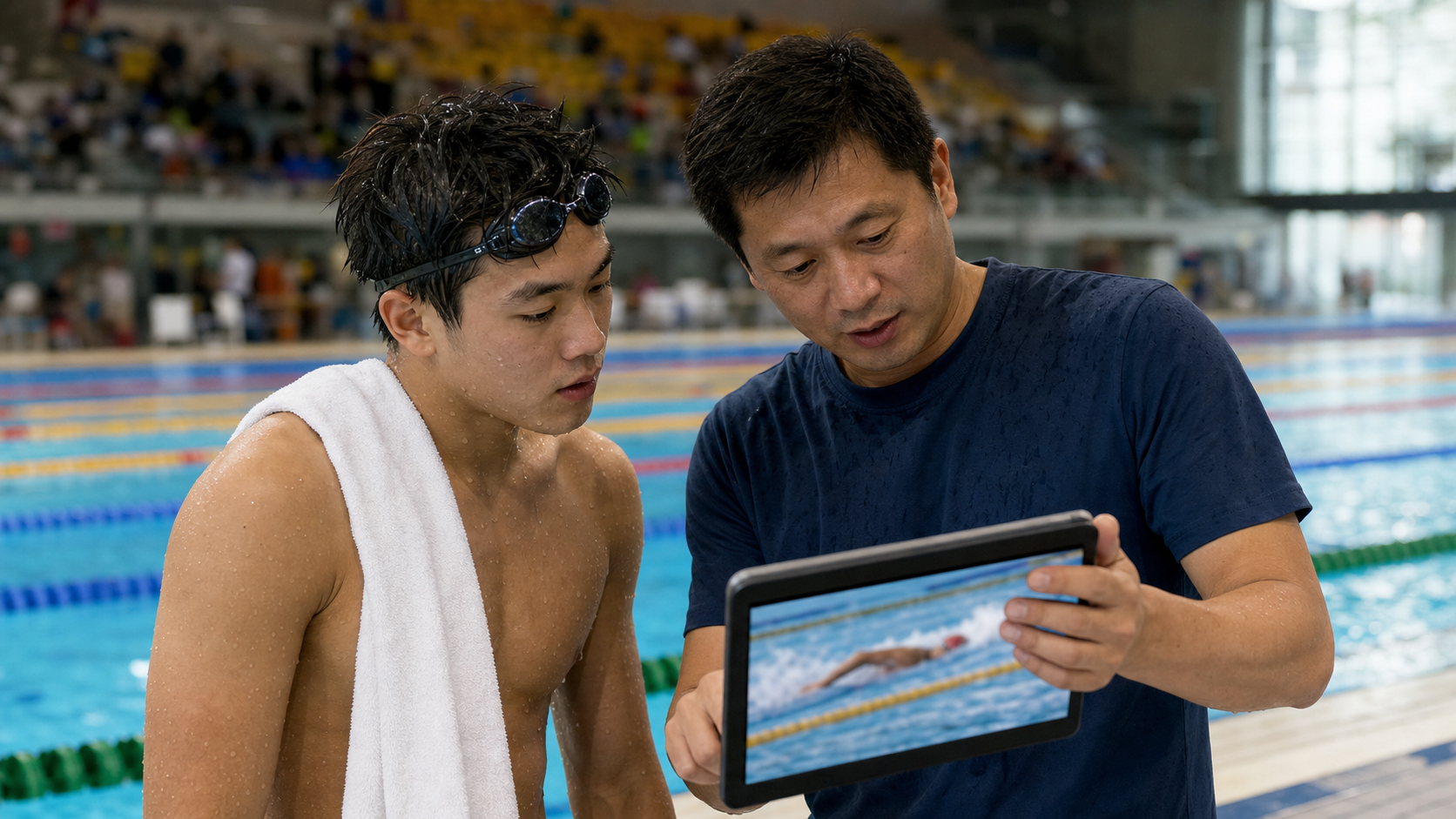
“Once the race is over, it’s over” is a common blind spot shared by many amateur swimmers in Taiwan. One of the key secrets to professional swimmers’ improvement is spending equal or even more time after a race on systematic analysis—not just looking at the result, but understanding “why this result.” With the widespread availability of smartphone videography and sports analysis technology, any swimmer can now build an effective post-race video analysis system, turning the data from every race into concrete areas for improvement in the next training cycle.
The Three Levels of Post-Race Analysis
Effective post-race analysis needs to be conducted at three levels:
| Analysis Level | Primary Tools | Analysis Focus | Time Required |
|---|---|---|---|
| Quantitative Performance Analysis | Timing systems, personal records | Split times, performance trends | 10–15 minutes |
| Technical Movement Analysis | Video recording, slow-motion replay | Stroke, turns, starts | 30–60 minutes |
| Competitive Situation Analysis | Race footage, opponent data | Relative positioning, breathing rhythm | 20–30 minutes |
Preparation for Video Analysis
The Importance of Camera Angles
Different camera angles can reveal different technical issues:
- Side angle (most important): Films the entire lane, clearly showing stroke rhythm, turn push-offs, and underwater dolphin kick depth
- Front/finish angle: Reveals symmetry issues (unequal stroke power between left and right, body tilt)
- Overhead angle: Shows whether the stroke path deviates, S-shaped stroke issues
- Underwater filming (advanced): Shows hand entry position, stroke depth, and dolphin kick amplitude
Filming notes for Taiwanese race venues:
- City/county games and national championships generally allow poolside filming, but be sure to check event rules
- It’s recommended to bring a tripod to secure the position and avoid shaky handheld footage
- Arrive early to test camera angles and confirm the lens covers the entire lane
Systematic Technical Analysis Process
Step 1: Performance Data Organization (within 24 hours after the race)
Create a personal race performance record:
- Total time and the gap to personal best (PB)
- Each 50m split time
- “Pace ratio” for each segment (actual time / target time)
- Identify which 50m segment was the slowest (this is usually the root of the problem)
Step 2: Full-Race Video Review (1–3 days after the race)
The first review focuses on “overall rhythm,” observing:
- Did the start go according to plan? Was reaction time normal?
- Did the underwater dolphin kick reach the intended distance (12–15m)?
- Did overall pacing match the plan? What was the difference between the first and second half?
- Did technique break down in the final 25m?
Step 3: Slow-Motion Analysis of Key Segments
Analyze the following four key technical phases in slow motion (0.25x speed):
1. Start
- Takeoff timing (reaction time)
- Entry angle (whether it falls within the 30–35 degree range)
- Whether the arms are fully extended after entry
2. Underwater Dolphin Kick
- Actual underwater distance (compare against the 15m mark)
- Whether dolphin kick amplitude is appropriate (approximately 30–35cm)
- Whether body streamline is maintained (no excessive bending at the waist)
3. Stroke
- Whether high-elbow catch (Entry Elbow Up) is maintained
- Whether stroke length noticeably shortens after fatigue sets in
- Whether the head rotation angle during breathing is excessive
4. Turn
- Whether the final stroke before touching the wall is complete or cut short
- Speed of the flip turn
- Streamline and dolphin kick initiation after pushing off the wall
Prioritizing Technical Issues
After analyzing the footage, multiple technical issues will typically surface. It’s recommended to prioritize them using the following framework:
- Priority fixes: Issues that directly affect speed and appear in every race (e.g., poor turn efficiency, insufficient underwater distance)
- Secondary fixes: Technical breakdowns that only appear after fatigue (e.g., shortened strokes in the latter part of the race)
- Long-term adjustments: Fundamental technical flaws that are difficult to change in the short term (e.g., S-shaped stroke path issues)
Recommended Analysis Tools
Modern digital tools make video analysis more convenient:
- Slow-motion apps (such as Coach’s Eye, Hudl Technique): Allow slow-motion playback and annotation on your phone
- Video comparison features: Place footage from the same time point in different races side by side for comparison
- Angle measurement tools: Measure key technical parameters such as entry angle and stroke angle
- Timeline annotation: Mark the exact time points where issues occur on the footage
Practical Advice
- Have footage of every race; if you can’t film yourself, ask a teammate or parent to help; video is the most objective tool for technical analysis
- Build a personal video library, archive footage from each race by date, and regularly perform “before-and-after comparisons”
- Analyze together with your coach; athletes have blind spots in their own perspective, and the coach’s external observation can fill those gaps
- Set the next training goal immediately after analysis, turning problems into specific training tasks
- Don’t try to fix everything at once; focus on 1–2 of the most critical technical improvements per training cycle
Conclusion
Improvement in swimming performance is a cycle: race → analyze → improve → race. The fastest-improving swimmers are often not the ones with the highest training volume, but those who are best at learning from every race. Establishing a systematic post-race video analysis habit will allow Taiwanese swimmers to continuously surpass themselves with clear technical awareness at the National Swimming Championships, city/county games, and triathlon events—seeing the numbers improve at every touch of the wall.
Related Reading
- Post-Race Analysis for Swimmers: Finding the Next Training Direction from Race Data
- Video Training for Swimmers: Practical Applications of Underwater Filming Analysis
- Post-Race Swim Analysis: Breaking Down the Technical Factors Behind Personal Bests
- Swim Video Analysis: Key Observation Points for Above-Water and Underwater Filming
西進武嶺 免費訓練分析服務 Intervals | 練不夠還是練過頭?你哪一種類型選手?AI模型告訴你! | 備戰神器 | 公路車 訓練 | CT Yeh
4 年前
崇越盃武嶺冠軍高手 賽前JJSC 群峰會精華!對應大數據分析,會有落差嗎?/ feat. JJSC中部公路車約騎 /公路車 / CT Yeh
2 年前
教學) 如何做出專業 慢動作 影片 Slow Motion 120fps GoPro 7 ActionCam AX700 A99II
7 年前
戀戀197 競賽組 | 50頁投影片心得報告 | 賽後檢討 攻略 #公路車
6 年前
[教學] Premiere 影片 手震 修正 教學 防抖 單眼 影像 GoPro 穩定 Video Stabilization
8 年前
西進武嶺 自製新版AI配速表產生器 x 賽前攻略 抱佛腳! 沒有功率計也可以產生配速表嗎?有什麼其他眉角賽前要注意的呢? | 西進武嶺 / 東進武嶺 KOM 攻略 | 公路車 | CT Yeh
4 年前
Live) 備戰2019彰化經典百K 賽前攻略 (已完賽請看新影片
7 年前
96聯賽 桃園市長盃 歷屆各路段大數據攻略 從菁英組到新手組的平均瓦數、均速、平均時間 x 賽前探路
5 年前