Introduction
In recent years, road running has become increasingly popular in Taiwan, and the foam roller has become a standard piece of equipment in every runner’s bag. At the finish area of the Taipei Marathon and after training sessions with various running clubs, you can see runners lying on the ground rolling around everywhere. However, surprisingly few people truly understand the correct techniques.
Incorrect use of the roller—such as pressing directly and repeatedly on the most painful spot, or rolling too fast—is not only ineffective but may also worsen local inflammation. This article will provide a correct operation guide for each commonly targeted area.
The Mechanism of Foam Rolling
Foam rolling is a Self-Myofascial Release (SMR) technique. Its effects come from two mechanisms:
- Mechanical Pressure: Direct pressure improves fascial adhesions and increases tissue mobility.
- Neuro-Reflexive Inhibition: Sustained pressure triggers the Golgi Tendon Organ, inhibiting excessive muscle tension and achieving a relaxation effect.
Basic Principles for Correct Use
- Speed: Move slowly (about 2 cm per second). Do not roll back and forth quickly.
- Pause: When you find a tight spot, pause for 20–30 seconds and wait for the tissue to “melt” and release.
- Pressure: Use your body weight to control the pressure. Beginners can support themselves with one hand on the ground to reduce body weight.
- Pain Points: Avoid the sharpest pain points (areas of acute inflammation). Work on the surrounding area.
- Duration: 60–90 seconds per area. It doesn’t need to be excessively long.
Correct Techniques for Each Area
Calves (Gastrocnemius + Soleus)
Position Setup:
- Sit on the ground with one leg extended, placing the roller directly behind the calf (gastrocnemius position).
- The other leg can be placed on the ground or crossed over the top (to increase pressure).
- Support yourself with your hands on the ground, slightly lifting your hips.
Operation Steps:
- Start 5 cm above the Achilles tendon and move slowly towards the back of the knee.
- When you encounter a tight spot, pause for 20–30 seconds, coordinating with deep breathing.
- Perform dorsiflexion/plantarflexion movements with the ankle (bobbing up and down) to enhance the relaxation effect.
- Rotate the foot inward/outward to roll the outer and inner sides of the calf.
Note: Avoid pressing directly on the Achilles tendon; if you have Achilles tendonitis, skip this area entirely.
Front of Thigh (Quadriceps)
Position Setup:
- Prone position (lying on your stomach), with the roller under the front of your thigh.
- Prop yourself up on your forearms, lifting your torso to control the body weight applied to the leg.
Operation Steps:
- Start 5 cm above the knee and move slowly towards the hip joint.
- Pay special attention to the outer thigh (vastus lateralis), which is often tight in patients with runner’s knee.
- When you encounter a tight spot, pause and perform knee bending/straightening movements (active contract-relax).
Back of Thigh (Hamstrings)
Position Setup:
- Seated position, with the roller placed under the back of the thigh.
- Support yourself with your hands on the ground, starting from just below the sit bones.
| Area | Start From | End At | Special Movement |
|---|---|---|---|
| Gastrocnemius | Above Achilles tendon | Below the knee pit | Ankle bobbing up and down |
| Quadriceps | Above the knee | Groin area | Knee bending and straightening |
| Hamstrings | Below the sit bones | Above the knee pit | Ankle dorsiflexion |
| IT Band | Outer side of the knee | Greater trochanter | Leg swinging forward and backward |
IT Band (Iliotibial Band) — The Most Commonly Misused Area
Important Concept Correction: The IT Band itself is dense connective tissue and can hardly be “rolled and stretched.” The benefits of foam rolling for the IT Band primarily come from the adjacent Tensor Fasciae Latae (TFL) and the lateral fibers of the Gluteus Maximus.
Position Setup:
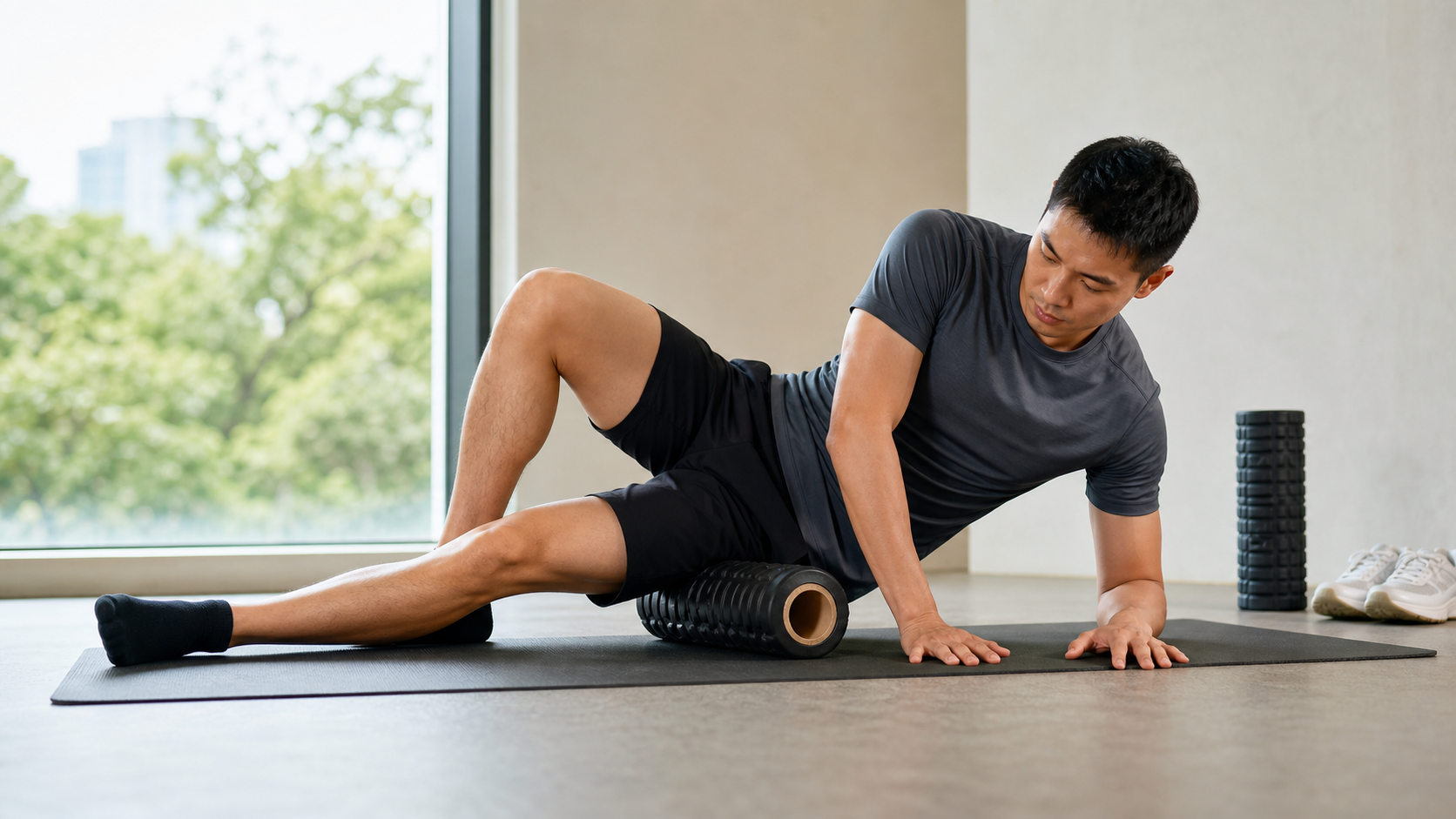
- Lie on your side, with the affected leg underneath and the roller under the outer thigh.
- Cross the top leg over to the front and place the foot on the ground to share body weight (for beginners).
- Or stack both legs (for advanced users, more pressure).
Operation Steps:
- Start 3 cm above the outer side of the knee and move towards the greater trochanter (the bony prominence on the outer hip).
- When you encounter the most sensitive point (usually in the middle of the outer thigh), pause for 20–30 seconds.
- Gently swing the leg forward and backward to add rotational release to the tissue.
- Do not press repeatedly and rapidly on the sharpest pain point.
Foam Roller Buying Guide (Taiwan Market)
- Entry-Level (Medium Firmness): EVA foam material, approximately NT$300–600 in Taiwanese sporting goods stores, suitable for most runners.
- Advanced (High-Density Foam): Firmer, providing deeper pressure, approximately NT$800–1500.
- Vibrating Roller: Built-in vibration motor to further enhance the effect, approximately NT$2000–4000.
- Short Roller (Grid Roller): Easy to carry, suitable for the office or a travel bag.
Recommended Usage Timing
- Pre-Run: Using the roller before dynamic warm-up can improve tissue extensibility (use 10–15 minutes prior).
- Post-Run: The optimal time to use it; the effect is even better when combined with static stretching.
- Rest Days: 5–10 minutes daily before bed to maintain fascial health.
Contraindications and Precautions
- Do not use within 48–72 hours after an acute sprain or muscle tear.
- Avoid direct pressure on areas with varicose veins.
- Do not roll directly over bony prominences (such as the kneecap or ankle bones).
- If pain significantly worsens after rolling, seek medical attention to rule out other causes.
Conclusion
The foam roller is the most cost-effective recovery tool for runners, but “the tool is good, but the technique is important.” 5–10 minutes of correct operation daily can significantly improve tissue flexibility and reduce the risk of injury over the long term. Taiwanese runners don’t lack equipment; they lack correct knowledge—I hope this article ensures your roller is no longer just a decoration.
Related Topic Reading
- Complete Post-Run Foam Roller Usage Guide
- Foam Rolling Release: Correct Rolling Methods for the Iliotibial Band, Calves, and Front Thighs
- Foam Roller Massage: Rolling Areas and Duration for Cycling-Specific Muscle Groups
- Foam Rollers and Massage Balls: A Complete Comparison of Essential Recovery Tools for Runners
西進武嶺 免費訓練分析服務 Intervals | 練不夠還是練過頭?你哪一種類型選手?AI模型告訴你! | 備戰神器 | 公路車 訓練 | CT Yeh
4 年前
CT 喇低賽) 武嶺牽車 才是王道 西進牽車四小時內秘訣 攝手位置 如何判斷 防抽筋小秘訣
7 年前
大禹嶺 到 武嶺牌樓 全程前後實況錄影 | 北進武嶺 | 東進武嶺 | KOM | 訓練台 | 坡度分析 | Taiwan KOM Last 10 km HARD | 公路車
6 年前
白沙屯媽祖進香在家走!UREVO 坡度自調走步機 / 可連接訓練遊戲APP MyWhoosh / 邊看直播邊走起來 / CT Yeh
11 個月前
武嶺配速表最佳使用方式 #bike
1 年前
一日北高常見問題大集合 | 攻略 | 路線 | 訓練 | 補給 | 自行車 單車 | 一日雙城 | 雙塔 | TWB北高360 | 屁股痛
6 年前
風櫃嘴 衝刺慢動作回放!
8 年前
#公路車 #Fitting 靠人工智慧APP 幫你調整單車
6 年前