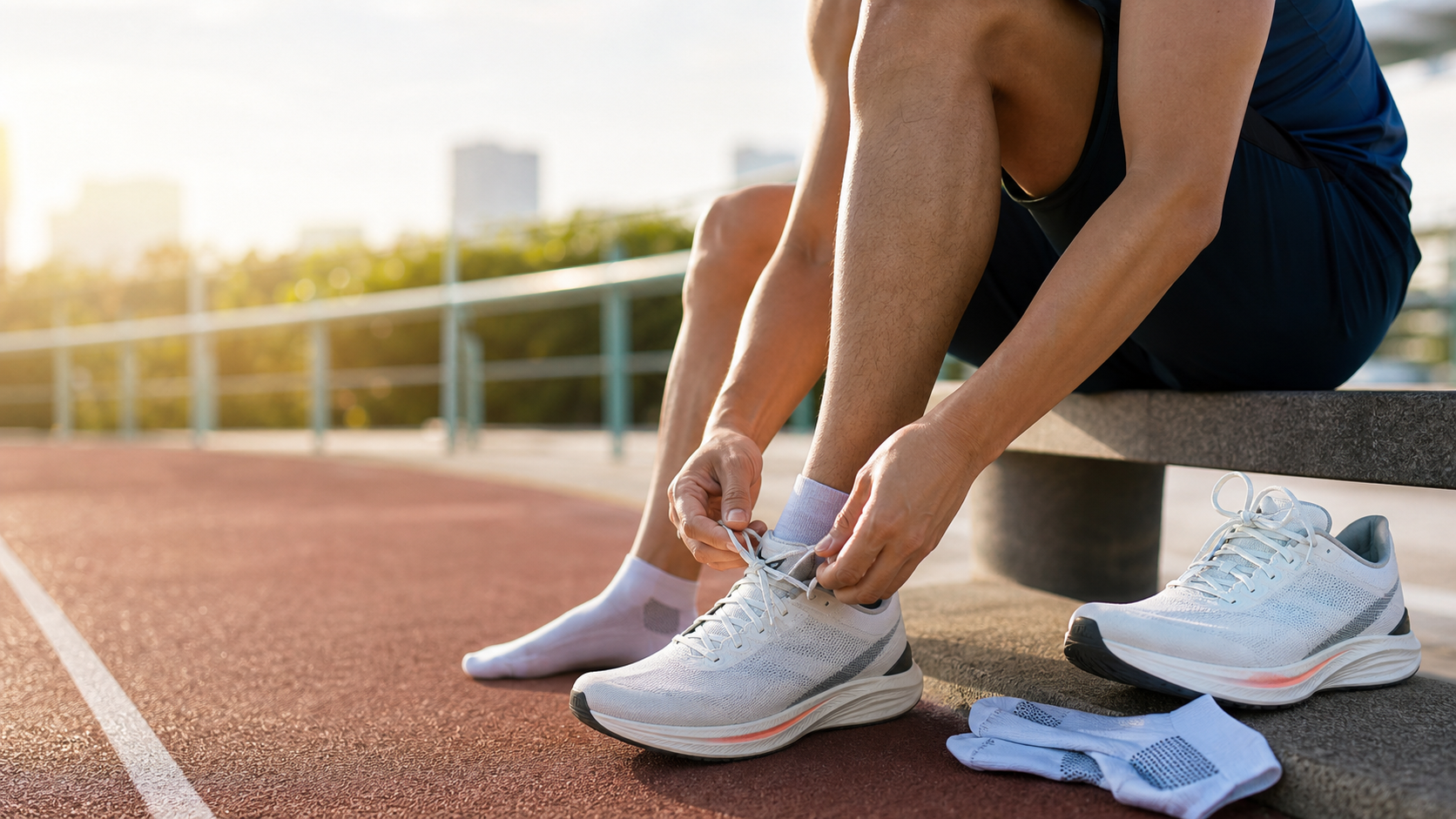
Introduction
Taking off your running shoes and discovering your big toenail has turned black—this is a common “surprise” for many Taiwanese runners after finishing their first marathon. Black toenail (subungual hematoma) occurs in as many as 15–20% of long-distance runners, making it the most common running-related skin injury.
Although black toenails are jokingly called a runner’s “badge of honor,” they indicate that the nail bed has been subjected to repeated pressure and shear forces. Not only is it painful, but in severe cases, toenail loss and nail bed infection can be troublesome. The good news is that with the right shoe selection and proper lacing techniques, black toenails are almost entirely preventable.
Causes of Black Toenails
Mechanical Causes
During running, the toenails repeatedly strike the toe box or the nail bed endures shear forces, causing microvascular rupture and bleeding in the nail bed. Blood accumulates under the nail, forming a black hematoma.
Main contributing factors:
| Factor | Explanation |
|---|---|
| Shoes too small | The most common cause; feet swell from heat during running, so shoes need to be half a size larger than usual |
| Shoes too large | Feet slide forward and backward, causing toenails to repeatedly strike the toe box |
| Excessive downhill running | Gravity increases the force of toes striking forward by 3–5 times |
| Laces too loose | Feet slide inside the shoes |
| Toenails too long | Increased frequency of toenails striking the toe box |
| Thick cotton socks | Take up space, compressing the toenail area |
Shoe Selection: A Shoe-Buying Guide for Taiwanese Runners
Sizing Principles
- Half to a full size larger than everyday shoes: Feet swell from increased blood flow and heat during running; foot length can increase by about 0.5 cm after long runs
- Wide-fit models: Taiwanese runners generally have wider feet; choosing 2E or 4E wide widths gives the big toe more room
- When to try on shoes: Try on in the afternoon (when feet are most swollen), wearing the thin technical socks you run in
- Toe space test: After putting on the shoes, there should be about one finger’s width (approximately 1–1.5 cm) of space between your big toe and the front of the shoe
Shoe Structure Recommendations
- Wider toe box: Brands like Altra and Topo Athletic offer natural foot-shape designs, available for try-on at major running shoe specialty stores in Taiwan
- Sufficient toe box height: Avoid toenails pressing against the upper, especially important for trail running models
- Softer upper materials: Mesh materials give toenails more room than leather materials
Shoe-Shopping Resources in Taiwan
- Running shoe specialty stores on Xinyi Road and Zhongxiao East Road (New Balance, Asics, Brooks stores) offer free foot analysis
- Trying on shoes in physical stores is more important than buying online, especially for long-distance shoes
Lacing Techniques: Changing Your Lacing Method Can Solve the Problem
Technique 1: Parallel Lacing
Suitable for runners with insufficient toe space:
- Thread the laces through the bottom eyelets (without crossing)
- Run each side of the lace straight up through the eyelets on the same side
- Only cross and tie at the very top
Effect: Does not compress the instep, giving toenails maximum room.
Technique 2: Toe Relief Lacing
Suitable for runners whose big toe tends to get rubbed:
- Start from the pair of eyelets closest to the big toe
- “Skip” one eyelet with that lace (to loosen the toe area)
- Lace the rest normally
Technique 3: Heel Lock / Lace Lock
Suitable for runners whose heels tend to slide inside the shoes:
- After threading through the top eyelets, form a small loop on each side
- Cross the lace through the opposite loop, then tie
- This “locks” the heel in place, preventing the forefoot from sliding forward and significantly reducing toenail impact
Lacing Method Comparison
| Lacing Method | Problem Addressed | Difficulty |
|---|---|---|
| Parallel Lacing | Instep pressure, cramped toenails | Moderate |
| Toe Relief | Big toe impact | Easy |
| Heel Lock | Foot sliding forward and backward | Moderate |
| High-Instep Bypass | Runners with high insteps | Harder |
Toenail Care: The Last Line of Defense
- Trim regularly: Trim toenails every 1–2 weeks, keeping them level with the tip of the toe (not too short, or ingrown toenails may result)
- How to trim: Cut straight across, not in a curved shape, to prevent ingrown toenails
- Don’t trim before race day: Avoid trimming toenails 2–3 days before a race to prevent them from being just “a bit too short”
What to Do If You Discover a Black Toenail During a Race?
Preventive Measures on Race Day
- Check lace tightness before starting (insert a finger under the laces over the instep to confirm)
- Apply toe protection tape (Sports Tape available at drugstores or running shoe stores)
- Wear appropriately thick technical running socks (not cotton)
Post-Race Management
- If the subungual hematoma is not painful, simply observe (it will usually be absorbed on its own, or the nail will fall off and regrow)
- If pain is significant, seek medical attention for subungual hematoma drainage (puncturing the nail to let the blood out)
- Keep the toenail clean; watch for nail bed infection if the nail falls off
Practical Advice
- Before long-distance training, complete a trial run of 21 km or more to confirm your shoes are suitable
- Trail runners should pay special attention to toe protection structures in their shoes (downhill impact is greater)
- Taiwan’s hot, humid summers cause toenails to soften from sweat, worsening injuries, so breathable running shoes are even more essential
Conclusion
Black toenails are not an inevitable price of road running. Through proper shoe selection (half size up, wide fit), appropriate lacing techniques (heel lock), and regular toenail care, most runners can completely avoid this annoying problem. Next time you shop for shoes, bring the knowledge from this article to your fitting session, and keep your toenails healthy after every marathon.
Related Reading
- Runner’s Black Toenails and Blisters: Prevention and Treatment Guide
- The Complete Guide to Runner’s Black Toenails: Causes, Treatment, and Prevention
- Identifying and Preventing Running Stress Fractures: Notes for High-Risk Groups
- Running Injury Prevention and Common Injury Management: Knees, Ankles, Plantar Fasciitis
iPhone內建一秒變長腿🤣 車友必備#cycling
2 年前
96聯賽 桃園市長盃 歷屆各路段大數據攻略 從菁英組到新手組的平均瓦數、均速、平均時間 x 賽前探路
5 年前
一日北高/長距離團騎 常見問題補充篇 / 組團或跟團的眉角 / 壯車友容易被瘦車友慢性拉爆 / 原來屁股痛可能是這個原因...? / 風場配速法 / 公路車 / CT Yeh
2 年前
2025 自行車錶排行榜 兩萬車友大數據 / Garmin Bryton 排名會大洗牌嗎? / 全新的碼表前身分析 /公路車 / CT Yeh
1 年前
單車 一日北高 ( 雙城 ) 肥宅雙人瘋狂行 紀錄片 REACTO
10 年前
洗完單車整隻手黑的解決妙招🤣 #bike
1 年前
一日北高常見問題大集合 | 攻略 | 路線 | 訓練 | 補給 | 自行車 單車 | 一日雙城 | 雙塔 | TWB北高360 | 屁股痛
6 年前
碟煞公路車 銑面器 !? 原來銑完差這麼多! 降低蹭碟機率! | TIME 公路車 保養小記錄 | CT Yeh
3 年前