/no_think
Introduction
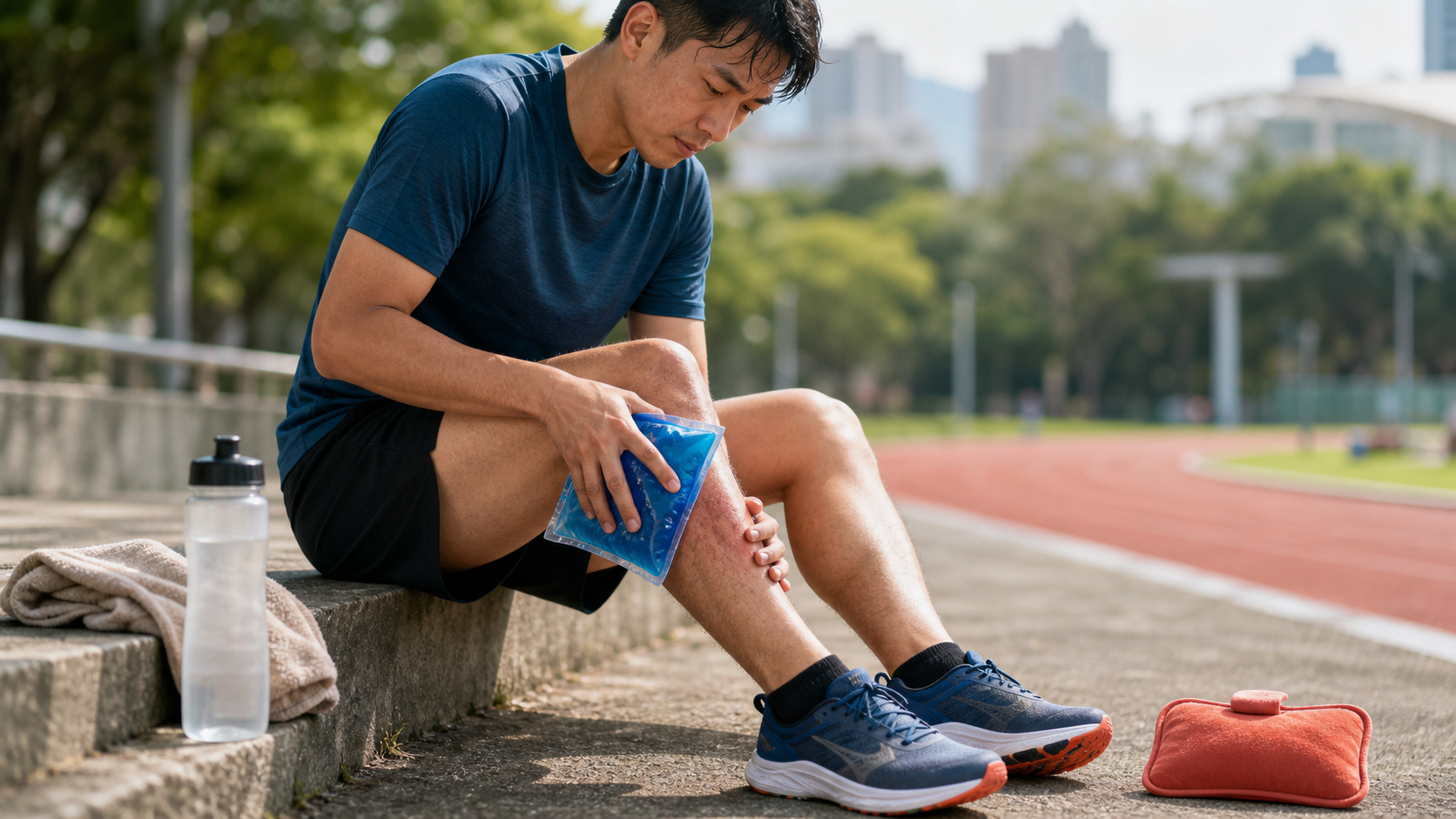
After running 30 kilometers, your knee hurts a bit—should you ice it or apply heat? It’s the third day after an ankle sprain, and the swelling has subsided slightly—can you soak it in hot water now? These kinds of questions pop up almost every week in Taiwan’s running group forums, and the answers are often all over the place.
Ice and heat therapy aren’t a matter of “which is better,” but rather “which fits this situation.” Choosing the wrong one isn’t just ineffective—it can also prolong recovery. This article provides a practical, actionable framework for making the call.
Physiological Effects of Ice Therapy
Ice therapy (Cryotherapy) lowers local tissue temperature, producing the following effects:
- Vasoconstriction: Reduces local congestion and suppresses the acute inflammatory response
- Slower nerve conduction velocity: Reduces pain signal transmission
- Lower metabolic rate: Decreases local oxygen demand, preventing secondary cell damage
- Reduced muscle spasms: Through sensory nerve inhibition mechanisms
Best Timing for Ice Therapy
- 0–72 hours after an acute injury (acute inflammatory phase)
- Immediately after exercise (to reduce exercise-induced inflammation)
- Frequency of use: once every 1–2 hours, 15–20 minutes per session
Physiological Effects of Heat Therapy
Heat therapy raises local tissue temperature, producing the following effects:
- Vasodilation: Increases blood flow and promotes clearance of metabolic waste
- Improved tissue extensibility: Collagen becomes more elastic at higher temperatures
- Muscle relaxation: Reduces muscle tension and spasms
- Accelerated tissue repair: Promotes migration of repair cells to the injured area
Best Timing for Heat Therapy
- Chronic injuries or the subacute phase (after 72 hours post-injury, with no significant swelling)
- Pre-training warm-up to increase tissue flexibility
- Chronic muscle tightness (not acute tears)
Choosing Correctly for Common Injuries
Decision Framework: The “STOP” Principle
- S (Swelling): Swelling present → ice
- T (Time): < 72 hours post-injury → ice; > 72 hours with no swelling → heat is acceptable
- O (Open): Open wound → use neither
- P (Pain type): Acute sharp pain → ice; chronic dull ache → heat
Injury Type Reference Table
| Injury Type | Acute Phase (< 72h) | Subacute/Chronic Phase (> 72h) | Notes |
|---|---|---|---|
| Ankle sprain | Ice | Heat (after swelling subsides) | Fracture must be ruled out |
| Muscle strain | Ice | Heat | Avoid heat during tearing phase |
| Runner’s knee (ITBS) | Ice | Heat (before warm-up) | Heat is primary in chronic phase |
| Plantar fasciitis | Ice (acute pain) | Heat (chronic phase, mornings) | Stretch after morning heat therapy |
| Achilles tendinitis | Ice | Moderate temperature (37–38°C) | Excessive heat may worsen it |
| Medial tibial stress syndrome | Ice | Ice preferred | Stress fracture must be ruled out |
| Delayed-onset muscle soreness | Ice or heat both fine | Heat + massage | Effects are similar for both |
Proper Ice Therapy Application
Common Ice Therapy Methods in Taiwanese Households
- Ice packs (convenience store ice packs): Ready-to-use ice packs available 24/7 at 7-Eleven and FamilyMart—convenient and practical
- DIY ice packs: Ice cubes + a small amount of water in a sealed bag (an ice-water mix conforms better to body contours)
- Frozen pea bags: Frozen vegetable bags are moldable and reusable
Key Application Points
- Never apply directly to skin: Wrap the ice pack in a towel to prevent frostbite
- Duration: 15–20 minutes per session, no more than 20 minutes
- Interval: Wait at least 45–60 minutes before reapplying
- Warning signs: If redness, blisters, or a stinging sensation appears on the skin, remove immediately
Proper Heat Therapy Application
Common Heat Therapy Methods in Taiwanese Households
- Electric heating pads: Available at Taiwanese pharmacies (Dachu, Watsons) or on Shopee, priced around NT$400–800
- Hot water bottles: A traditional method that is effective and inexpensive
- Soaking method: For ankle or lower leg injuries, soak in a bucket of 38–40°C warm water for 15–20 minutes
Key Application Points
- Temperature: 38–42°C, based on comfort—should not feel scalding
- Duration: 15–20 minutes per session
- Contraindications: Diabetic patients (reduced sensation, prone to burns) need to pay special attention to temperature
Special Scenarios: Pre-Exercise vs. Post-Exercise
- Pre-exercise: Light heat therapy (38°C) for 10 minutes to raise tissue temperature, combined with dynamic warm-up
- Post-exercise (general training): Ice for 15 minutes to reduce acute inflammation, then light active recovery
- Post-exercise (chronic injury): If the injured area is a chronic issue (e.g., chronic runner’s knee), ice the acute component after exercise, then apply heat 48 hours later
Conclusion
Ice and heat therapy are both effective tools, but they must be used at the right time and for the right injury. Remember the simplest principle: Acute swelling → ice; chronic stiffness → heat; not sure → ice. Taiwanese runners can make good use of convenience store ice packs and home electric heating pads to provide proper initial treatment for injuries at any time.
Related Reading
- Cold Therapy vs. Heat Therapy: The Science of Temperature Treatment After Road Running
- Post-Run Ice Bath vs. Hot Bath: Which Recovery Strategy Fits Your Training Cycle?
- Do Ice Baths After Running Actually Work? Latest Scientific Research Explained
- Cold Water Bath vs. Ice Bath: Key Differences in Temperature and Duration
#公路車 #Fitting 靠人工智慧APP 幫你調整單車
6 年前
4K 東眼山 x 水蜜桃冰沙 百人單車約騎! 操完再吃冰 多爽快
7 年前
詳測) 小米 電動打氣筒 公路車胎要充多久? 值得買嗎? 米家充氣寶 小心燙手!
7 年前
CT暗黑廚房) 車友必備 宇宙無敵鮮蚵湯 幫助訓練恢復 天然食補 好市多 超肥鮮蚵 破PR
7 年前
[防寒衣體驗] 鐵人魂 三鐵 防寒衣試穿會 於松運 深水游泳池 鯨魚池
8 年前
滑雪新手們慘摔學習全紀錄(請開字幕),滑雪好好玩 | Snowboard + Ski | 岩原 スキー場 | 滑雪APP使用 | GoPro Max
6 年前
3D 列印車褲墊 / 舒適改善? / 無痕 x 分區壓縮 / ATK & Decider系列 / JE22黑科技 / #公路車 #CTYEH
11 個月前
摔車後補裝備: 好市多新款單車安全帽& Specialized Romin 北高整路屁股都不痛的坐墊 | 一千元居然有MIPS | CT Yeh | 公路車
4 年前