Introduction
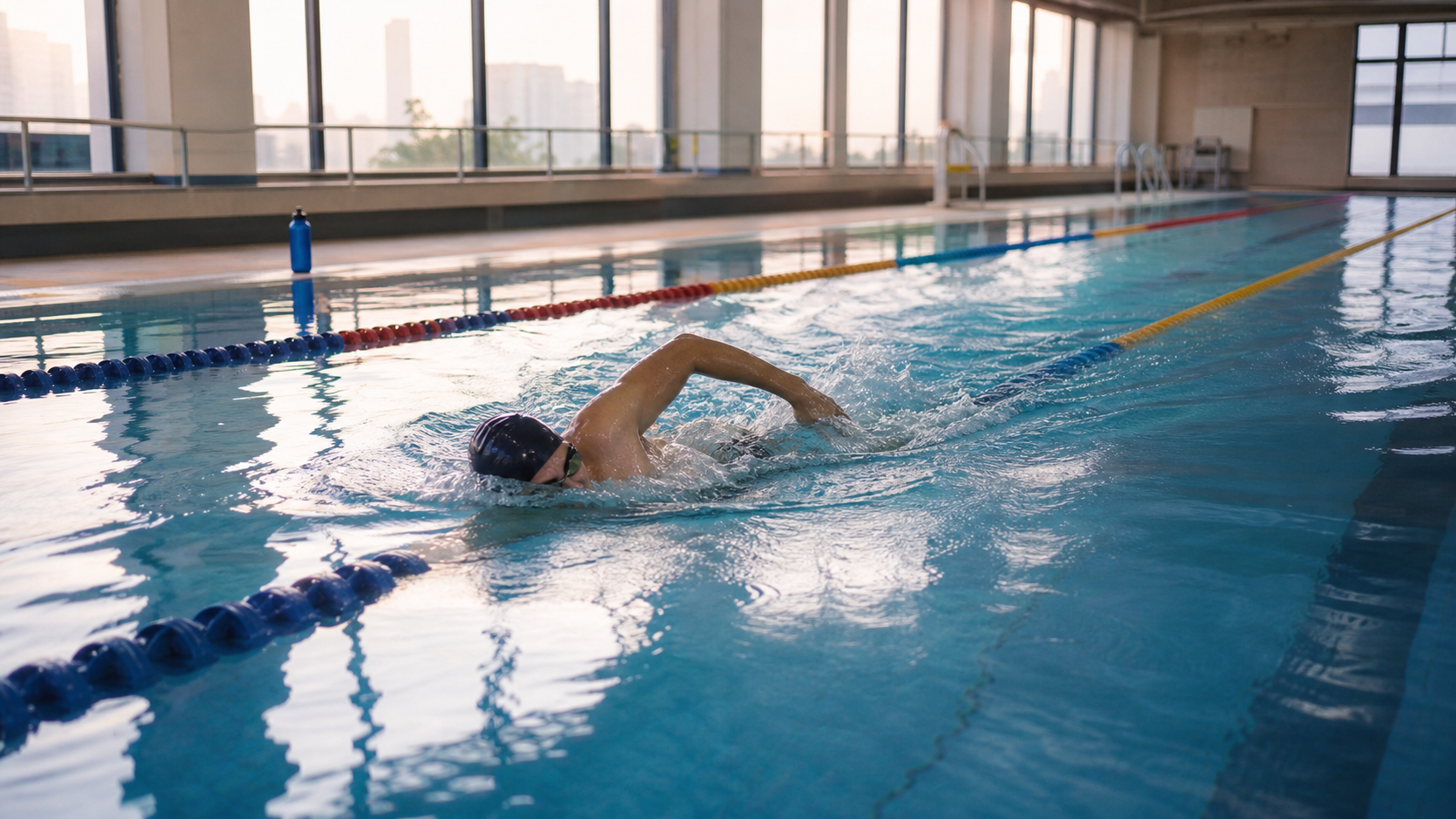
In Taiwan’s swimming training culture, long slow distance (LSD) training is often the most undervalued training method. Many swimmers prefer short intervals because they “feel more tiring and more effective.” However, exercise physiology has long confirmed that long-distance aerobic swimming is a core means of improving cardiorespiratory efficiency, fat metabolism, and muscle capillary density—and it serves as the “foundation” upon which all high-intensity training is built.
Scheduling one 3000–5000m continuous swim per week doesn’t require exceptional speed or effort, yet it delivers deep physiological adaptations that interval training cannot provide.
Five Key Physiological Benefits of Long-Distance Training
- Increased mitochondrial density: The energy factories in muscle cells multiply, improving aerobic metabolic efficiency
- Enhanced fat oxidation capacity: The body becomes better at using fat as an energy source, delaying glycogen depletion
- Lower resting heart rate: Long-term long-distance training can reduce resting heart rate by 2–5 bpm per year
- Strengthened cardiac pumping capacity (stroke volume): Each heartbeat delivers more blood, improving exercise efficiency
- Building mental endurance: Sustaining pace over long periods trains not just the body, but also the will to “push through”
3000–5000m Workout Design: Categorized by Level
| Level | Recommended Distance | Suggested Pace | Intensity Target | Estimated Completion Time |
|---|---|---|---|---|
| Beginner (< 1 year) | 3000m | CSS + 20 seconds | Z1–Z2 | Approximately 70–80 minutes |
| Intermediate (1–3 years) | 3500–4000m | CSS + 10–15 seconds | Z2 | Approximately 75–90 minutes |
| Advanced (3+ years) | 4500–5000m | CSS + 5–10 seconds | Upper Z2 | Approximately 90–105 minutes |
Structuring the Long-Distance Workout
Long distance doesn’t mean “swimming mindlessly to the end”—sensible segmentation helps maintain quality:
Beginner Version (3000m):
- 400m warm-up swim (easy pace)
- Main set: 2 × 1000m @ Z2, with 2 minutes rest between (hydrate as needed)
- 600m technique swim (e.g., single-arm stroke, closed-eye awareness drills)
- Easy cool-down swim to reach 3000m
Advanced Version (5000m):
- 400m warm-up
- 4 × 1000m @ Z2, with 1.5 minutes rest after each 1000m
- 600m technique drills
- Easy swim to reach 5000m
Marathon-Style Swim (suitable for open-water race preparation):
- Continuous 3000–5000m swim without stopping
- Steady Z2 pace
- May intersperse 200m of technique swimming (breaststroke, sidestroke) to relax muscle groups
Challenges and Solutions for Long-Distance Training in Taiwan
Taiwan’s swimming pools are generally short (mostly 25m) and lane changes are cumbersome, creating specific challenges for long-distance training:
- 25m pool turn-around issue: Swimming 5000m requires 200 turns. It’s recommended to choose a lane next to the wall and use push-offs to practice underwater leg power
- Crowded peak hours: Long-distance swimming requires a relatively stable lane; it’s best to go on weekday mornings or between 7–9 PM
- Hydration issue: Get out to hydrate every 1500–2000m; place a water bottle at the start of the lane
- Mental aspect: Swimming 5000m is a major psychological challenge for many. It’s recommended to count in segments (treat every 500m as a milestone) rather than focusing only on total distance
Practical Tips
- Choose a fixed long-distance training day: Usually scheduled on weekend mornings when time is ample and recovery is better
- Pair with music or headphones: Use waterproof Bluetooth earphones (such as Shokz OpenSwim) to listen to steady-rhythm music, which helps maintain long-distance pace
- Recovery after long-distance sessions: Consume 30g of protein + 60g of carbohydrates post-training to accelerate muscle recovery
- Don’t increase every week: Increase long-distance workout distance (+500m) every 2–3 weeks; no need to adjust weekly
Conclusion
A weekly long-distance continuous swim is one of the most valuable habits in swimming endurance training. It doesn’t require the fastest speed or the highest heart rate—only that you keep moving through the water, allowing your body to quietly undergo deep adaptation. Three months later, you’ll find your daily 1000m workouts feel easier, your pace has improved, and your heart rate is lower—that is the “quiet revolution” long-distance training brings you.
Related Reading
一起升級!海鷗盃LSD團練...JJSC Zone2招待 騎到手抖 / 公路車 / CT Yeh
1 天前
西進武嶺 免費訓練分析服務 Intervals | 練不夠還是練過頭?你哪一種類型選手?AI模型告訴你! | 備戰神器 | 公路車 訓練 | CT Yeh
4 年前
CT暗黑廚房) 車友必備 宇宙無敵鮮蚵湯 幫助訓練恢復 天然食補 好市多 超肥鮮蚵 破PR
7 年前
一日北高前的西濱集訓 | 跟著11小時軍團 | 300W踩不動的大逆風 | 輪車破風差幾瓦?
6 年前
實景訓練台) 彰化經典百K 高強度喵團 90分鐘 跟著一起練功 2019 Indoor workout Changhua Classic 100 Taiwan
7 年前
Live) 備戰2019彰化經典百K 賽前攻略 (已完賽請看新影片
7 年前
一日北高/長距離團騎 常見問題補充篇 / 組團或跟團的眉角 / 壯車友容易被瘦車友慢性拉爆 / 原來屁股痛可能是這個原因...? / 風場配速法 / 公路車 / CT Yeh
2 年前
2019 柯P 超越北高 第一集團實錄 (11小時實錄請參考另一部影片) 一日雙城 一日北高 NeverStop Taiwan Long Distance Cycling Challenge
7 年前