Introduction
Bike Fit is a professional process that uses systematic evaluation and adjustment to achieve the best possible match between a rider and their bicycle. More and more bike shops and studios in Taiwan now offer professional fitting services, but many cyclists are still unsure whether it’s worth the investment, when they should get fitted, or how to judge a fitter’s level of expertise.
Comparing the Main Types of Fitting Available in Taiwan
| Fitting Type | Price Range | Best Timing | Depth of Assessment |
|---|---|---|---|
| Basic Static Fitting | NT$1,000–2,500 | Initial setup after buying a bike | Basic riding position adjustment |
| Dynamic Fitting | NT$3,000–6,000 | When discomfort appears | Riding dynamics analysis |
| Full Retül Fitting | NT$5,000–10,000 | Serious discomfort or before an upgrade | Full 3D motion capture analysis |
| Medical-Grade Fitting | NT$8,000–15,000 | Post-injury rehab, pelvic issues | Skeletal structure assessment |
Breaking Down the Standard Fitting Process
A complete dynamic fitting session typically includes the following stages:
Stage 1: Assessment (approx. 30–45 minutes)
- Detailed interview about riding habits, areas of discomfort, and riding goals
- Flexibility testing (hip joint, spinal rotation, ankle flexibility)
- Leg length discrepancy measurement (a difference of more than 5mm between legs requires special handling)
- Sit bone width measurement to help select an appropriate saddle
Stage 2: Dynamic Analysis (approx. 45–60 minutes)
- The rider pedals normally on a trainer
- The fitter observes knee tracking (knees should stay vertical, without drifting inward or outward)
- Ankle motion analysis (roundness of the pedal stroke, degree of heel drop)
- Pelvic stability assessment (amount of side-to-side rocking, pelvic tilt angle)
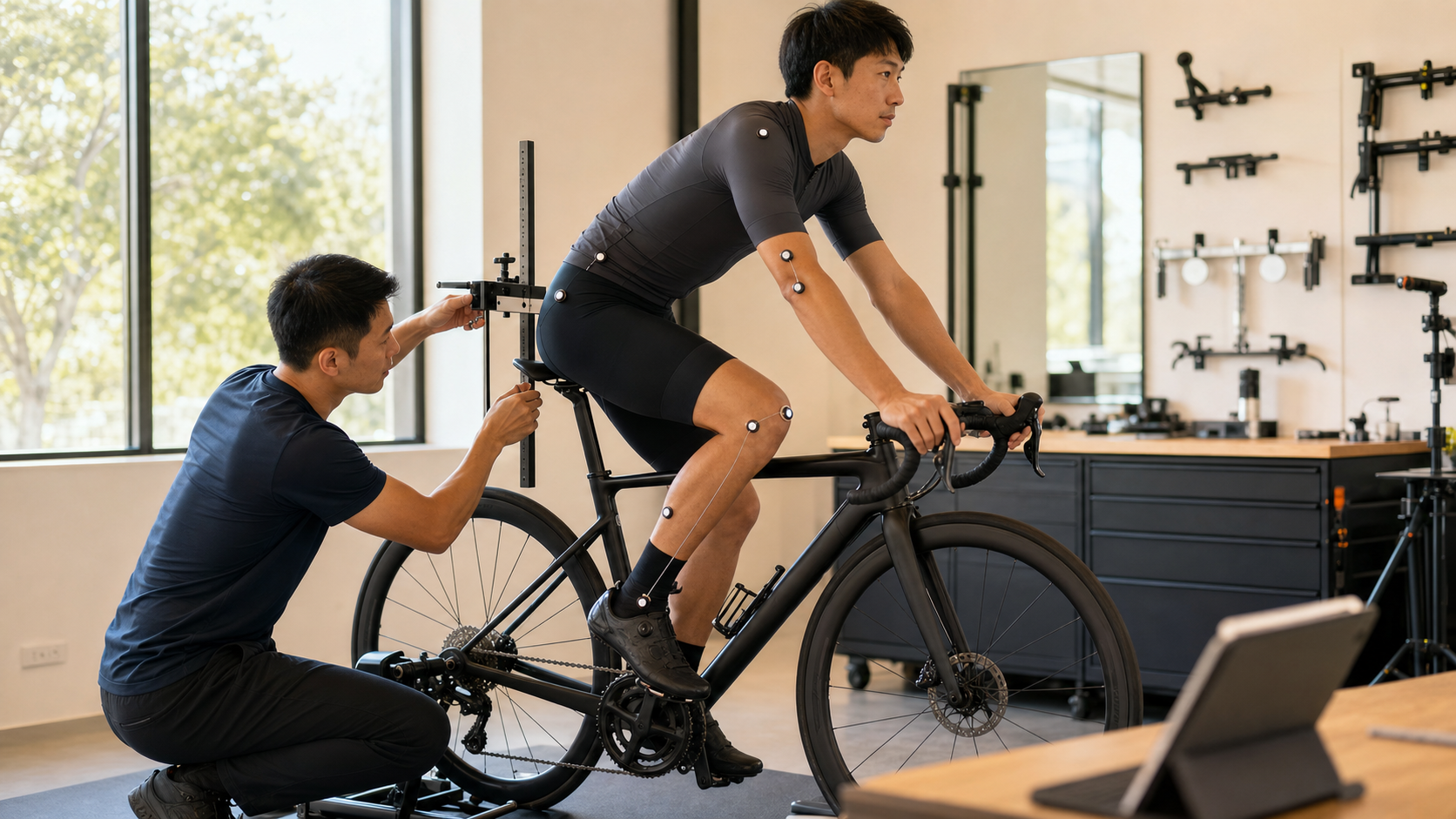
- If a motion capture system such as Retül is used, sensors are attached at joint points for precise measurement
Stage 3: Adjustment (approx. 30–45 minutes)
- Adjustments are made step by step based on the analysis: saddle height → fore-aft saddle position → handlebar height → reach → cleat position
- Rider feedback is confirmed after each change to avoid altering too many variables at once
Stage 4: Reporting and Follow-Up
- A written report is provided, recording all the measurements and settings
- A follow-up visit 2–4 weeks later is recommended to confirm the rider has adapted well
What Problems Can Fitting Solve
Common issues that can be effectively improved through fitting include:
- Knee pain: Pain at the front of the knee is usually caused by a saddle that’s too low, pain at the back usually means the saddle is too high, and pain on the inner or outer side may point to pedal position or cleat issues
- Wrist and neck discomfort: Usually caused by improper handlebar height or reach, which prevents the body from properly supporting its own weight
- Saddle discomfort and numbness: May be caused by incorrect saddle height, fore-aft position, or saddle shape that doesn’t suit the rider; this usually improves significantly after fitting
- Poor climbing efficiency: Pelvic tilt angle and saddle height affect how well the core muscles engage
- Asymmetric pedaling: A large difference in power output between the left and right leg is often related to leg length discrepancy or pelvic issues
When You Should Get Refitted
Refitting is recommended in the following situations:
- After getting a new bike or replacing major components (saddle, handlebar, pedals, frame)
- A weight change of more than 5 kg
- A change in riding goals (switching from leisure riding to racing, or vice versa)
- New discomfort appears and doesn’t improve with rest
- Returning to cycling after injury rehabilitation
How to Choose a Qualified Fitter
The quality of fitting services available in Taiwan varies considerably. The following can serve as reference criteria:
- Certification: Holds recognized credentials such as SBCU (Shimano Bike Fitting), Retül Certified Fitter, or other internationally recognized certifications
- Use of dynamic tools: Static, visual-only assessment is more subjective; a fitter who uses cameras or a Retül motion capture system provides more accurate analysis
- Provides a written report: A complete fitting should come with a paper or digital report recording all the settings
- Can provide referrals: If an issue falls outside the scope of bike fitting (such as pelvic asymmetry), the fitter should be able to refer the rider to a physical therapist or sports medicine specialist
Long-Term Benefit Analysis
The direct benefits of fitting usually start to show after 2–4 weeks. Long-term benefits include:
- Injury prevention: Reduces the risk of chronic injuries to the knees, lower back, and wrists, lowering long-term medical costs
- Improved riding efficiency: A 3–8% speed increase for the same power output (most noticeable for power-focused riders)
- Increased riding volume: No longer held back by discomfort, riders are more willing to ride for longer periods, naturally improving training outcomes
- More precise equipment purchases: With accurate measurement data in hand, future bike or component purchases are no longer guesswork, saving on costly trial and error
Practical Advice
- Get fitted before buying a new bike: Know your sizing needs first, then choose a frame size accordingly, rather than buying a bike and forcing adjustments afterward
- Bring your current bike: If you already own a bike, bring it to the fitting session so the fitter can trace the root cause from your current setup
- Wear your riding gear: Bring the pedals, shoes, and padded cycling shorts you normally use, so the measurement environment closely matches actual riding conditions
- One fitting session isn’t enough: After the initial fitting, your body needs time to adapt — the follow-up visit 2–4 weeks later is just as important
Conclusion
Bike Fit is one of the most underrated investments in cycling. Spending NT$3,000–6,000 on a complete dynamic fitting session often brings a more direct improvement to your riding than upgrading NT$10,000 worth of components. For riders dealing with chronic discomfort in particular, fitting is often the fundamental solution to the problem, rather than an endless cycle of swapping parts. Achieving unity with your bike first, before talking about upgrading equipment, is the smartest logic for investing in cycling.
Related Reading
#公路車 #Fitting 靠人工智慧APP 幫你調整單車
6 年前
單車 一日北高 ( 雙城 ) 肥宅雙人瘋狂行 紀錄片 REACTO
10 年前
Fitting訓練兩用功率車 ! Thinkrider ST900 完整實測!/ 坡度升降 / 鄰居測試/ smart bike/公路車/ CT Yeh
2 年前
多到選擇障礙... 換個單車把帶想一個小時 / BTP / 編織&軟木特有材質超吸睛! / 公路車 / CT Yeh
1 年前
靠單車減肥35公斤 心得分享與整理
7 年前
TIME 公路車 Alpe d'Huez 21 開箱實錄! 購車/Fitting/組車/心得 | 新車入艙 | 時間的主人 CT Yeh
3 年前
拍單車比賽能賺多少?一日Phomi攝影師實境測試| #公路車 | CT Yeh | 用科學分析賺錢!
3 年前
單車AI教練!全新 ChatGPT4o 幫你分析訓練成果!排武嶺課表,分析騎車姿勢! 太神了! / 公路車 / CT Yeh / feat. 緯緯
2 年前