Introduction
“I’ll improve just by running more”—this mindset leads many runners to neglect core training. Yet running research repeatedly shows that core stability is the foundation of running economy and a fundamental preventive factor against common running injuries such as knee, iliotibial band, and lower back issues.
The core is not just “ab training”; it encompasses the entire trunk stability system from the diaphragm to the pelvic floor. With every step while running, the core muscles are needed to maintain pelvic level, control efficient arm swing, and prevent energy waste from unnecessary body sway. This article provides two 20-minute core routines and explains how to embed them into a weekly running plan without adding extra time burden.
Which Core Muscles Do You Need for Running?
The core muscles that running relies on include:
- Transversus abdominis (TVA): The deepest abdominal muscle, providing foundational stability for the spine and pelvis
- Multifidus: Small muscles distributed along the spine, controlling fine segmental stability of the vertebrae
- Gluteus medius: Prevents pelvic drop (hip drop) while running, reducing knee valgus and iliotibial band stress
- Gluteus maximus: Provides running propulsion, the runner’s most important “engine” muscle
- Hip flexors: Control the efficiency of the leg lift motion
- Obliques (internal and external): Control trunk rotation, allowing arm swing without wasting excess energy
Two 20-Minute Core Routines
Routine A: Foundational Stability Core (Pre-Intensification Phase)
Focuses on static and slow-controlled movements to build foundational neuromuscular connections:
| Exercise | Sets × Reps/Time | Key Cues |
|---|---|---|
| Dead Bug | 3×10 reps (each side) | Lower back pressed into the floor, breathing uninterrupted |
| Glute Bridge | 3×15 reps | Squeeze glutes at the top, hold for 1 second |
| Side Plank | 3×30 seconds (each side) | Pelvis does not drop, body in a straight line |
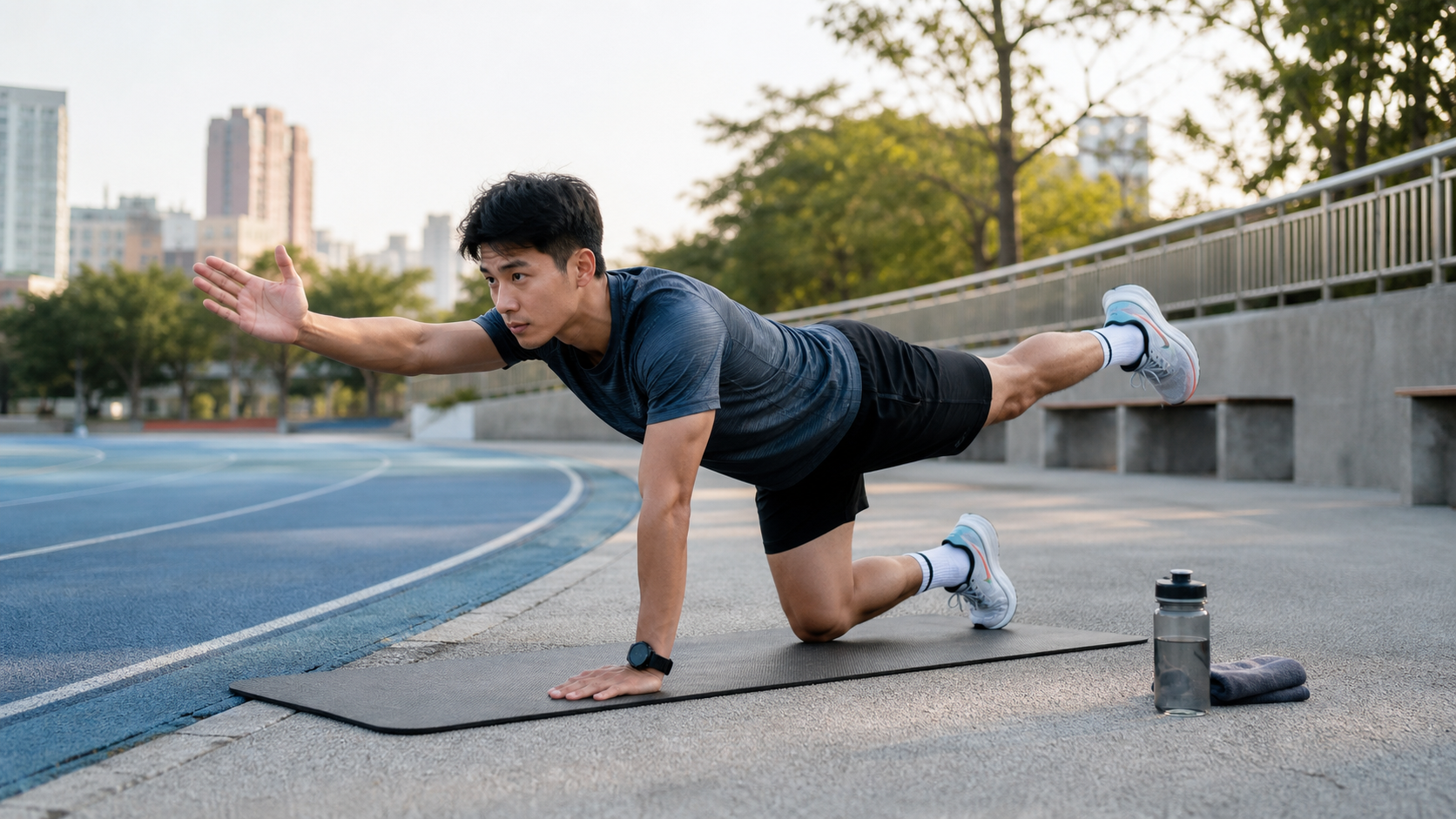
| Bird Dog | 3×10 reps (each side) | No rotation in the lower back, extend slowly |
| Hollow Plank | 3×20 seconds | Draw the abdomen toward the spine |
| Single-Leg Glute Bridge | 2×10 reps (each side) | Maintain pelvic level |
Rest: 20–30 seconds between sets
Total time: Approximately 18–22 minutes
Routine B: Dynamic Functional Core (Post-Intensification Phase)
Focuses on dynamic and functional movements that more closely mimic the core demands of running:
| Exercise | Sets × Reps/Time | Key Cues |
|---|---|---|
| Lateral Band Walk | 2×15 steps (each direction) | Toes pointing forward, push knees outward |
| Single-Leg Standing Rotation | 2×12 reps (each side) | Standing leg stable, rotate the upper body |
| Mountain Climber | 3×20 reps (alternating) | Core fixed, hips not raised |
| Runner’s Lunge + Rotation | 2×10 reps (each side) | Rotate the upper body toward the front leg during the lunge |
| Single-Leg Deadlift (Bodyweight) | 3×10 reps (each side) | Back leg and body form a straight line |
| Glute Activation Kickback | 2×15 reps (each side) | Lying prone, squeeze glutes to lift the leg |
Rest: 20–30 seconds between sets
Total time: Approximately 20–25 minutes
How to Embed into Your Weekly Running Plan
There are two optimal timing options for embedding core training:
Option 1: Immediately After Running (Recommended)
After the cool-down phase of your run, your body is already warmed up—this is the time to do core work:
- Advantages: No extra scheduling needed; perform it right by the roadside after your run or on the floor once you’re home
- Timing: Choose to do it after an “easy run,” not after a speed workout (the body is already fatigued after speed sessions, and core movement quality suffers)
Option 2: Standalone Training Day (Morning)
Perform it independently on a non-running day or in the morning before a run:
- Advantages: You can execute core training in the best possible state, resulting in higher movement quality
- Note: If you have a speed workout on the same day, schedule core training 4–6 hours before the run to give the nervous system time to recover
Weekly Embedding Example (50 km Weekly Mileage)
- Monday: Rest
- Tuesday: Easy run 10 km → Routine A (20 minutes)
- Wednesday: Interval training 9 km
- Thursday: Easy run 8 km → Routine B (20 minutes)
- Saturday: Long run 18 km
- Sunday: Easy recovery run 8 km
Core training twice per week totals an additional 40 minutes, yet it can significantly improve running economy and injury prevention.
Periodizing Core Training
Core training volume should also be adjusted in line with your running cycle:
- Base Phase: Focus on Routine A, 2–3 times per week, to build foundational stability
- Intensification Phase: Focus on Routine B, 2 times per week, to enhance functional movement capacity
- Peak Phase: Maintain 1–2 sessions of Routine A per week (conservative version), without adding extra training stress
- Taper Phase: Once per week, shortened version (10–12 minutes), just to maintain the feel
Practical Tips
- Quality over quantity: The quality of each core movement matters more than the number of reps; proper muscle activation is what produces training effects
- Beginners start with static movements: If you have never done core training, spend the first 3–4 weeks doing only Routine A to let the neuromuscular system build connections
- The gluteus medius is the most neglected muscle among runners: Side planks and lateral band walks specifically strengthen the gluteus medius, which is particularly effective for preventing iliotibial band syndrome and runner’s knee
- Don’t use “ab soreness” to judge effectiveness: The sensation of proper core training is “stability,” not soreness in a single muscle
Conclusion
Two 20-minute core sessions per week are the highest-value investment in running improvement. They won’t directly make you run faster, but they will help you maintain proper running form after 35 kilometers, make your speed workout sessions more efficient, and keep you healthy and injury-free after a full season of training. Core stability is the foundation of all running abilities—build this foundation well, and every step you take will be more powerful and more efficient.
Related Reading
- Core Muscle Activation in Running: The Scientific Link Between Stability and Economy
- Preventive Strength Training: Twice-Weekly Glute and Core Training Reduces Injury Rates
- Core Training for Road Runners: Stabilizing the Pelvis to Improve Running Economy
- The Impact of Core Strength on Running Economy
西進武嶺 免費訓練分析服務 Intervals | 練不夠還是練過頭?你哪一種類型選手?AI模型告訴你! | 備戰神器 | 公路車 訓練 | CT Yeh
4 年前
實景訓練台) 彰化經典百K 高強度喵團 90分鐘 跟著一起練功 2019 Indoor workout Changhua Classic 100 Taiwan
7 年前
一日北高/長距離團騎 常見問題補充篇 / 組團或跟團的眉角 / 壯車友容易被瘦車友慢性拉爆 / 原來屁股痛可能是這個原因...? / 風場配速法 / 公路車 / CT Yeh
2 年前
西進武嶺 自製新版AI配速表產生器 x 賽前攻略 抱佛腳! 沒有功率計也可以產生配速表嗎?有什麼其他眉角賽前要注意的呢? | 西進武嶺 / 東進武嶺 KOM 攻略 | 公路車 | CT Yeh
4 年前
Live) 備戰2019彰化經典百K 賽前攻略 (已完賽請看新影片
7 年前
一日北高前的高裝檢 | 北高 360 | 挑戰11小時的裝備 | 一日雙塔 | 補給
6 年前
一日北高常見問題大集合 | 攻略 | 路線 | 訓練 | 補給 | 自行車 單車 | 一日雙城 | 雙塔 | TWB北高360 | 屁股痛
6 年前
[教學] Premiere 影片 手震 修正 教學 防抖 單眼 影像 GoPro 穩定 Video Stabilization
8 年前