Night Riding Technique Guide: Light Selection, Visual Adaptation, and Safe Cycling on Taiwan's Roads
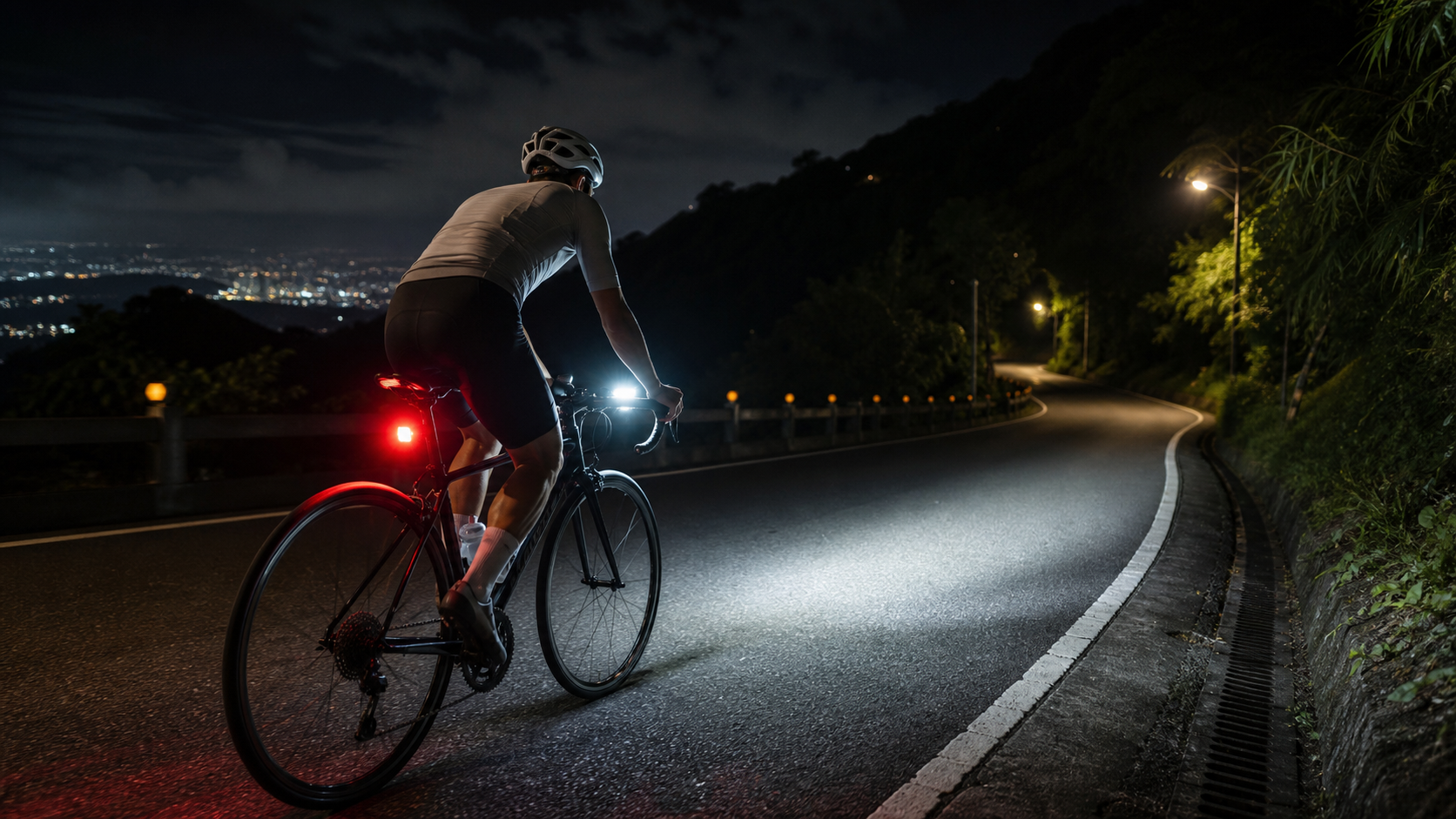
Introduction
For many long-distance cyclists in Taiwan, night riding is a threshold that must be crossed. Whether it’s departing at 3–4 AM to conquer Wuling, tackling the late-night sections of a 300km Audax, or continuing to ride after summer evenings, the roads in the dark present entirely different challenges.
Many accidents and abandonments stem from “incorrect light selection” or “not understanding the physiological limitations of the human eye in darkness.” This article will systematically walk you through how to make the technical preparations for night riding.
The Logic Behind Light Selection
The choice of light specifications depends on your riding scenario—there is no single “best” light:
| Scenario | Recommended Front Light Brightness | Recommended Rear Light | Special Considerations |
|---|---|---|---|
| Urban night riding | 300–600 lumens | Flashing red light | Being seen matters more than seeing clearly |
| Suburban highways | 800–1,200 lumens | Steady + flashing dual mode | Need to illuminate road surface details |
| Mountain descents | 1,200–2,000+ lumens | Rear-side reflective tape | Higher speeds require longer road preview distance |
| Ultra-long-distance night riding | Main light 1,000+ + backup light | Main + backup | Battery endurance becomes the key factor |
The importance of illumination angle:
- The front light should be mounted on both the helmet (turning with your line of sight) and the handlebar (fixed illumination direction)
- The helmet light lets you see road conditions ahead when cornering; the handlebar light lets oncoming vehicles spot you earlier
- Single-light setups are not recommended for night riding: once the main light’s battery dies, you’re in danger without a backup
Battery management:
- Ultra-long-distance night rides require carrying spare batteries or a power bank
- Choose light models that support USB charging while riding (such as the Cateye Volt series, Lezyne series)
- Charge to full before departure; it’s recommended to start charging when the battery drops below 30%, rather than waiting until it’s completely drained
The Physiological Mechanism of Visual Adaptation
After moving from a bright environment into darkness, the human eye needs 20–30 minutes to fully achieve “dark adaptation.” During this period, your night vision is only 20–30% of what it will be once fully adapted.
This means:
- After leaving a bright area (convenience store, streetlight zone), there is a dangerous visual transition period
- Do not ride at high speed immediately before your vision has adapted
Practical strategies:
- After leaving a bright environment, ride at a slow pace for 2–3 minutes to let your eyes readjust
- Avoid staring directly at oncoming headlights (turn your head or close one eye to protect your visual adaptation)
- Tunnel entrances and exits in Taiwan are high-risk points for night riding; slow down before entering and maintain awareness of oncoming traffic
Utilizing moonlight and ambient light:
- Visibility on a full-moon night is far higher than on a half-moon night; you can plan long-distance night rides around the lunar phase
- The sea reflection along Taiwan’s east coast (Provincial Highway 11) can provide additional ambient light on moonlit nights
Nighttime Road Surface Reading Techniques
Roads that look smooth during the day can present the following challenges at night:
- Standing water and slippery surfaces: It’s difficult to judge whether the road is wet at night; be especially cautious on Taiwan’s roads after rain (particularly in mountainous areas)
- Cracks and potholes: Nighttime shadows make cracks harder to see, and fatigue later in a long ride makes it easier to miss them due to distraction
- Animal crossings: Wild boars, muntjacs, cats, dogs, and other animals cross Taiwan’s mountain roads at night; collisions at speed are extremely dangerous
Training methods to improve nighttime road surface reading:
- Deliberately practice riding on sections with weaker lighting during training (roads with streetlights but widely spaced), to build a habit of sensing the road surface
- Learn to “listen” to the road: tires produce different sounds on different surface materials, which can help you judge road conditions
Practical Recommendations
- Don’t ride alone in mountain areas at night: For night riding in Taiwan’s mountains, it’s recommended to ride with at least 2 people and inform others of your route and estimated return time
- Wear high-visibility clothing: Always wear reflective or fluorescent clothing for night riding, and try to have reflective elements across your entire body
- Familiarize yourself with the route in advance: Riding an unfamiliar route for the first time at night carries extremely high risk; ride it once in daylight first and memorize the dangerous sections
- Phone and location sharing: Set up GPS tracking on your phone before departure and share your real-time location with family; ensure your phone has sufficient charge
- Taiwan’s list of high-risk night riding sections: Provincial Highway 2A (Beiyi Highway), Provincial Highway 7A (Yilan Xibei Highway), and Provincial Highway 8 (Central Cross-Island Highway) require the highest level of preparation for night riding
Conclusion
Night riding has a charm that daytime cannot replicate—starry skies, silent roads, the distant glow of city lights—but these beauties belong only to those who are prepared. Master the correct light configuration and visual adaptation techniques, and Taiwan’s roads at night will become your personal stage.
Related Reading
- Technical and Safety Preparation for Night Riding
- Night Riding Safety for Long-Distance Cycling: Light Configuration and Route Planning
- Road Bike Night Riding Safety: Front/Rear Light Specifications, Reflective Gear, and Route Selection
- The Complete Night Riding Training Manual: Safety, Efficiency, and Equipment Optimization Guide
單車 一日北高 ( 雙城 ) 肥宅雙人瘋狂行 紀錄片 REACTO
10 年前
單車賞雪 裝備準備及注意事項分享 | 公路車
5 年前
碟煞公路車 優缺點?換車一年半實際經驗分享 / 公路車 / CT Yeh
2 年前
大禹嶺 到 武嶺牌樓 全程前後實況錄影 | 北進武嶺 | 東進武嶺 | KOM | 訓練台 | 坡度分析 | Taiwan KOM Last 10 km HARD | 公路車
6 年前
#公路車 #Fitting 靠人工智慧APP 幫你調整單車
6 年前
新玉門關 單車挑戰賽 多視角主集團衝刺菁華版 4K #公路車
5 年前
再一組! 全碳幅條 碟煞/無內胎輪組 開箱! 到底好騎嗎? UNAAS X40 | 公路車 | CT Yeh
4 年前
一日北高常見問題大集合 | 攻略 | 路線 | 訓練 | 補給 | 自行車 單車 | 一日雙城 | 雙塔 | TWB北高360 | 屁股痛
6 年前