Introduction
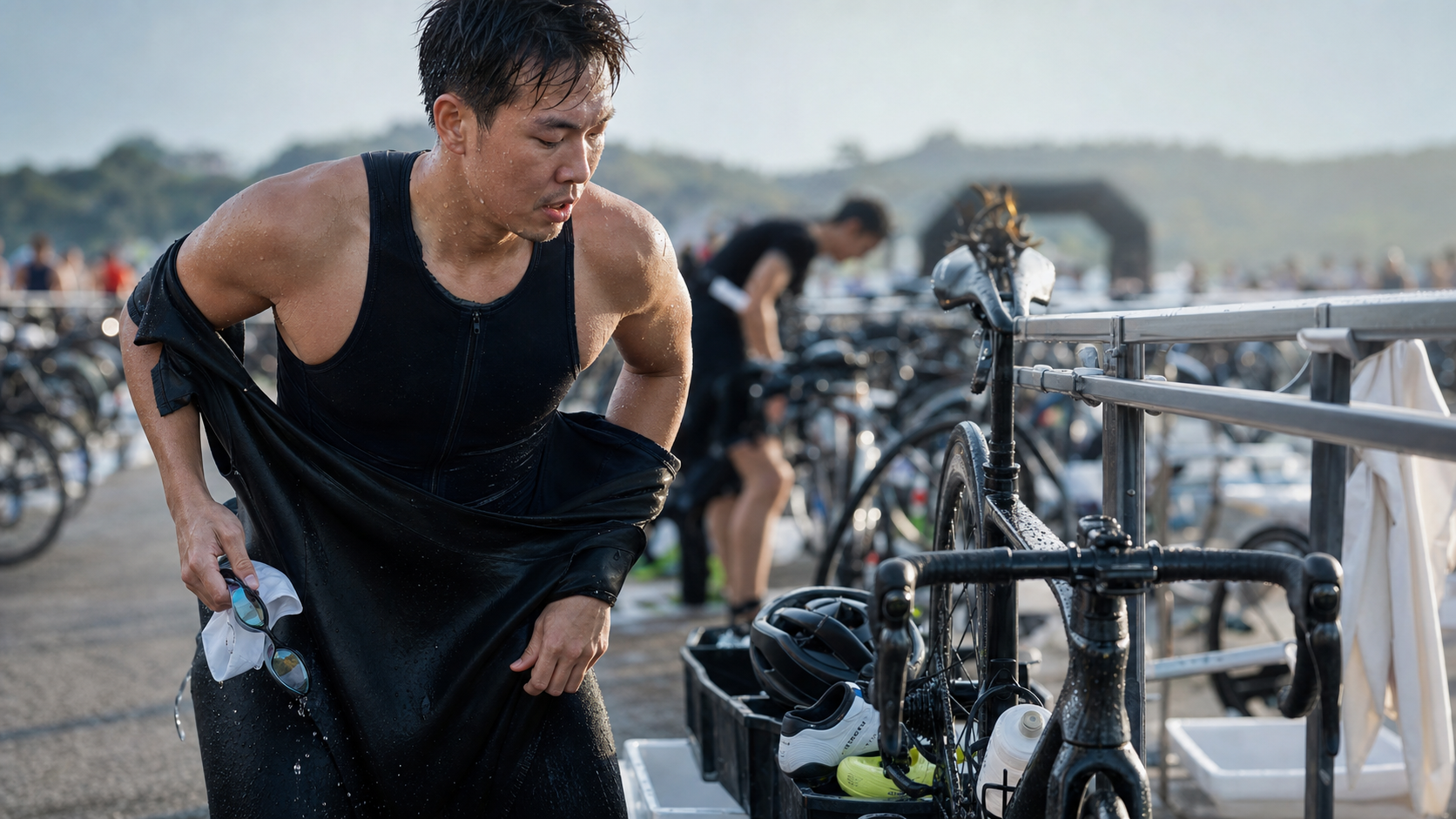
Many triathletes spend a significant amount of time training for the swim, bike, and run, yet overlook the transition area—the “fourth discipline.” T1 (swim-to-bike) is the most chaotic moment of the entire race: athletes are soaking wet, energy is already depleted, and a series of transition actions must be completed in the shortest possible time. Systematically practicing T1 and designing a well-planned transition flow can easily save dozens of seconds—or even over a minute—on race day.
Standard T1 Process and Time Analysis
A typical T1 includes the following steps:
- Run from the water to the transition area (30–120 seconds, depending on distance)
- Remove swim cap and goggles (5–15 seconds)
- Remove open-water wetsuit (15–60 seconds)
- Put on cycling helmet (10–20 seconds)
- Put on cycling shoes (10–30 seconds)
- Grab bike and head out (5–10 seconds)
In total, a well-trained athlete can complete T1 within 60–90 seconds; an unpracticed athlete may take 3–5 minutes. This gap is highly significant over the course of the entire race.
Quick Wetsuit Removal: Step-by-Step Breakdown
The quick removal of an open-water wetsuit is the key to T1 efficiency. Here is the standard fast-removal procedure:
Step 1: Unzip in the water During the final 10–20 meters before reaching the swim exit, begin pulling open the zipper on the back of the wetsuit (many athletes do this immediately after their final sprint). Be careful not to unzip too early, as it may affect your swimming speed in the water.
Step 2: Pull down immediately after exiting Once out of the water, grab both shoulders of the wetsuit with both hands simultaneously and pull firmly down to the waist. Lean your body forward to let the wetsuit’s own weight assist in pulling it off.
Step 3: Step and peel off the legs After pulling the wetsuit down to the waist, step on the bottom edge of the wetsuit with one foot (using the heel of the other foot), while simultaneously lifting that leg out. Repeat with the other leg. Be decisive in your movements to avoid hesitation that could cause a stumble.
| Action | Target Time | Common Mistakes |
|---|---|---|
| Unzip | 2–3 seconds | Zipper covered by swim cap, hard to locate |
| Pull down from shoulders | 5–8 seconds | Pausing mid-pull, wasting momentum |
| Step and peel legs | 8–12 seconds | Wetsuit sticks to ankles; apply Vaseline in advance |
| Toss wetsuit aside | 2–3 seconds | Throwing it too far and losing it; rule violation |
Best way to prevent the wetsuit from sticking to your ankles: The day before the race, apply a layer of Vaseline to your ankles and heels to significantly reduce friction between the wetsuit and your skin.
Goggle and Swim Cap Storage Strategies
Many athletes don’t know what to do with their goggles and swim cap during T1, often wasting unnecessary time. Here are several common strategies:
- Strategy 1: Place directly into the helmet While removing the wetsuit, stuff the goggles and swim cap into the cycling helmet (race rules typically require the helmet to be placed on the bike). This way, you can deal with them all at once when grabbing the helmet.
- Strategy 2: Loop around the wrist After exiting the water, pull the goggles down and loop them around your wrist, then store them in your bag or attach them to the helmet after completing the transition.
- Strategy 3: Leave them in the wetsuit When rolling up the wetsuit, roll the goggles and swim cap inside it. Sort everything out after the race.
The most important principle: Decide on a strategy before race day and practice it repeatedly in training. Making decisions on the spot often leads to wasted time.
Designing Your T1 Transition Flow
The placement of your transition bag and the arrangement of your gear are the foundation of T1 efficiency. It is recommended to arrange items from top to bottom in order of use:
- Top layer (used first): Cycling helmet (already adjusted for fit, buckle unfastened), sunglasses (placed inside the helmet)
- Middle layer: Cycling gloves (if worn), race number belt
- Bottom layer (used last): Cycling shoes, spare nutrition
Additionally, it is recommended to practice “blind transitions” at home—completing the entire T1 process without looking—to simulate the race-day stress and limited visibility.
Practical Advice
Before triathlon races across Taiwan (such as events in Taitung Guanshan, Tainan Qigu, Miaoli, and elsewhere), it is recommended to complete at least 5–10 full T1 simulation sessions. You can swim in a home pool, then run to your bike in your wetsuit and perform a complete transition practice. Time yourself and look for areas to improve.
Conclusion
T1 is the most overlooked segment of a triathlon, yet it offers the most immediate and visible performance gains. A well-designed, repeatedly practiced T1 not only saves time but also helps you enter the bike leg with a stable mental state, laying a solid foundation for the second half of the race.
Related Reading
- Swim-to-Bike Transition (T1) Efficiency: Optimizing Seconds for Wetsuit Removal, Shoe Change, and Mounting
- Triathlon T1 Wetsuit Change Technique: Training Methods for Quick Wetsuit Removal
- Triathlon Transition Area T1 Optimization: Efficient Switching from Water to Bike
- T1 Transition Optimization: The 90-Second Time-Saving Technique from Water Exit to Bike Mount
Live) 備戰2019彰化經典百K 賽前攻略 (已完賽請看新影片
7 年前
CT 喇低賽) 武嶺牽車 才是王道 西進牽車四小時內秘訣 攝手位置 如何判斷 防抽筋小秘訣
7 年前
FTL 與 SYB 車隊專訪 西進武嶺 實用攻略分享! 2小時 如何練?!你不知道的眉角!新手準備武嶺必看 EP1 | 實力派女車友 | 精華版 | 公路車 | CTYeh
4 年前
自助洗車場 洗單車 50元有找 清鍊條大法 居然還有小小兵
7 年前
西進武嶺 免費訓練分析服務 Intervals | 練不夠還是練過頭?你哪一種類型選手?AI模型告訴你! | 備戰神器 | 公路車 訓練 | CT Yeh
4 年前
TIME 公路車 Alpe d'Huez 21 開箱實錄! 購車/Fitting/組車/心得 | 新車入艙 | 時間的主人 CT Yeh
3 年前
3D 列印車褲墊 / 舒適改善? / 無痕 x 分區壓縮 / ATK & Decider系列 / JE22黑科技 / #公路車 #CTYEH
11 個月前
一日北高前的高裝檢 | 北高 360 | 挑戰11小時的裝備 | 一日雙塔 | 補給
6 年前