Children's Swimming Development: The Neurodevelopmental Golden Window for Learning to Swim at Ages 6–12 and Training Design
Introduction
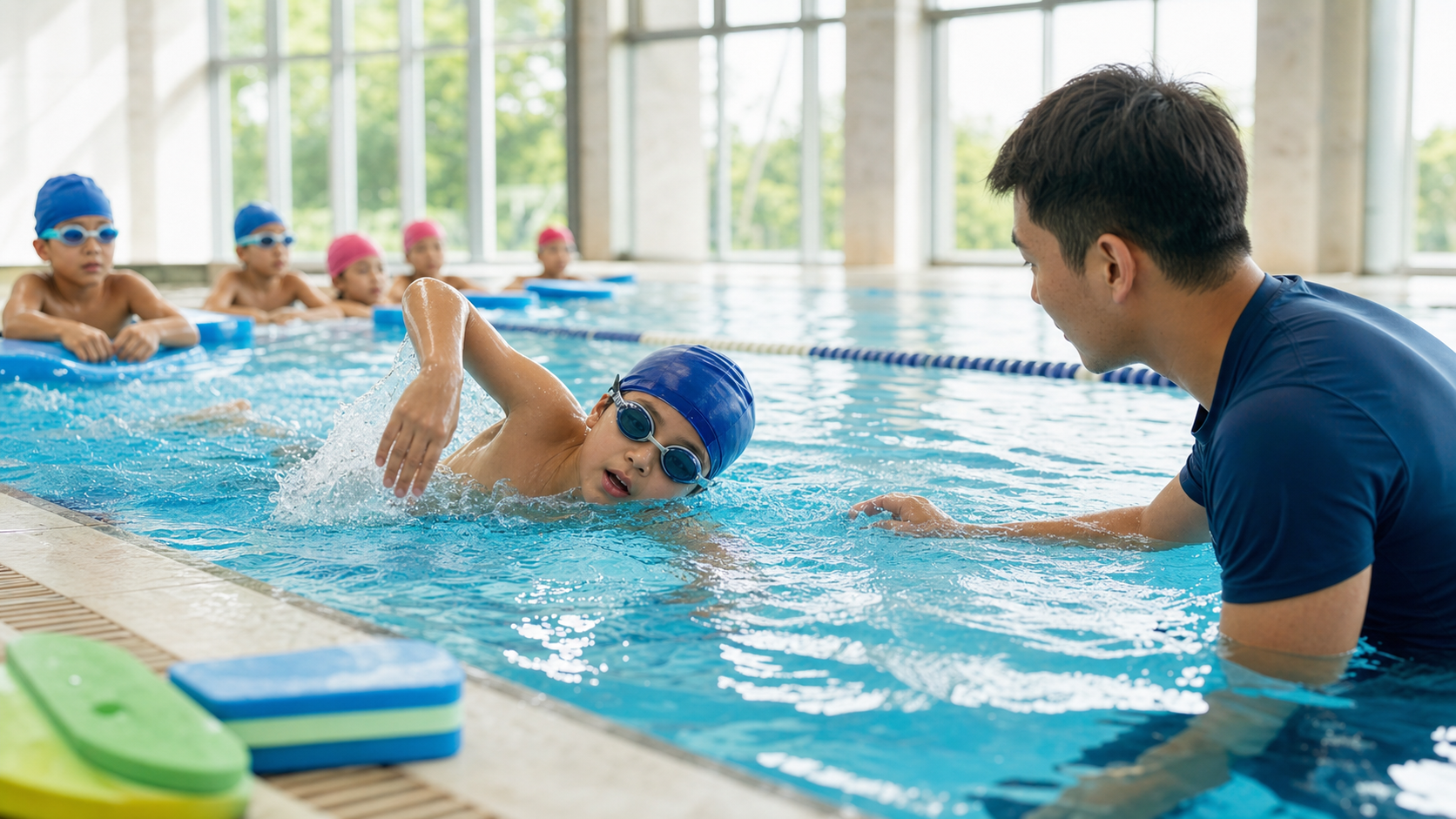
Child drowning accidents occur every year in Taiwan. Swimming is not just a sport—it is a fundamental life-saving skill. However, the benefits of swimming for children go far beyond safety. During the neurological golden window between ages 6 and 12, swimming training can simultaneously promote sensory integration, motor coordination, and cognitive development, laying a solid foundation for a child’s physical and mental well-being.
Characteristics of the Neurological Golden Window at Ages 6–12
Several key features of childhood brain development make this period the optimal window for learning to swim:
- Rapid cerebellar development: Ages 6–10 mark the synaptic pruning period of the cerebellum (responsible for motor coordination and balance). Repeated swimming movements can build more efficient neural circuits.
- Accelerated myelination: The completion rate of myelin sheaths on neural axons increases, speeding up motor command transmission and helping children quickly master complex movements.
- Proprioceptive development: The buoyancy and resistance of water provide rich sensory input, enhancing children’s awareness of their own body position and movement.
- Bilateral coordination integration: Swimming requires coordinated use of both sides of the body, supporting corpus callosum development and integration between the brain’s two hemispheres.
Research shows that children who learn to swim before age 10 perform significantly better in motor coordination, spatial awareness, and attention tests than their peers who did not receive swimming training.
Training Design Priorities by Age Group
| Age | Development Focus | Training Content | Target Skills |
|---|---|---|---|
| 6–7 years | Water adaptation, overcoming fear | Bubble blowing, floating, kickboard drills | Front float + back float |
| 8–9 years | Building foundational strokes | Breaststroke arm/leg breakdown, freestyle breathing | Complete 25m freestyle |
| 10–11 years | Technique refinement, fitness foundation | Freestyle technique correction, backstroke introduction | Complete 50m in two strokes |
| 12 years | Multi-stroke integration, competitive introduction | Butterfly basics, individual medley | Complete 100m medley |
Swimming Training Settings and Resources for Children in Taiwan
Swimming pools across Taiwan’s cities and counties offer children’s swimming programs in a variety of formats:
- School swimming classes: Some municipalities (such as Taipei City) include swimming as a required physical education subject, with 5th–6th graders required to pass a swimming certification.
- Community swimming classes: Summer swimming courses subsidized by local cultural affairs or sports bureaus, costing approximately NT$1,500–3,000 per session.
- Private swimming schools: More refined instruction with smaller class sizes, costing approximately NT$3,000–8,000 per session.
- Swim team training: Suitable for children aged 9 and above with competitive interest, such as county/city swimming teams or private swim clubs.
Recommendations for choosing a swim coach:
- Holds a Level C or above coaching certificate from the Chinese Taipei Swimming Association
- Has experience teaching children’s swimming and understands the psychological characteristics of each age group
- Class size should not exceed a 6:1 student-to-coach ratio
Additional Benefits of Swimming for Children’s Physical and Mental Development
- Breathing control: Learning breathing techniques improves diaphragm function and may help alleviate symptoms in children with asthma.
- Confidence building: Mastering swimming skills is an important early source of achievement for children.
- Social skills: The group environment of swimming lessons promotes peer cooperation and a spirit of healthy competition.
- Emotional regulation: The sensory stimulation of aquatic exercise has a calming effect on children with ADHD; some studies suggest it can reduce inattentive behaviors.
Practical Advice (for Taiwanese Parents)
- Start at age 6—no need to wait until the child is “not afraid of water”: Well-designed programs themselves help overcome water fear; parents do not need to deliberately expose children to water earlier.
- Avoid forcing children into the water: Coercive behavior creates negative memories and undermines trust. Choose game-oriented teaching methods instead.
- Continue practice after lessons: Allow at least one free swimming session per week after the course ends to consolidate technical memory.
- Teach water safety alongside swimming: Incorporate drowning rescue knowledge (calling for help, throwing flotation devices, waiting for rescuers) into training, and discourage children from jumping in to rescue others.
- Track developmental milestones: Use distance-based milestones (such as completing the first 25m swim) as indicators and provide appropriate encouragement.
Conclusion
Ages 6 to 12 represent the most effective neurological window for children to learn swimming. Investing in swimming training during this stage allows children to learn quickly and thoroughly, while also laying the foundation for cognitive development, emotional health, and lifelong safety. Taiwan’s abundant children’s swimming resources and policy support give every child the opportunity to find their own rhythm and confidence in the water.
Related Reading
- The Best Age for Children to Learn Swimming: Scientific Evidence for Skill Development at Each Stage
- Designing Children’s Swim Schedules: Balancing Technical Learning and Physical Development for Ages 6–12
- The Complete Guide to Children’s Swimming Milestones: Technical Development and Safe Teaching from Age 3 to 12
- The Impact of Swimming on Child Development: Neuromuscular and Cognitive Growth
滑雪新手們慘摔學習全紀錄(請開字幕),滑雪好好玩 | Snowboard + Ski | 岩原 スキー場 | 滑雪APP使用 | GoPro Max
6 年前
西進武嶺 免費訓練分析服務 Intervals | 練不夠還是練過頭?你哪一種類型選手?AI模型告訴你! | 備戰神器 | 公路車 訓練 | CT Yeh
4 年前
CT 喇低賽) 武嶺牽車 才是王道 西進牽車四小時內秘訣 攝手位置 如何判斷 防抽筋小秘訣
7 年前
近視雷射三個月後悔嗎?單車族/工程師必看,Smart TransPRK 術後血淚史與後遺症全公開 / CT Yeh
4 個月前
教學) 如何做出專業 慢動作 影片 Slow Motion 120fps GoPro 7 ActionCam AX700 A99II
7 年前
一起升級!海鷗盃LSD團練...JJSC Zone2招待 騎到手抖 / 公路車 / CT Yeh
2 天前
FTL 與 SYB 車隊專訪 西進武嶺 實用攻略分享! 2小時 如何練?!你不知道的眉角!新手準備武嶺必看 EP1 | 實力派女車友 | 精華版 | 公路車 | CTYeh
4 年前
live) 超越北高 之一日北高12小時 策略
7 年前