Introduction
“What is your lactate threshold?” This question is increasingly discussed in Taiwan’s cycling community. Lactate Threshold (LT) is a key physiological indicator that determines endurance performance—it represents the critical point where the body shifts from primarily relying on aerobic metabolism to accumulating lactate significantly. Training near this threshold can most efficiently improve aerobic capacity.
However, “correctly measuring lactate threshold” is not as simple as weighing yourself. Laboratory tests are expensive and require professional equipment; field tests are convenient but their accuracy is questioned. This article will thoroughly compare the two methods so you can make the best choice for yourself.
The Physiological Significance of Lactate Threshold
In exercise physiology, the lactate threshold actually has two key points:
| Indicator | Common Abbreviation | Definition | Corresponding Blood Lactate |
|---|---|---|---|
| Aerobic Threshold (First Lactate Turnpoint) | LT1 / AeT | Intensity at which lactate begins to rise steadily | ~2 mmol/L |
| Anaerobic Threshold (Second Lactate Turnpoint) | LT2 / FTP | Intensity at which lactate can no longer be maintained steadily | ~4 mmol/L |
- LT1: The optimal upper limit for long-distance endurance training; Taiwan’s 600K-type long rides should be kept below this
- LT2: Corresponds to Functional Threshold Power (FTP); most training plans use this as the basis for dividing training zones
Laboratory Lactate Testing
Testing Protocol
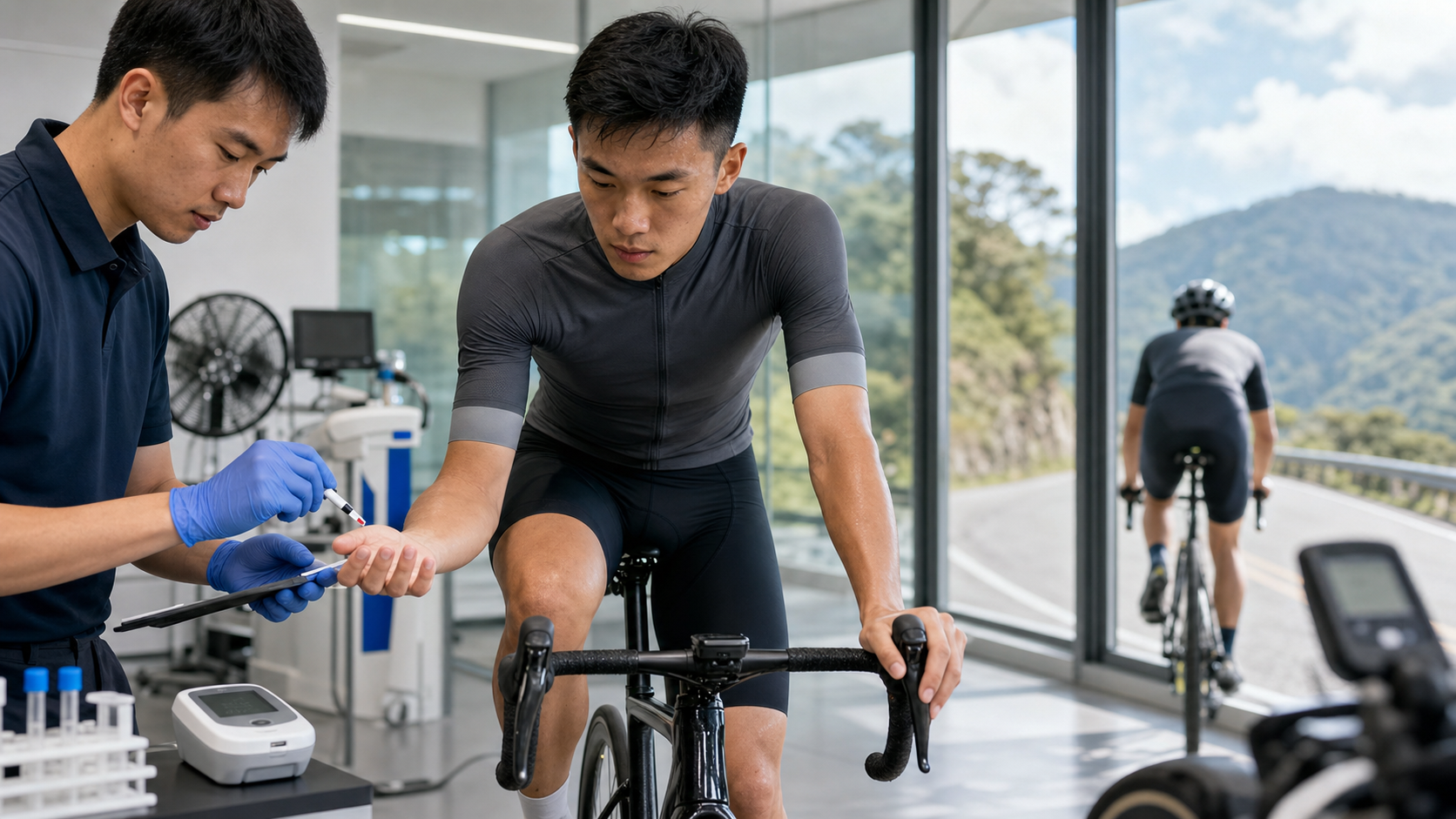
The standard incremental-load lactate test is typically performed on an ergometer (such as the Lode Excalibur):
- Each load stage lasts 3–5 minutes, with 25–50 µL of blood drawn from the earlobe or fingertip 30 seconds before the end
- Blood lactate is measured in real time using a lactate analyzer (such as Lactate Plus or Biosen)
- Power increases by 20–30W each stage until the subject can no longer maintain cadence or lactate exceeds 8–10 mmol/L
- Power vs. blood lactate data is plotted to identify the LT1 and LT2 inflection points
Advantages
- The most direct physiological measurement, not an estimated value
- Can measure both LT1 and LT2 simultaneously, providing a complete metabolic picture
- Highest research quality, often regarded as the “gold standard”
Disadvantages
- High cost: In Taiwan, sports medicine clinics or university sports science laboratories typically charge NT$3,000–6,000
- Requires appointment and travel to a specific location
- Blood sampling causes mild discomfort and requires trained personnel
- Single test; cannot reflect day-to-day changes in training status
Field Lactate Threshold Estimation Methods
Method 1: FTP Test (20-Minute Power Method)
The most widely used field estimation method:
- After a thorough warm-up, sustain a maximal 20-minute effort
- Average power × 0.95 = estimated FTP (approximately equal to LT2)
Accuracy: Studies show a correlation of r=0.91–0.95 with laboratory LT2, with an error of approximately ±5–8%
Method 2: Ramp Test
Power increases by a fixed amount each minute (usually 20W) until exhaustion:
- Last completed power × 0.75 = estimated FTP
- Advantages: Short duration (about 20 minutes), less psychological stress
- Disadvantages: May overestimate FTP for high-power athletes (sprinters)
Method 3: Lactate Threshold Heart Rate (LTHR) Method
Indirect estimation using a heart rate monitor:
- Average heart rate of a 30-minute time trial ≈ LTHR
- Without a power meter, heart rate zones can replace power zones to guide training
- Lower accuracy, affected by multiple factors such as temperature, altitude, and caffeine
Method 4: Ventilatory Threshold (VT) Estimation
Some smart trainers (such as Garmin Tacx paired with Firstbeat) can estimate ventilatory threshold from heart rate variability, with accuracy falling between the FTP method and laboratory testing.
Method Accuracy Comparison
| Method | Cost | Accuracy | Convenience | Recommended Retest Frequency |
|---|---|---|---|---|
| Laboratory Lactate Test | NT$3,000–6,000 | ★★★★★ | ★★ | Once per season |
| FTP 20-Minute Test | Free | ★★★★ | ★★★★ | Every 4–6 weeks |
| Ramp Test | Free | ★★★ | ★★★★★ | Every 4 weeks |
| LTHR Heart Rate Method | Free | ★★★ | ★★★★ | Every 4–6 weeks |
| Garmin Ventilatory Threshold Estimate | Equipment cost | ★★★ | ★★★★★ | Continuous monitoring |
Recommendations for Taiwan-Specific Scenarios
Scenario 1: Amateur Riders Aiming to Complete KOM or Formosa 900
- Recommended: Ramp Test or FTP 20-minute method, paired with a power meter
- Retest every 4–6 weeks to track training effectiveness
Scenario 2: Competitive Athletes Preparing for National Championships or Asian Championships
- Recommended: Undergo one laboratory lactate test before the season to establish precise training zones
- Track progress during the season with FTP tests
Scenario 3: Climbing Challenge Enthusiasts (Wuling, Hehuan Mountain)
- Recommended: LTHR method combined with actual riding feel on mountain roads
- Lactate metabolism efficiency differs at high altitude; laboratory values need appropriate adjustment
Practical Advice
- Regardless of the method chosen, standardization before testing is critical: adequate sleep, no high-intensity training within 48 hours, and a fasted or light-meal state
- Field tests are best performed on a fixed route (such as a specific section of Alishan Highway) or on a fixed trainer to eliminate wind and gradient variables
- Lactate threshold is not a fixed value—as training improves, significant changes can occur every 6–8 weeks, so regular retesting is necessary
- A power meter is a prerequisite for field test accuracy; the heart rate method has too much error to be recommended as the sole basis
Conclusion
There is no absolute “best method” for lactate threshold testing—only the choice that best fits your current goals and resources. For most amateur riders in Taiwan, a monthly FTP test combined with data tracking already provides sufficient training guidance. If the opportunity arises, scheduling one laboratory test before the season will give you a completely different understanding of your own capabilities through that precise physiological data.
Related Reading
- Cycling Lactate Testing: Application of Blood Lactate Concentration in Training Zone Setting
- Lactate Threshold Training: How to Find Your Cycling Critical Pace
- Running Lactate Threshold Training: Scientific Methods to Break Through the LT Speed Wall
- Portable Lactate Analyzers: Practical Operation and Training Application of Lactate Threshold Testing for Road Running
#公路車 #Vo2Max #最大攝氧量 測驗 體驗 | 心肺測試
6 年前
西進武嶺 免費訓練分析服務 Intervals | 練不夠還是練過頭?你哪一種類型選手?AI模型告訴你! | 備戰神器 | 公路車 訓練 | CT Yeh
4 年前
2021 96聯賽 桃園市長盃 4K多視角實況 當天選手瓦數/推力比/均速/時間 即時數據分析 | 公路車 | CT Yeh
5 年前
一個測試有沒有認真練車的方法😂 #公路車
10 個月前
RAMP FTP Test 直播 究竟能撐到幾瓦 訓練台 Gravat Zwift
6 年前
單車AI教練!全新 ChatGPT4o 幫你分析訓練成果!排武嶺課表,分析騎車姿勢! 太神了! / 公路車 / CT Yeh / feat. 緯緯
2 年前
單車 一日北高 ( 雙城 ) 肥宅雙人瘋狂行 紀錄片 REACTO
10 年前
#公路車 台北 #風櫃嘴 23:47 全台單車實境請訂閱鎖定
7 年前